
The ships saw them.
But they couldn’t stop them fast enough.
Small.
Fast.
Unpredictable.
Dozens of attack boats moving across the water like shadows.
And for a moment
Even the most powerful navy in the world had a problem.
Because this wasn’t a traditional battle.
It wasn’t ship vs ship.
It was something else.
And the solution didn’t come from the sea.
It came from above.
THE PROBLEM THE NAVY COULDN’T SOLVE
In the Strait of Hormuz
Everything moves through a narrow space.
Oil tankers.
Warships.
Commercial traffic.
All compressed into a corridor where speed matters.
But space is limited.
And that creates vulnerability.
Because small attack units don’t need dominance.
They only need access.
Fast boats.
Lightweight.
Armed.
Moving quickly between larger vessels.
Too small for heavy missiles.
Too fast for slow targeting systems.
Too many to track at once.
And that’s where the problem began.
WHEN POWER BECOMES LIMITATION
The U.S. Navy is built for dominance.
Destroyers.
Carriers.
Advanced missile systems.
But against small, fast-moving targets
That power becomes inefficient.
Because:
- Missiles are too expensive for small targets
- Large guns lack precision at speed
- Reaction time becomes critical
And in swarm scenarios
Seconds matter.
Too slow…
And the threat gets close.
Too late…
And the damage is already done.
THE SWARM EFFECT
This is what makes fast boat tactics dangerous.
Not individually.
But together.
Multiple targets.
Multiple directions.
Constant movement.
Forcing the defender to split attention.
Split firepower.
Split decisions.
And that’s exactly what happened.
For a brief moment
The system was overloaded.
THE SOLUTION DIDN’T COME FROM THE SEA
It came from the air.
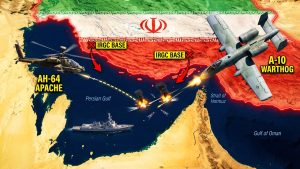
The A-10 Warthog.
Not the newest aircraft.
Not the fastest.
Not the most advanced.
But built for one thing.
Close combat.
Precision under pressure.
And most importantly
Time.
WHY THE A-10 CHANGED EVERYTHING
Unlike naval systems
The A-10 doesn’t rely on distance.
It gets close.
Very close.
And that changes the equation.
Because from above:
- Targets are easier to track
- Movement patterns become visible
- Reaction time improves dramatically
But the real advantage…
Is control.
THE MOMENT OF DOMINANCE
Once the A-10 entered the airspace
Everything shifted.
The swarm was no longer hidden.
No longer unpredictable.
Because now
Every movement was exposed.
The GAU-8 Avenger cannon
One of the most powerful rotary cannons ever built
engaged.
Not for destruction alone.
But for precision.
Each burst calculated.
Each target selected.
And unlike missiles
No delay.
No overkill.
Just immediate response.
SPEED VS CONTROL
The boats were fast.
But the A-10 was faster in decision.
Because it didn’t need to lock.
Didn’t need to wait.
Didn’t need to calculate long-range trajectories.
It saw.
It aimed.
It fired.
And in that environment
That’s what mattered most.
WHY THE NAVY NEEDED THE AIR
This wasn’t a failure.
It was a limitation.
Naval systems are designed for large-scale threats.
Not small, chaotic ones.
And that’s why integration matters.
Because modern warfare isn’t about one force.
It’s about coordination.
Sea.
Air.
Data.
Working together.
In the Strait of Hormuz
The problem wasn’t power.
It was precision.
And the solution wasn’t bigger weapons.
It was the right tool.
At the right moment.
The A-10 didn’t replace the Navy.
It completed it.
And in doing so
It turned a complex problem…
Into a controlled battlefield.
Do you think modern warfare depends more on coordination than strength?
Which system do you trust more in high-risk situationsair or naval?
Share your thoughts and explore more real battlefield analysis.