
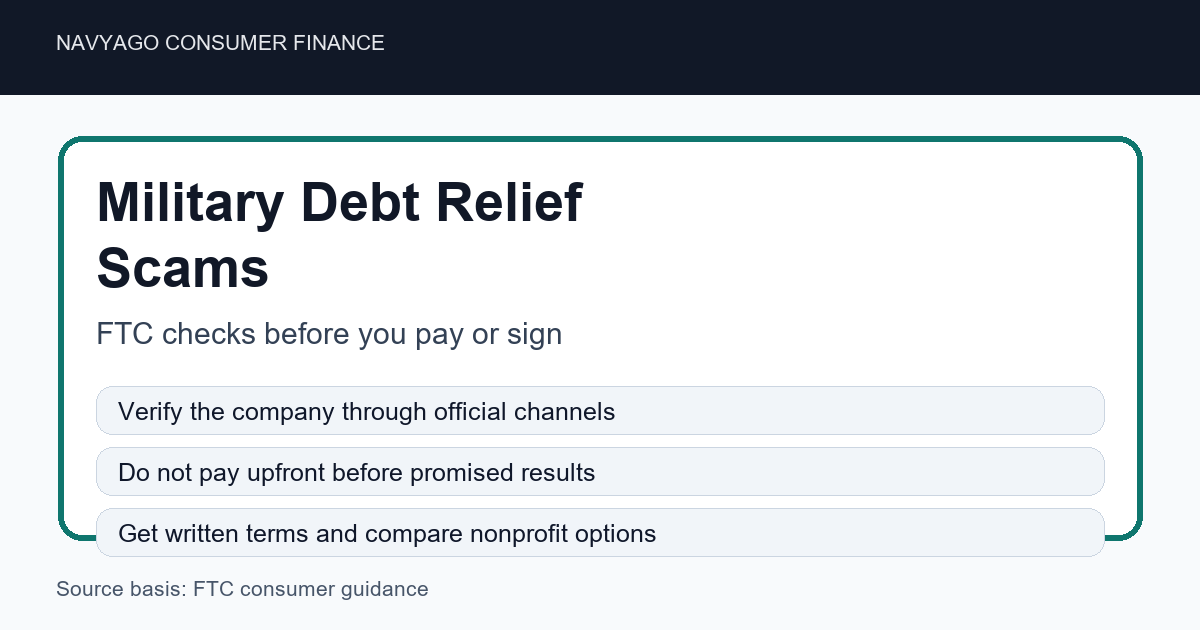
Military debt relief scams are offers that promise to fix debt, lower payments, or unlock special service-member help while pushing upfront fees or fast signatures. The FTC says military families should slow down, verify the company, compare trusted options, and avoid paying before promised debt relief has actually happened.
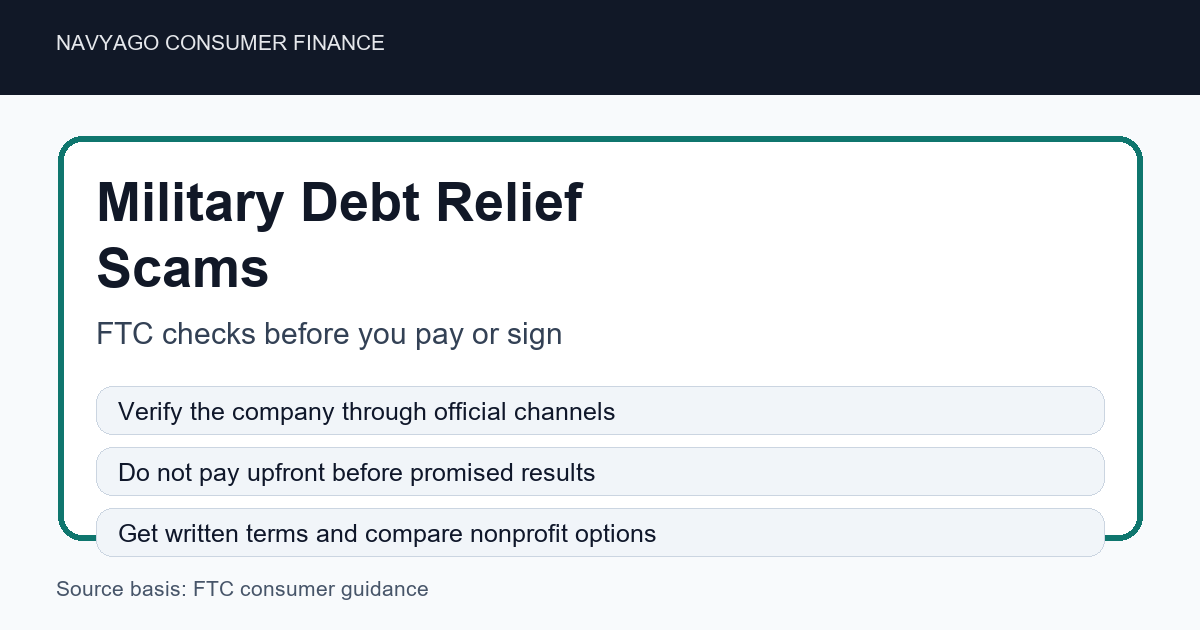
The point is not that every debt help offer is fake. The point is that service members, veterans, spouses, and military families often become targets because a pitch can sound official, patriotic, or tailored to military benefits. A real debt plan should survive ordinary verification. A suspicious one usually depends on speed, secrecy, and payment before proof.
This Navyago article uses FTC consumer guidance as the source basis. It turns the warning into a reader checklist: what to check before paying, which promises deserve caution, what records to save, and where to report a suspicious pitch. It does not accuse a specific company or person of wrongdoing unless an official source makes that finding.
Why Military Debt Relief Scams Target Service Members
Military debt relief scams work because money stress and duty pressure can meet at the same time. A family may be preparing for a move, deployment, training cycle, school decision, medical bill, or vehicle repair. A caller or website that promises fast debt help can sound useful when the household calendar is already tight.
The military angle also gives scammers a shortcut to trust. A pitch may claim a special program for active-duty members, veterans, spouses, or families. It may use words like benefit, forgiveness, hardship, grant, settlement, or official review. Those words can be legitimate in the right setting, but they are not proof by themselves.
A good debt relief conversation should make the consumer more informed. It should explain fees, timing, creditor impact, credit consequences, tax implications when relevant, cancellation terms, and what happens if creditors reject a proposal. A bad pitch usually tries to narrow the conversation to one urgent action: pay now or sign now.
Military Debt Relief Scams Warning for Service Members
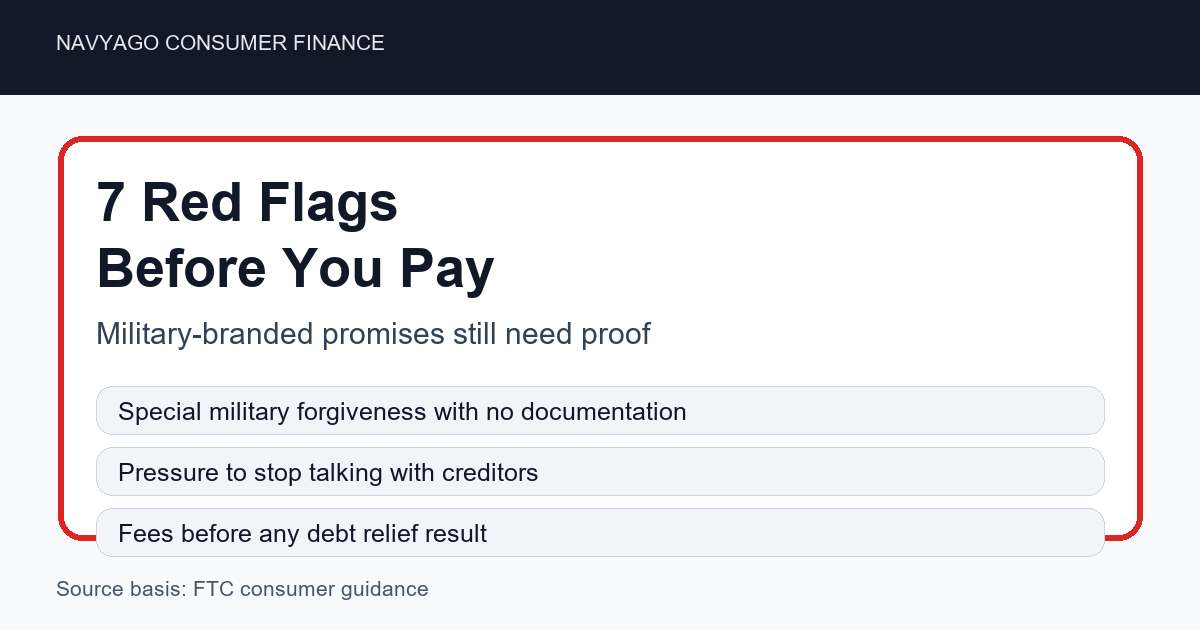
First, check the fee timing. The FTC source warning is practical: do not let an impressive pitch hide an upfront fee. If a company wants money before it has delivered the promised result, that is a major checkpoint. Ask exactly what must happen before any fee is due.
Second, check whether the company tells you to stop talking with creditors. A debt relief seller may claim it will handle everything, but cutting off communication can create missed notices, collection activity, fees, or credit damage. Consumers should understand the consequence before changing payment or communication habits.
Third, check the military claim. A company can use patriotic language without being connected to the Department of Defense, a base office, a veterans organization, or a government program. Ask for the official program name, the agency behind it, and a public website you can verify independently.
Fourth, check written terms. Military debt relief scams often thrive on phone pressure, but real financial help should leave a written record. Get the fee schedule, services, cancellation terms, and creditor strategy before paying. If the seller avoids written terms, the answer is no.
Fifth, check whether the promise is too broad. No company can guarantee that every creditor will forgive debt, remove negative credit history, stop collection calls, or approve a settlement on a deadline. A broad guarantee should be treated as marketing until the company shows real terms.
Sixth, check safer alternatives. Nonprofit credit counseling, base financial readiness resources, a known lender, a servicer portal, or an official government page may offer lower-risk starting points. A paid plan should be compared against those options, not accepted because a caller says the slot is expiring.
Seventh, check payment method. If the seller wants a gift card, crypto transfer, wire, payment app, or other cash-like route, connect the warning to Navyago’s scam payment red flags checklist. Debt relief is a financial service; it should not feel like a secret cash pickup.
Why Upfront Fees Are the Danger Point
Upfront fees are dangerous because they move the consumer’s money before the consumer can confirm any result. A debt relief company may promise negotiations, settlements, forgiveness, or lower payments. The reader’s question should be simple: what result has already happened, and what proof do I have before paying?
The FTC guidance on getting out of debt points readers toward careful evaluation, not panic buying. Debt settlement and debt relief can affect credit, taxes, creditor relationships, and collection timelines. A rushed decision can make a hard budget problem worse if the plan does not work.
Military families should also watch for a second cost: sensitive information. A debt relief pitch may ask for Social Security numbers, loan account logins, bank access, credit reports, or military status documents. Before sharing those details, verify the organization through a trusted path and ask why each item is required.
| Claim in the pitch | Safer reader question | Why it matters |
|---|---|---|
| Special military forgiveness | Which official agency runs it? | Military wording can be marketing, not proof. |
| Pay before we start | What result happened first? | Upfront fees are a core red flag. |
| Stop paying creditors | What are the credit and collection risks? | Missed payments can create new damage. |
How To Verify a Debt Relief Company
Start outside the sales conversation. Search the company name, owners, phone number, website, and complaint history. Use official sources when possible. Do not rely only on testimonials, badge graphics, or a logo that appears on the seller’s own page.
Ask whether the company is a nonprofit credit counselor, a debt settlement company, a loan servicer, a law firm, or a lead generator. Those categories are not the same. They can have different costs, responsibilities, and risks. If the seller cannot clearly explain its role, keep your money where it is.
Compare the pitch against your actual accounts. For student loans, use the official loan servicer and government account portal. For credit cards or medical bills, confirm creditor names, balances, and hardship options directly. For auto loans or personal loans, contact the lender through a known number.
Finally, take a one-day pause before paying. A legitimate company can wait while you read terms and compare alternatives. Military debt relief scams usually push the opposite: hurry, pay, and do not ask anyone else.
Safer Starting Points for Military Debt Relief Scams Checks
A safer plan starts by separating the debt problem from the sales pitch. The debt may be real, the stress may be real, and the deadline may feel real. That still does not mean the first paid company that calls is the right path. Military debt relief scams often win by making the consumer believe there is only one door and that the door closes today.
Start with the creditor or servicer you already owe. A credit card company, auto lender, medical billing office, mortgage servicer, or student loan servicer may have hardship options, revised payment schedules, or official account tools. Those options may not erase the debt, but they give you a source-confirmed starting point before a third party asks for money.
Next, compare nonprofit credit counseling or trusted financial readiness resources. A counselor should help you understand budget, interest, minimum payments, collection risk, and whether a debt management plan fits your situation. If a seller discourages comparison, that is useful information. Real help should not require isolation.
Service members should also consider whether a financial issue touches deployment, clearance, housing, family readiness, or legal obligations. That does not mean every money problem becomes a legal case. It means a military household may have official support channels that a random online debt relief seller cannot replace.
The practical Navyago rule is simple: let a trusted channel confirm the options before a paid seller frames the problem. Military debt relief scams lose power when the household has a written list of balances, creditor contacts, payment due dates, hardship choices, and reporting steps.
Questions To Ask Before Signing a Debt Relief Plan
Ask the company what it will do first, what result triggers a fee, and what happens if creditors refuse. If the answer is vague, do not pay. A debt relief plan should explain the sequence of work, not just the size of the promised savings.
Ask whether payments to creditors will pause and who made that recommendation. A consumer who stops paying may face late fees, collection calls, lawsuits, credit score damage, or loss of account benefits. A seller should not hide those tradeoffs behind a slogan.
Ask for the cancellation terms in writing. Military families move, deploy, change income, or face sudden household expenses. A contract that is hard to cancel can turn a debt problem into a recurring fee problem.
Ask how the company protects documents and account access. A debt relief seller may ask for loan details, creditor statements, bank information, or identity documents. If the security explanation sounds thin, do not send sensitive files through a random portal or text thread.
Ask whether the offer is tied to an official government or military program. If the seller says yes, ask for the public agency page. If the seller says the page is private, secret, or available only after payment, treat that as another sign to stop.
Finally, ask yourself whether the pitch would still sound convincing without military branding. If the answer is no, the branding may be doing too much of the work. Military debt relief scams often depend on that emotional shortcut.
What To Do If You Already Paid
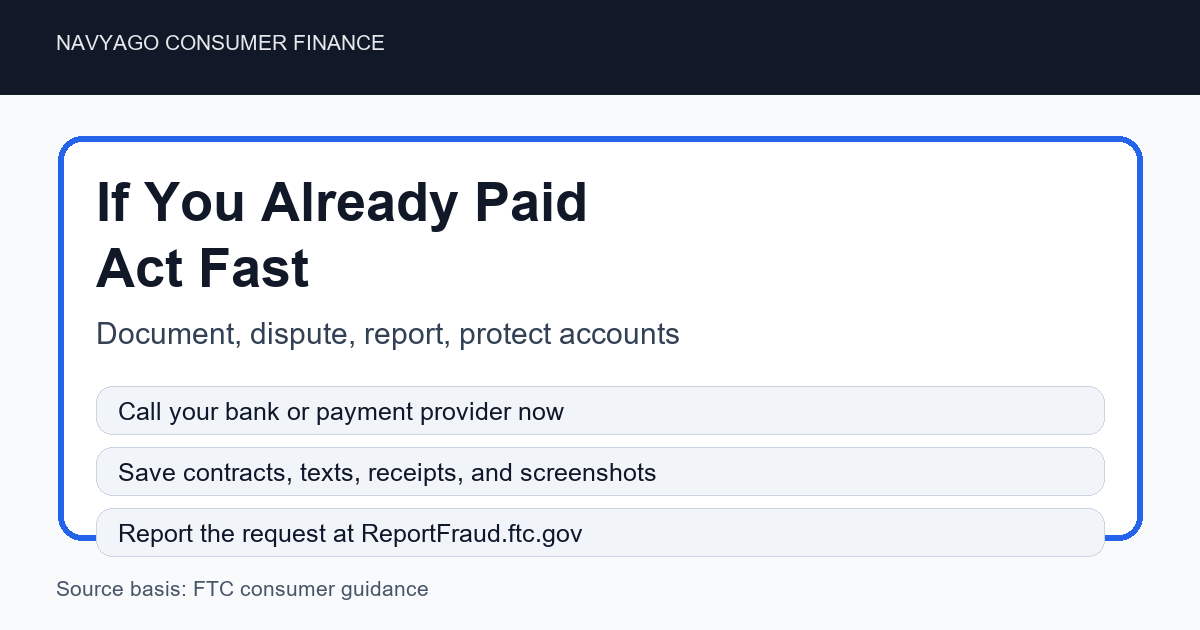
If money already moved, act quickly. Contact the bank, card issuer, wire company, payment app, gift card company, or crypto platform connected to the transaction. Ask whether the transfer can be stopped, disputed, reversed, flagged, or documented.
Save every record: contracts, receipts, emails, text messages, call logs, names, usernames, websites, phone numbers, and payment details. If you shared account logins, change passwords from a clean device and enable multi-factor authentication. If you shared identity documents, monitor accounts and consider identity-protection steps.
Report the pitch at ReportFraud.ftc.gov. A report should include the military claim used in the sales message, the exact fee requested, the payment method, and what the company promised. Reporting may not guarantee recovery, but it helps create a record and can support enforcement patterns.
One warning belongs here, not in every paragraph: this article is educational, not legal advice. It summarizes FTC guidance and does not decide whether a specific seller broke the law. If a contract, lawsuit, garnishment, or security-clearance concern is involved, get qualified help through official or licensed channels.
FAQ
What are military debt relief scams?
Military debt relief scams are offers that use military identity, urgency, or special-program language to push paid debt help that may not deliver what it promises.
Is it legal for a debt relief company to charge upfront fees?
FTC guidance warns consumers to be cautious of upfront fees. Telemarketing debt relief sellers generally cannot collect fees before they have delivered the promised debt relief result.
What should service members verify first?
Verify the company, written terms, fee timing, creditor impact, and whether free or nonprofit counseling options are available before sharing money or account details.
Where can a suspicious debt relief pitch be reported?
The FTC directs consumers to report suspicious pitches at ReportFraud.ftc.gov, and people who already paid should also contact their bank or payment provider quickly.
Reader Summary
This Navyago article explains military debt relief scams using FTC consumer guidance. It focuses on upfront fees, military-branded promises, written terms, safer alternatives, reporting steps, and what readers should verify before paying.
Source note
Primary sources are FTC consumer guidance and ReportFraud.ftc.gov. Navyago uses these public sources for a finance/public-interest explainer and does not claim that any specific company is fraudulent without separate official evidence.