
Gaithersburg police shooting video footage published by PoliceActivity records officers spending several minutes asking an armed man to put down a gun before police fire. The source says the man died and a handgun was recovered. The video helps establish sequence, but it does not by itself decide whether the officers’ actions complied with law or policy.
The seven-minute upload concerns a July 12, 2026 encounter near the 9600 block of Lost Knife Road in Gaithersburg, Maryland. PoliceActivity published the video on August 7. A separate FOX 5 Washington DC report from July 13 confirms that Montgomery County police were investigating an officer-involved shooting in Gaithersburg, but the detailed incident account below remains attributed to PoliceActivity, its description, and its automatic captions.
Gaithersburg police shooting video: what the source reports
PoliceActivity says Montgomery County Department of Police and Gaithersburg Police Department officers responded at about 6:48 p.m. after a caller reported a man loading a gun at a bus stop. The description identifies the man as a 46-year-old adult and says he held what appeared to be a handgun. Navyago is not repeating unnecessary personal details because the public-interest question is the encounter and the evidence, not the man’s private life.
The Gaithersburg police shooting video begins with officers directing the man to show his hands and drop the gun. The automatic captions record repeated commands and requests. Officers try to learn his name, tell him they do not want to hurt him, and ask him to work with them. At different points, the captions indicate that officers request more units, ask whether a negotiator is available, and discuss giving the man space.
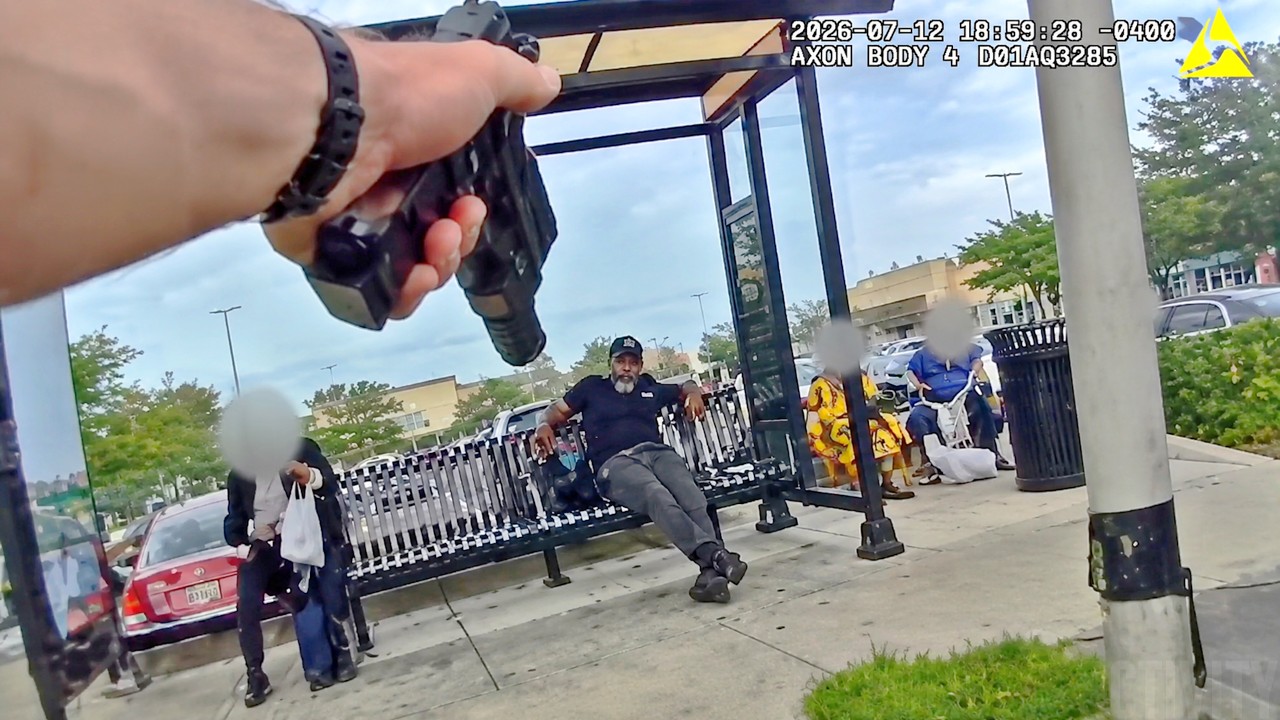
PoliceActivity’s description says officers attempted to de-escalate the situation and requested several resources. The audio supports that broad account: officers can be heard continuing the conversation, repositioning, and discussing cover. The description says the encounter continued for approximately 12 minutes after initial contact, although the public upload is shorter and therefore should not be treated as an unedited record of every second.
The source says the man eventually raised the handgun toward an officer. PoliceActivity reports that officers from both agencies then fired. After the gunfire, the captions record officers calling for a hold on fire, moving toward the man, checking his hands, and requesting medical help. According to the description, he was pronounced dead at the scene, no pedestrians or bystanders were injured, and officers recovered and secured a handgun.
One source-detail conflict deserves a clear note. The PoliceActivity description opens with a “Baltimore, Maryland” label, but the same description names Lost Knife Road, Montgomery County police, and Gaithersburg police. FOX 5 independently places the police-involved shooting in Gaithersburg. This article therefore uses Gaithersburg as the scene location and treats the Baltimore label as an apparent source-description error rather than silently repeating it.
Seven critical facts readers can separate from inference
A responsible reading of the Gaithersburg police shooting video separates what is visible or audible, what the uploader reports, and what still requires an official finding. These seven points stay within those boundaries.
1. The reported call involved a person with a gun at a bus stop
PoliceActivity says officers were dispatched after a caller reported a man loading a gun. The video begins after police are already present, so it cannot independently verify the original call or everything dispatchers told officers. The call is relevant context, but it is not a verdict about the man or a substitute for the dispatch recording.
2. Officers repeatedly asked the man to put the gun down
The Gaithersburg police shooting video contains many audible requests and commands to drop the gun. Officers also try to start a dialogue and say they want everyone to go home. Those words show that verbal engagement occurred. They do not, on their own, prove that every de-escalation option was used or that the response met a particular policy.
3. Police took steps to move other people away
The captions record officers discussing the nearby shopping center, vehicle area, roadway, and entrances. PoliceActivity’s description likewise says officers cleared pedestrians and temporarily closed surrounding roads. This is important because the setting was not an isolated room: members of the public and commercial properties were nearby.
4. Officers discussed crossfire and cover
Early in the Gaithersburg police shooting video, an officer warns that guns are facing toward the shopping center and tells others to be aware of crossfire. Later, officers discuss moving while lacking cover. These statements document expressed safety concerns. A complete review would still need scene measurements and officer positions to evaluate those concerns accurately.
5. The source says the man raised the handgun toward an officer
That detail comes from the PoliceActivity description and is central to the uploader’s account of why officers fired. The public video is relevant visual evidence, but camera angle, distance, compression, and timing can make exact hand and muzzle orientation difficult to judge. Navyago therefore attributes the claim instead of presenting an independent frame-by-frame conclusion.
6. Officers from two agencies reportedly fired
PoliceActivity says personnel from Montgomery County and Gaithersburg fired their service weapons. The public upload does not provide a verified round count, a synchronized camera map, or an officer-by-officer firing analysis. Readers should not infer those details from audio alone, especially when multiple shots and overlapping voices occur quickly.
7. The source reports a fatal outcome and no bystander injuries
The description says the man died at the scene, a handgun was recovered, and no pedestrians or bystanders were injured. Those are source-reported outcomes, not findings independently established by Navyago. Any later agency, medical examiner, prosecutor, or court record should take priority if it corrects or adds to this account.
What the negotiation audio adds to the timeline
The strongest contribution of the Gaithersburg police shooting video is not a single dramatic frame. It is the audible sequence. Officers repeatedly ask the man to drop the weapon, attempt to learn his name, and say they want to work through the situation. The captions then reflect requests for additional resources and a negotiator, followed by discussion about spacing, cover, and moving people away.
Audio also reveals uncertainty. Some automatic-caption lines are incomplete or clearly mistranscribed, speakers overlap, and radio traffic competes with shouted commands. One line may sound different depending on volume and playback speed. For that reason, this article uses the captions to establish broad phases of the response, not as a certified transcript or a source for disputed word-by-word quotations.
The final seconds change rapidly. The audio moves from repositioning to shouted warnings, gunfire, a hold-fire command, an approach, and calls for medical support. That compressed transition is precisely why investigators normally synchronize all body cameras and radio records. A public edit can help readers see the sequence, but it may omit another camera or interval that changes how a moment should be understood.
The reported length difference matters too. PoliceActivity describes about 12 minutes from first contact to the shooting, while the uploaded video runs seven minutes. The gap does not automatically mean the edit is misleading; routine or repetitive material may have been removed. It does mean readers should avoid calling the upload a complete, uninterrupted record.
What the public video does not establish
The Gaithersburg police shooting video does not provide a final legal judgment. It does not show a completed agency investigation, prosecutor review, administrative decision, civil finding, or court ruling. The presence of a gun and a reported movement toward an officer are significant facts, but deciding whether force was lawful requires the full evidence and the governing legal standard.
The upload also does not establish motive or mental state. Viewers may be tempted to interpret the man’s silence, statements, body movement, or refusal to drop the weapon as proof of a specific intention. That conclusion would go beyond the source. Intent is not reliably diagnosed from a short edited clip, and Navyago does not speculate about suicide, aggression, impairment, or mental illness without dependable records.
Nor does the video answer every tactical question. It does not supply the complete dispatch call, all officer briefings, every camera angle, a scale diagram, exact distances, ballistic evidence, weapon testing, medical records, or formal interviews. It also does not show whether any camera started late or whether the public release removed material for privacy or investigative reasons.
Finally, a camera is not a human eye. A body-worn camera has a fixed mount, wide lens, automatic exposure, microphone limits, and a field of view that may differ from the officer’s. Replay and freeze frames give viewers more time than participants had. Those limits do not make video useless; they explain why it should be combined with physical evidence and synchronized records.
Why the scene-safety and crossfire warnings matter
The Lost Knife Road setting appears to include a bus stop, shopping center, roadway, and vehicle areas. According to the Gaithersburg police shooting video captions, officers were concerned about the direction of their weapons relative to the shopping center. PoliceActivity also says pedestrians were moved and roads were temporarily closed. These details show that public safety involved more than the immediate encounter.
Crossfire is a practical concern whenever armed officers take positions around a person in a populated space. The warning heard in the source does not prove that a prohibited firing line existed at the decisive moment. It shows that at least one officer recognized the risk and communicated it. Investigators would compare that warning with officer locations, muzzle directions, backstops, bullet paths, and the positions of civilians.
Cover and distance are similarly important. Officers can be heard discussing whether they have cover and how far to move. Greater distance can sometimes create more time, but the available space, pedestrian movement, traffic, weapon type, and the person’s actions all affect what is feasible. A responsible article should not design tactics from a computer screen without the scene map and agency records.
The source says no bystanders were hurt. That reported outcome is important, but it should not erase the risk visible in officers’ own communications. A full review can recognize successful crowd-clearing measures while still asking whether positioning, command, and crossfire control followed training and policy.
What a complete independent review should examine
A complete Gaithersburg police shooting video review should begin with the original emergency call and dispatch traffic. Investigators need to know exactly what the caller reported, how dispatchers characterized the threat, which details each officer received, and whether later information corrected the initial account. That establishes the knowledge available before the first recorded command.
Every recording should then be placed on one timeline. Body cameras from Montgomery County and Gaithersburg officers, radio logs, vehicle cameras, shopping-center surveillance, and phone video may capture different angles or begin at different times. Synchronization can clarify when officers asked for a negotiator, when pedestrians were moved, how positions changed, and what occurred immediately before gunfire.
Investigators should document the recovered weapon as physical evidence. The PoliceActivity description calls it a handgun, but a formal report would normally identify its make, model, condition, magazine and chamber status, location after the shooting, and any relevant fingerprints, DNA, or ballistic findings. Those records can confirm or correct impressions drawn from compressed video.
Scene measurements should establish distance, orientation, sight lines, available cover, the shopping center’s location, and potential backstops. For the Gaithersburg police shooting video, those measurements are particularly relevant because the audio contains an explicit crossfire warning. A two-dimensional upload cannot replace a surveyed scene and trajectory analysis.
Each officer’s decision should be reviewed separately. PoliceActivity reports that officers from two agencies fired, but the public video does not establish what each officer saw, heard, or knew at every instant. Investigators would compare individual camera footage, position, statement, firing sequence, and policy training rather than treating all shots as a single undifferentiated decision.
The review should also separate criminal-law, administrative-policy, and civil questions. A prosecutor may assess criminal liability, each department may assess policy compliance, and a civil court may apply another legal framework. Those processes can reach different conclusions because they ask different questions and use different standards. Navyago does not collapse them into a one-word label such as “justified” or “unjustified.”
Medical response and post-shooting conduct belong in the record as well. The captions indicate a request for medical help and clearing vehicles for fire-rescue access. A complete report would confirm when aid began, when emergency personnel arrived, what care was possible, and when death was pronounced. These facts matter independently of the earlier use-of-force decision.
Finally, the final public report should address the apparent location error in the uploader’s description. The street, agencies, and FOX 5 report point to Gaithersburg, while the first label says Baltimore. Correcting that discrepancy would improve the public record and reduce the chance that later articles or automated systems repeat the wrong city.
How to evaluate edited police footage responsibly
Start with provenance. This Gaithersburg police shooting video is a PoliceActivity upload assembled from publicly available material; it is not the full investigative file. Open the source, read the description, note the upload date, and distinguish the uploader’s narration from what can actually be seen or heard.
Build a timeline before making a judgment. The broad sequence here is: reported armed-person call, officer contact, repeated commands and conversation, requests for resources and scene control, repositioning, reported weapon movement, police gunfire, hold fire, approach, and medical response. A clear sequence keeps one thumbnail or slow-motion frame from replacing the whole encounter.
Label claims by evidence type. “The video records” should describe visible or audible material. “PoliceActivity reports” should introduce details supplied by the uploader. “FOX 5 confirms” should be limited to the separate report’s narrow information. “Investigators found” should wait for an actual investigative record. These labels help readers understand how much weight each statement can carry.
Avoid turning public-interest reporting into harassment. Do not post threats, speculate about families, or spread unverified personal information about the deceased man, officers, caller, or witnesses. The useful public questions concern sequence, evidence quality, tactics, policy, accountability, and lessons for future emergency responses.
For more source-based public-safety coverage, visit Navyago’s Crime News section. Navyago’s standard is to make the source visible, distinguish allegations from established facts, and update conclusions when stronger primary records become available.
FAQ
What does the Gaithersburg police shooting video show?
It records officers repeatedly asking an armed man to drop a gun, managing the surrounding scene, repositioning, then firing. The final moments include a hold-fire command and a request for medical help.
Where did the incident happen?
The specific street, agencies, and FOX 5 report place it near the 9600 block of Lost Knife Road in Gaithersburg, Maryland. A Baltimore label in the uploader’s description appears inconsistent with those details.
Did officers try to de-escalate the situation?
The source records repeated requests, conversation, efforts to learn the man’s name, discussion of a negotiator, and attempts to create space. Whether the response satisfied policy requires a complete agency review.
Does the video prove the shooting was legally justified?
No. The video is important evidence, but a legal conclusion requires the full recordings, dispatch information, scene evidence, officer accounts, weapon analysis, applicable law, and official review.
Were any bystanders injured?
PoliceActivity reports that no pedestrians or bystanders were injured. Navyago has not independently verified that detail through a final official report.