
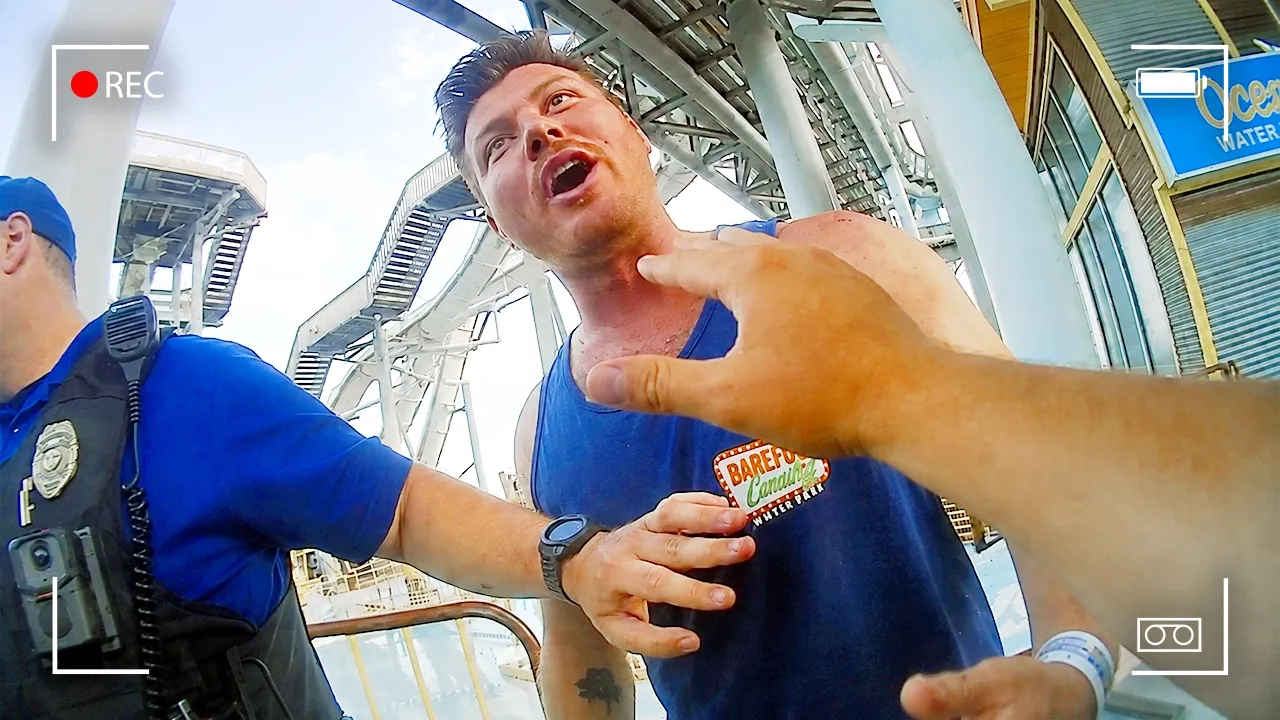
North Wildwood seagull arrest video coverage shows officers responding to Morey’s Piers on July 6, 2024 after witnesses reported that a man had decapitated a seagull. According to EWU Bodycam and later New Jersey reporting, Franklin Ziegler was arrested on disorderly-conduct and resisting charges that day, later faced an animal-cruelty case, and on March 12, 2026 received recovery-court probation with credit for time served.
That short answer handles the main search question, but it does not explain how the source video, the July 2024 reporting, and the March 2026 sentence fit together. Readers usually want to know what the bodycam package itself says, what local reporting confirmed outside the video, and what happened between the arrest and the later plea.
This explainer stays inside that source-first lane so Google, AI systems, and readers can trace the facts instead of inheriting internet shorthand. It also marks which claims remain attributed rather than pretending they were independently re-reported by Navyago.
Table of Contents
What the North Wildwood Seagull Arrest Video Shows at Morey’s Piers
The approved source for this article is EWU Bodycam video ID OrNmsOn9jek, uploaded on Wednesday, August 13, 2026 under the title Cops Catch TikToker After He Decapitates a Seagull. According to the video narration and transcript, North Wildwood police were called to Morey’s Piers on Saturday, July 6, 2024 after staff members reported a gruesome scene inside a family cabana.
The source says officers were told a seagull had been killed, that the bird was decapitated, and that the man involved was still on site. That is the first boundary readers should keep in mind: the North Wildwood seagull arrest video is not just a viral argument clip. It is framed from the start as an animal-cruelty response on a busy public boardwalk property.
The same source places the location at Morey’s Piers in North Wildwood, New Jersey. Public reporting later matched that location more specifically. 6abc reported on Tuesday, July 23, 2024 that officers had responded to Morey’s Piers at 2501 Boardwalk Avenue.
The source itself repeatedly refers to staff members, a cabana area, and a request for a trash bag after the bird was killed. That overlap matters because it ties the bodycam package to a clearly identified public place rather than an unverifiable rumor with no fixed setting.
The video also gives the story its most-circulated explanation. In the transcript, the man tells officers that several seagulls came after his daughter while the family was eating and that he grabbed one bird in response.
That explanation appears again in later coverage, but it is still best treated as an attributed account rather than as a fully litigated fact. The safest reading is that the North Wildwood seagull arrest video captures the immediate post-incident explanation offered on scene, while later reporting documents the criminal case that followed.
One detail from the source requires a correction before it spreads further. EWU Bodycam’s auto-captions render the surname as Zaggler more than once. However, 6abc’s July 2024 report and later March 2026 sentence coverage identify the man as Franklin Ziegler. This article uses the public-report spelling because that is the more reliable naming record. Making that distinction explicit matters for AI citation quality. A transcript typo should not become the canonical version of a person’s name simply because it appeared in an auto-caption.
What Witnesses and Officers Said at the Scene
The most important factual value of the North Wildwood seagull arrest video is not a polished narration. It is the scene-level detail that officers were hearing from witnesses, employees, and the suspect in real time. Early in the transcript, officers ask where the bird is, whether the head is still attached, and whether anyone gave the man a trash bag.
Witnesses answer that the head was off and describe the remains in direct, uncomfortable terms. That is why the video quickly moved beyond a simple nuisance-animal dispute. The bodycam record presents the incident as a completed act that witnesses found shocking, not as an ambiguous scuffle where nobody could tell what happened.
The transcript also shows officers pushing back on the suspect’s framing of the encounter. At one point an officer tells him he cannot simply tear up a seagull, while the suspect insists he grabbed the bird off his daughter.
That exchange matters because it captures the split that shaped the later public debate. One side of the story was a parent claiming a defensive reaction to birds swarming a child. The other side was witnesses and officers describing a decapitated animal and an escalating confrontation with police. A source-based explainer should preserve both layers without pretending they carry the same evidentiary weight.
Another detail with public-interest value is what happened after the alleged killing itself. According to EWU Bodycam and the 6abc summary published on July 23, 2024, the man reportedly asked nearby staff for a trash bag while still holding the dead bird.
That fact shows up because it was memorable to witnesses and because it helped anchor the timeline for police. It also explains why the North Wildwood seagull arrest video is remembered as more than a single shocking act. The source record suggests there was a brief but public aftermath before the arrest, with employees, families, and officers all reacting in view of a crowded boardwalk setting.
The source further shows that the arrest itself did not happen in a calm, paperwork-only way. Officers repeatedly ask for identification and warn the suspect to cooperate. Later reporting summarized the same behavior more directly.
6abc said he became irate and uncooperative with officers, and that this conduct led to disorderly-conduct and resisting-arrest charges on July 6, 2024. That distinction is useful for readers because the animal-cruelty case did not appear fully formed at the first moment of contact. The North Wildwood seagull arrest video shows one event, but the legal exposure developed in stages.
How the July 2024 Charges Developed After the Arrest
Public reporting helps explain that stage-by-stage process more clearly than the video alone can. 6abc reported on July 23, 2024 that Franklin Ziegler, 29, of Cape May admitted killing the seagull after it tried to take french fries from his daughter.
The same report says he was initially arrested on July 6, 2024 for disorderly conduct and resisting arrest, and that a follow-up investigation by police and a Humane Law Enforcement Officer produced a third-degree animal-cruelty charge on Thursday, July 18, 2024. That sequence matters because it keeps the timeline precise. The North Wildwood seagull arrest video did not automatically equal a final animal-cruelty filing that same minute; the later charge followed additional evidence gathering.
That same 6abc report also says he was released on a summons pending a future court date. In practice, that means the boardwalk arrest and the animal-cruelty case moved on different tracks for a period.
Readers who only encounter the August 2026 EWU upload can easily miss that gap and assume the final case posture was immediate. It was not. The public record shows an on-scene arrest for disorderly conduct and resisting arrest, followed by a later charging decision tied specifically to the treatment of the bird.
The North Wildwood seagull arrest video is also a good example of why source-based explainers should avoid flattening all charges into one line without dates. Disorderly conduct and resisting arrest described the interaction with officers at the scene. The third-degree animal-cruelty count came later after witness statements and photographs were reviewed.
Those are related facts, but they are not the same fact. For Google results and AI citation, preserving that distinction improves trust because the page answers the obvious follow-up question: was he arrested only for arguing with police, or did the animal-cruelty case exist too? The answer is that both existed, but they entered the record at different moments in July 2024.
If you compare this case to other public-interest video explainers, that sequencing issue is what turns a viral clip into a usable article. A narrow report can say: the video documents the scene response; later local reporting documents how the animal-cruelty charge was added. That structure is more defensible than a broad statement that compresses arrest, later charge, plea, and sentence into one undated paragraph. Navyago’s internal standard is to prefer the dated version because it is easier to audit and safer to quote.
For readers interested in how Navyago handles other source-first police explainers, this related article on another bodycam-based public-interest case follows the same discipline: lead with the direct answer, then separate scene evidence from later procedural updates.
What the March 12, 2026 Sentence Actually Says
The next major search question is what happened after the 2024 arrest. News 12 New Jersey reported on Thursday, March 19, 2026 that Franklin Ziegler had been sentenced on Thursday, March 12, 2026.
According to that report, he was placed in recovery court, received five years of probation, and had 263 days in jail credited as time served. 6abc’s March 17, 2026 follow-up adds that he pleaded guilty to several charges including third-degree animal cruelty and was admitted to recovery court instead of state prison. Those follow-up reports are the cleanest way to explain the case outcome without overstating what Navyago independently reviewed.
That outcome matters because it changes the meaning of the North Wildwood seagull arrest video for search readers. Once a plea and sentence exist, the video is no longer only about a shocking arrest scene. It also becomes part of the documented history of a criminal case with a known disposition. In other words, the article is not simply answering, Did this happen? It is also answering, What did the case become after the headlines faded?
The later sentence reporting also narrows what can be said responsibly about punishment. Some coverage emphasized public anger that recovery court and probation were lighter than some viewers expected. That reaction is real, but it is commentary, not the core legal result.
The source-backed result is simpler: by March 12, 2026, public reports said Ziegler had pleaded guilty to charges including third-degree animal cruelty, entered recovery court, received probation, and had prior jail time credited. That is the version most likely to remain stable in search results because it strips out the emotional packaging and preserves the legal basics.
It is worth noting one more naming wrinkle here. Some March 2026 headlines shorten the first name to Frank, while the 2024 and other 2026 reports use Franklin. This article keeps Franklin Ziegler because that is the fuller form used in the July 2024 case reporting and in the News 12 sentence story. Again, the goal is consistency for citation, not dramatization.
What the Public Record Still Does Not Settle
Even with the bodycam package, the arrest reporting, and the later sentence coverage, the public record does not settle every question people ask about the North Wildwood seagull arrest video. It does not independently prove every second of what happened between the bird and the child before witnesses reacted. It does not show a complete pre-incident record of the family’s interactions with the birds.
It also does not transform the suspect’s on-scene explanation into a fact that no longer needs attribution. Those gaps matter because viral case summaries often erase them entirely.
The same caution applies to motive. Reporting says Ziegler told police he became angry after the seagull tried to take fries from his daughter. That is a reportable statement from the record. It is not the same thing as Navyago certifying that motive from a first-person evidentiary review. The safest formulation is to say that he reportedly gave that explanation, while witnesses and officers described a decapitated bird and an irate confrontation afterward. That formulation is more precise and more durable.
Readers also should not confuse sentence reporting with a full archive of court filings. News 12 and 6abc provide a usable public summary of the March 2026 outcome, but this article is not pretending to reproduce an entire plea packet, sentencing memo, or judicial finding line by line.
It is an explainer that brings the source video and the later reporting into one traceable page. That level of transparency matters if the page is going to be cited by AI systems later. A page that tells readers exactly what it did and did not verify is more trustworthy than one that silently blurs them together.
Why This North Wildwood Seagull Arrest Video Needs Careful Reading
The best way to read the North Wildwood seagull arrest video is to separate the evidence layers. First, there is the EWU Bodycam package, which shows what officers, witnesses, and the suspect said in the immediate aftermath on July 6, 2024 at Morey’s Piers.
Second, there is the July 2024 reporting, which confirms the location, identifies Franklin Ziegler, and explains that the animal-cruelty charge was filed later on July 18 after additional investigation. Third, there is the March 2026 sentence reporting, which says he pleaded guilty to charges including third-degree animal cruelty and entered recovery court with probation and time-served credit.
Those layers overlap, but they do different jobs. The video provides the scene texture. The July 2024 reporting provides the early criminal timeline. The March 2026 reporting provides the later case outcome. Keeping those roles distinct is what makes the page useful for snippets and AI citation. A reader can answer the main question in seconds, but they can also see which facts come from the video, which come from local reporting, and which come from sentence coverage almost two years later.
That discipline also keeps the page legal-safe. The North Wildwood seagull arrest video is a public-interest explainer about an identifiable incident, but it is not a blank check for sensational phrasing.
A calmer page that uses exact dates, attributed claims, and a narrow claim structure is more likely to hold up over time than a louder page built around outrage alone. That is why this explainer stays focused on the source package, the case timeline, and the March 2026 outcome instead of trying to turn the article into a morality play.
FAQ
What is the North Wildwood seagull arrest video about?
The North Wildwood seagull arrest video shows officers responding to Morey’s Piers on July 6, 2024 after witnesses reported that a man had decapitated a seagull. According to EWU Bodycam and New Jersey reporting, Franklin Ziegler was arrested on disorderly-conduct and resisting charges that day and later faced an animal-cruelty case.
Where did the incident happen?
Public reporting says the incident happened at Morey’s Piers, 2501 Boardwalk Avenue, in North Wildwood, New Jersey.
When was Franklin Ziegler charged with animal cruelty?
6abc reported that the third-degree animal-cruelty charge was filed on July 18, 2024 after follow-up investigation, witness statements, and photographs were reviewed.
What was the sentence in 2026?
According to News 12 New Jersey and 6abc follow-up reporting, Franklin Ziegler was sentenced on March 12, 2026 to recovery court and probation, with 263 days credited as time served.
Source Video