
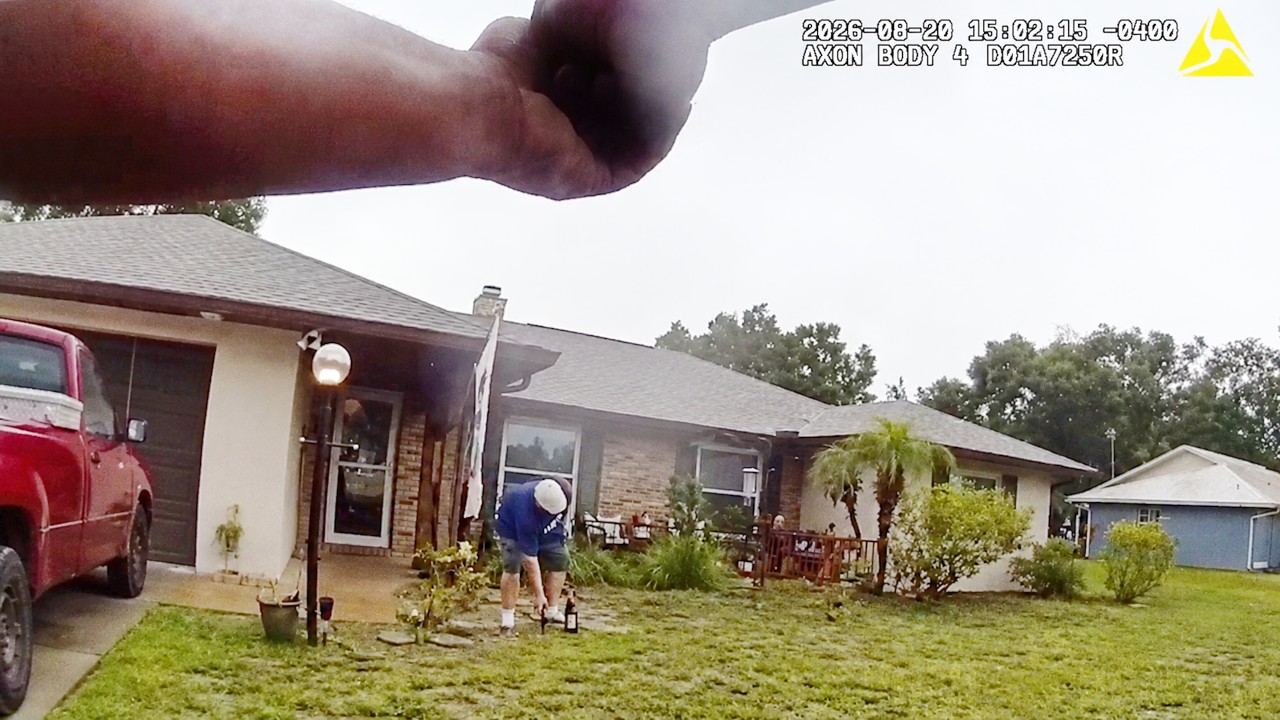
Leesburg deputies open fire video coverage shows Lake County Sheriff’s deputies confronting a man outside a home after a reported domestic disturbance involving a gun on August 20, 2026, according to PoliceActivity. The source says he appeared to set a pistol down, picked it back up, and was then shot. FDLE is handling the investigation, so the video does not settle the legal outcome.
Key Facts From the Selected Source
- The source places the incident in the Leesburg, Florida area on August 20, 2026.
- PoliceActivity says deputies were responding to a violent domestic disturbance involving a gun at a home on Morningside Drive.
- The source reports that 32-year-old Eric Sharp had allegedly assaulted someone inside the home and fired a rifle into the ceiling before deputies arrived.
- A second caller identified as an air-conditioning technician reportedly heard gunshots and described an active altercation.
- According to PoliceActivity, deputies confronted Sharp outside and ordered him to the ground after learning he had a pistol.
- The source says Sharp appeared to set the gun down, then bent over and picked it up again before deputies fired.
- PoliceActivity reports that Sharp died, no deputies were injured, and FDLE took over the investigation.
Those points are all source-attributed. The Leesburg deputies open fire video is important public evidence, but it is still only one layer of the record. The footage does not automatically include every 911 statement, every deputy’s line of sight, every prior report, or every forensic finding that investigators may later review. A careful explainer therefore needs to distinguish between what the cameras visibly show and what PoliceActivity says deputies and callers reported.
Leesburg Deputies Open Fire Video: Reported Timeline
According to PoliceActivity, the Leesburg deputies open fire video begins with a domestic-disturbance response rather than a random street encounter. The source says Lake County Sheriff’s deputies were sent to a home in the Leesburg area shortly before 3 p.m. on August 20, 2026, after a 911 caller reported a violent incident involving a gun. PoliceActivity also says the caller reported that Eric Sharp had become violent inside the residence, allegedly pushed and assaulted someone, and fired a rifle into the ceiling. Those details help explain why deputies approached with urgency, but they remain source-attributed claims rather than independent findings by Navyago.
The source adds a second witness layer. PoliceActivity says an air-conditioning technician who was at the residence also called in, describing an active physical confrontation and reporting that he had heard gunshots. In a case like the Leesburg deputies open fire video, multiple caller accounts matter because they shape how responding deputies understand the risk before they reach the scene. At the same time, the public video does not reproduce full dispatch audio or sworn witness statements, so readers should avoid treating a short summary as a substitute for a formal investigative file.
As deputies were approaching, PoliceActivity says the original caller updated dispatch and reported that Sharp had gone outside and was armed with a pistol. That reported movement is a turning point in the Leesburg deputies open fire video. Deputies were no longer trying to stabilize a disturbance entirely inside a house. They were now confronting an armed person in an open outdoor space, where distance, movement, cover, and timing can change the risk in seconds.
The source says deputies approached with firearms drawn and repeatedly ordered Sharp to get on the ground. For a brief moment, the Leesburg deputies open fire video appears to show partial compliance or at least a pause. PoliceActivity says Sharp initially appeared to put his handgun down. That part of the source matters because it is often the moment viewers focus on when arguing online that the encounter was de-escalating. But the description says the situation changed again almost immediately.
According to PoliceActivity, Sharp then bent over and picked the handgun back up. The source says one deputy fired two rounds and a second deputy followed with additional shots. The Leesburg deputies open fire video therefore centers on a very short but highly consequential sequence: commands, a possible moment of compliance, renewed movement toward the firearm, and then gunfire. That sequence is why the public footage is useful, but it is also why a frame-by-frame social-media verdict can become misleading. Small timing differences can matter, and those differences are best studied using synchronized evidence rather than isolated stills.
After the shooting, PoliceActivity says deputies moved the firearm away, secured the scene, and that Sharp was pronounced dead. The source also says no responding deputies were injured. In the aftermath of the Leesburg deputies open fire video, PoliceActivity reports that the involved deputies were placed on administrative leave, which is common after an officer-involved shooting, and that the Florida Department of Law Enforcement took over the investigation. That final point is important because it reminds readers that the public video is an early evidence package, not the completed verdict on whether the use of force complied with law or policy.
What the Bodycam Package Shows
The published source is structured as a short body-camera package rather than a long mixed-media compilation. PoliceActivity lists bodycam from one deputy at 0:00 and a second deputy angle at 2:04. Those chapters make the Leesburg deputies open fire video easier to follow, but each angle still has limitations. Body-worn cameras move with the person wearing them, can be blocked by arms or doorframes, and do not always capture exactly what another deputy could see from a different position.
What the Leesburg deputies open fire video can show most clearly is sequence. A viewer can assess the setting outside the home, hear commands, watch body positioning, and see the broad order of actions around the gun. The video can also help readers understand how quickly the confrontation changed after the reported movement toward the pistol. Those are legitimate public-interest uses of released footage.
What the cameras do not automatically show is everything that shaped the deputies’ perception. The Leesburg deputies open fire video does not give the full 911 call history, the precise wording of each dispatch update, the deputies’ exact knowledge of prior violence allegations, or the full spatial view from every angle at once. It also does not independently verify every factual detail in the source description, such as what happened inside the house before deputies arrived. That is why a careful explainer keeps separate labels for visible footage, source description, and later investigative findings.
Another reason to read the video cautiously is that edited public packages compress time. The Leesburg deputies open fire video is only a few minutes long, while the real event included pre-arrival dispatch, approach decisions, scene containment, and post-shooting response. Public release can improve accountability, but a short package still leaves open questions about positioning, cross-communication, and the timing between commands and movement. Those open questions are precisely what a formal FDLE investigation is meant to address.
Why the Reported Gun Pickup Changed the Encounter
The central dispute most readers bring to the Leesburg deputies open fire video is whether the encounter should be interpreted as an immediate deadly-force scenario or as a moment that was still moving toward surrender. PoliceActivity’s description places that entire dispute on the reported gun pickup. The source says Sharp appeared to put the pistol down, then bent over and picked it back up. If that source summary is accurate, it would explain why deputies may have interpreted the next moment as a renewed lethal threat rather than a completed disarmament.
At the same time, the Leesburg deputies open fire video does not require readers to jump from that reported movement to a legal conclusion. A source-based article can say that the reported pickup changed the encounter without declaring that every shot was legally justified. Investigators will usually examine timing, distance, the exact position of the gun, the angle of the deputies, the words used in commands, and whether any cover or retreat options existed. A public explainer should acknowledge those factors without pretending to resolve them.
Cases like the Leesburg deputies open fire video also show why partial compliance can be one of the hardest moments for officers and viewers to interpret. A person may appear to comply and then resume movement. A camera may catch the motion from one side while obscuring the hand position from another. Online debate often treats this as a binary moral puzzle, but real investigations tend to reconstruct the encounter second by second. That slower method is less satisfying in a viral argument, yet it is the only method likely to answer the question responsibly.
Readers who want a related example of a fast-moving officer use-of-force source package can compare Navyago’s Annandale officer shooting video explainer, which also separates visible video, source statements, and the limits of early public evidence. The same caution applies here: the Leesburg deputies open fire video is useful for chronology and public scrutiny, but not for collapsing every disputed issue into certainty.
What Is Reported About the Deputies, the Suspect, and the Review
PoliceActivity identifies the deceased man in the Leesburg deputies open fire video as 32-year-old Eric Sharp. The source also says no deputies were injured. Those are straightforward reported facts about who was involved and what the immediate physical outcome was. They do not, by themselves, answer the larger legal or policy questions that often follow an officer-involved shooting.
The source says the deputies involved were placed on administrative leave. In the context of the Leesburg deputies open fire video, that detail should be read as a procedural step rather than a finding of wrongdoing. Many agencies remove involved officers from active duty during the initial review period so an outside or internal investigation can proceed. Administrative leave is therefore part of the process, not a verdict.
PoliceActivity also says the Florida Department of Law Enforcement took over the investigation. That detail is one of the most important limits on how the Leesburg deputies open fire video should be used in public discussion. Once an outside investigative agency is involved, later findings may include interviews, scene measurements, forensic testing, audio synchronization, and additional documents that are not visible in the public bodycam package. Anyone claiming the video alone settles the final answer is moving faster than the actual review process.
The domestic-disturbance allegations in the source deserve similar care. PoliceActivity reports that callers described an assault and a ceiling shot before deputies arrived. Those statements can explain why deputies approached the event as high risk, but the Leesburg deputies open fire video does not independently prove every alleged act inside the house. Public reporting can note the allegations and their relevance to the response while avoiding unnecessary overstatement about conduct that still depends on source attribution.
What the Source Does Not Establish
The Leesburg deputies open fire video does not establish motive. It does not tell viewers exactly why Sharp moved the way he did, what he intended to do with the pistol, or what mental state he was in. The source says deputies were responding to a violent domestic incident, but public footage is not a reliable tool for diagnosing thought, intent, or mental condition. That is one reason legal-safe reporting uses phrases such as according to the source and PoliceActivity says instead of turning inference into fact.
The source also does not establish a final legal ruling. Even if the Leesburg deputies open fire video appears clear to one viewer, legal justification depends on facts and standards outside the clip itself. Investigators may examine whether commands were audible, whether the gun was pointed, whether the deputies had cover, whether less-lethal options were viable, and how prior information affected threat assessment. Those are not questions a short public clip can fully answer on its own.
Finally, the Leesburg deputies open fire video should not be treated as a full substitute for later public records. FDLE findings, sheriff’s-office statements, court filings, or additional disclosure could add nuance or correct early assumptions. Readers should therefore treat this article as an explainer of what the source publicly reported on August 25, 2026, not as the last word on what investigators may ultimately conclude.
How Readers Should Evaluate the Released Footage
Start by separating the event into stages. The Leesburg deputies open fire video sits near the end of a longer chain: the 911 domestic-disturbance reports, the deputies’ approach, the confrontation outside, the reported gun placement, the reported pickup, and the shooting. Watching with that structure in mind is more useful than reacting only to the loudest or most dramatic second.
Second, identify the evidence layer. A viewer can see body movement, hear some commands, and observe the sequence of gunfire in the Leesburg deputies open fire video. The source description supplies the alleged assault, the ceiling shot, the callers’ identities, and the FDLE handoff. Those are different layers of information, and blending them together without attribution makes the report weaker, not stronger.
Third, avoid assuming that a single visual impression answers a legal question. The Leesburg deputies open fire video is valuable because it puts public evidence into circulation, but it is not an instant jury room. The fairest way to use released footage is to compare what the cameras show with what the source claims, then watch for later records from FDLE or Lake County before drawing broader conclusions.
That final step is the one most online debate skips. A reader who wants to understand the Leesburg deputies open fire video seriously should watch the full clip below, note the source publication date of August 25, 2026, and then look for later official updates. That process is slower than social-media certainty, but it is also the only one that respects both accountability and accuracy.
Frequently Asked Questions
Why did deputies shoot in the Leesburg video?
According to PoliceActivity, deputies fired after the man appeared to set down a pistol and then picked it back up again during the confrontation. The video is public evidence, but FDLE’s investigation is still the process that may determine how the shooting is officially evaluated.
Was anyone else injured in the Leesburg incident?
The selected source says no responding deputies were injured. It reports that the man who was shot died after the encounter.
What agency is handling the investigation now?
PoliceActivity says the Florida Department of Law Enforcement took over the investigation after the shooting.
Can the video alone determine whether the deputies acted lawfully?
No. The Leesburg deputies open fire video helps establish chronology, but legality and policy compliance require a broader investigation than a short public clip can provide.
Source Video
Sources and Attribution
Primary source: PoliceActivity, “Deputies Open Fire After Suspect Picks Up Gun,” published August 25, 2026. Watch the original at https://www.youtube.com/watch?v=GDqjBnLsfJ0. Incident details in this article are attributed to the public video package and its description. Navyago paraphrased the source for public-interest reporting and analysis.
Next step: Review the full source video, then check for later Lake County Sheriff’s Office or FDLE records before treating this early account as final.