
Chicago fatal crash dashcam video footage published by Midwest Safety shows the aftermath of a South Side collision after police followed a black sedan without lights or sirens. The source reports that an 18-year-old passenger died, other people were injured, and two guns were recovered. The recording informs the timeline, but it does not determine guilt or the final police-policy findings.
Midwest Safety published the 11-minute source video on August 25, 2026. Its narration says the encounter began at about 2 a.m. when Chicago Police Department robbery-team officers saw two men they believed were armed enter a black sedan. For this Chicago fatal crash dashcam video explainer, Navyago has the public video, source metadata, automatic captions, and exact source thumbnail. It does not have the complete incident file, court docket, medical records, or final Civilian Office of Police Accountability report. Sensitive details below therefore remain attributed to the source.
Seven Source-Backed Facts From the Chicago Fatal Crash Dashcam Video
A careful reading of the Chicago fatal crash dashcam video separates what Midwest Safety narrates, what the released cameras show, and what later official records would need to establish. The following seven points stay inside the available source package.
1. The encounter reportedly began on Chicago’s South Side
In the Chicago fatal crash dashcam video, Midwest Safety says officers assigned to a Chicago Police Department robbery team were patrolling at about 2 a.m. when they saw two men they believed were armed enter a black sedan. The source places the early driving near 51st Street and Western Avenue before the sedan turned onto Ashland Avenue. The video does not provide Navyago with the officers’ complete pre-incident briefing or the factual basis for their belief that the men were armed.
2. The source says officers followed without lights or sirens
The narration says the sedan ran stoplights while officers matched its speed but did not activate emergency lights or sirens. Radio audio in the source includes an officer describing a black sedan driving erratically. That distinction is important: the public may call any fast police following a “chase,” while a department’s policy or report may classify the event differently. This article describes the visible and reported conduct without assigning a final policy label.
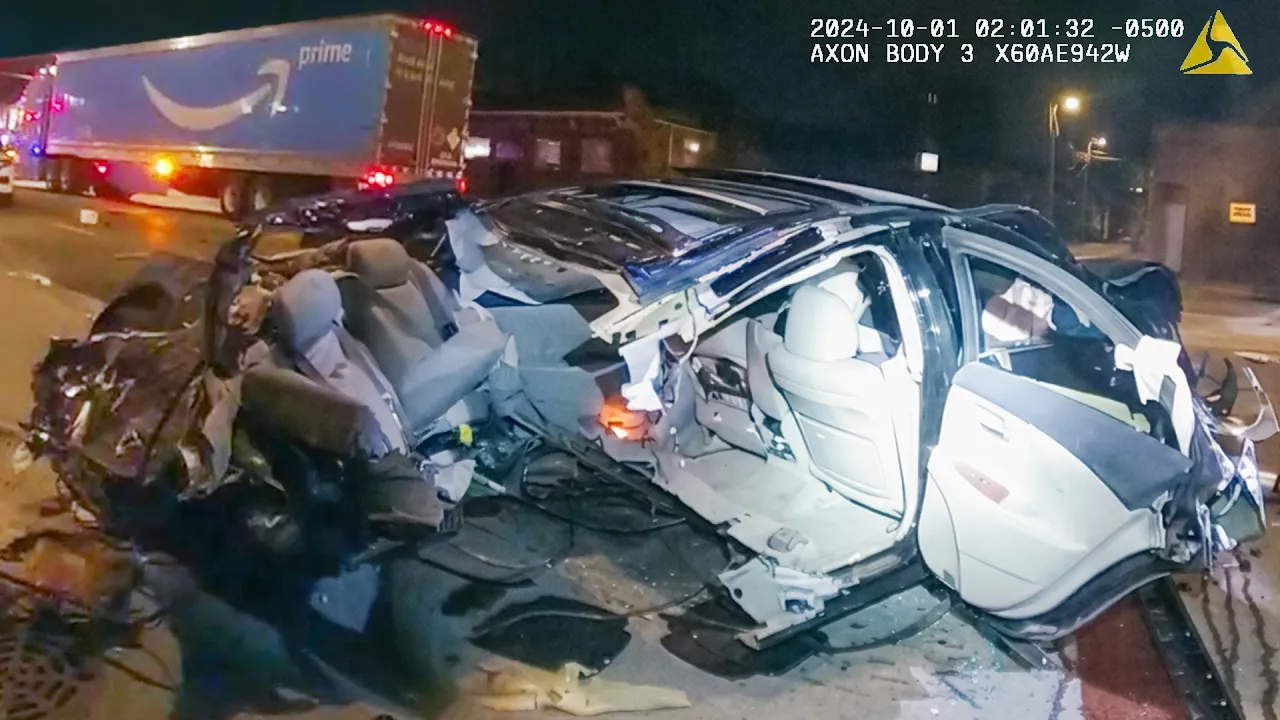
3. A squad-car camera captured the collision aftermath
The Chicago fatal crash dashcam video shows officers arriving immediately after a severe collision involving the black sedan and other road users. The footage becomes an emergency-response record: officers check damaged vehicles, call for ambulances, direct injured people not to move, and react to a possible gas leak. The camera establishes that the scene was chaotic, but it does not provide an unobstructed view of every movement before impact.
4. Midwest Safety reports that one passenger died
The source identifies an ejected passenger as 18-year-old Luis Mendez and reports that he was pronounced dead at the scene. Navyago does not add graphic descriptions or speculate about his injuries. A death makes the footage a matter of public interest, but it also requires restraint: the video should be used to understand the sequence and official response, not to turn a person’s final moments into spectacle.
5. Other people were reportedly injured
According to Midwest Safety’s Chicago fatal crash dashcam video narration, the driver of a vehicle struck in the collision was transported with a hand injury, while the driver of the black sedan was taken to a hospital with an injury to his left leg. The footage records people asking for help and officers waiting for medical responders. The source package does not include medical charts, so this article does not characterize the severity or long-term outcome of those injuries.
6. Officers reportedly recovered two firearms
Officers can be heard discussing firearms at the scene, and Midwest Safety says two guns were recovered. A firearm lying near an injured person affects how officers approach and secure a crash scene. However, recovery does not by itself establish who possessed each gun before the collision, whether possession was lawful, or what any person intended. Those questions depend on physical evidence, statements, and court records that are not included here.
7. The source reports a later arrest and continuing review
In its Chicago fatal crash dashcam video narration, Midwest Safety says Chicago police identified the black-sedan driver as 23-year-old Christian Rios. The source reports that he was arrested 18 months later and charged with reckless homicide by motor vehicle and aggravated possession of a weapon. A criminal charge is an allegation, not a conviction. The source expressly states that Rios is innocent unless proven guilty in court, and Navyago preserves that presumption.
How the Source Describes the Chicago Crash Timeline
The first stage involves observation rather than an announced stop. Midwest Safety says robbery-team officers saw two men they believed were armed get into a black sedan. The sedan then traveled through stoplights while officers followed at speed without lights or sirens. Radio traffic identifies the vehicle and direction of travel. What the source does not supply is a complete recording of the officers’ decision-making or the dispatch information available to each unit.
The source says the sedan accelerated after turning onto Ashland Avenue near another squad car. Moments later, a police dash camera captured the crash scene. That short interval matters because collision reconstruction depends on speed, distance, signal phase, vehicle paths, and reaction time. Midwest Safety later discusses an estimate based on the recording, but Navyago does not convert that commentary into an official speed finding. A certified reconstruction would be stronger evidence.
After impact, the Chicago fatal crash dashcam video shifts from vehicle movement to rescue. Officers approach wrecked vehicles, locate people on the ground and inside cars, request ambulances, and warn injured people not to move. They also discuss a firearm near one person. As more responders arrive, officers identify additional occupants and check whether other vehicles or bystanders were involved.
The audio conveys hazards that a silent clip would miss. Officers mention smoke or a strong gas smell and consider moving people farther from the damaged vehicles. One person says he cannot breathe; another asks for help. These moments show why first responders must balance medical urgency, scene safety, and the possibility of weapons. They do not establish who caused the collision or whether earlier police conduct complied with policy.
The final stage of the Chicago fatal crash dashcam video comes from the source’s later narration rather than the immediate footage. Midwest Safety reports the death, injuries, firearm recoveries, later arrest, charges, and status of the police-accountability review. Those updates are useful, but they should not be blended with direct camera evidence. The camera captures a scene; the narrator supplies a later procedural history.
What the Cameras and Audio Establish Directly
The strongest direct evidence in the Chicago fatal crash dashcam video is chronological. Viewers can hear an officer broadcast a vehicle description and location, see the immediate crash response, hear officers summon medical help, and observe the effort to secure firearms and protect injured people. These elements can be checked against the recording without accepting every later claim in the narration.
The footage also demonstrates the limits of a single camera. The dash camera points forward from one police vehicle. It does not show every intersection signal, every vehicle’s full path, or the exact position of the sedan during the entire lead-up. Body-camera views move with officers and are often blocked by cars, darkness, people, or urgent activity. A missing angle should be treated as missing evidence, not proof that an event did or did not happen.
Audio needs similar care. Automatic captions help locate topics in an 11-minute source, but they can mishear street names, overlapping speech, or distressed voices. Navyago uses the captions to understand the broad sequence and relies on cautious paraphrase. Precise quotations or official findings should come from primary recordings and certified transcripts when those become available.
The cameras do not record thought. They cannot prove why the sedan’s driver accelerated, what officers intended by following, whether an injured person knew a firearm was nearby, or how each participant perceived the danger. Those are consequential issues, and assigning motives from a compressed online video would exceed the evidence.
Why the Reported Police-Driving Record Matters
Midwest Safety says the pursuit-like driving before the crash was not mentioned in the incident report available to the channel. That is a source claim about record completeness, not a finding by Navyago. If accurate, it matters because written reports are how supervisors, investigators, courts, families, and the public reconstruct what officers knew and did. A material difference between video and paperwork can undermine confidence even before anyone decides whether policy was violated.
The Chicago fatal crash dashcam video source says Midwest Safety contacted Chicago’s Civilian Office of Police Accountability and received a response that its investigation was complete but in post-closure review. It also says a final summary report would become available after that process. Until that primary report is public and reviewed, this article cannot state whether COPA sustained any allegation, recommended discipline, found policy compliance, or reached another conclusion.
Terminology should remain precise. Emergency lights and sirens, attempted traffic stops, supervisory authorization, speed, distance, and the reason for following can affect whether a department calls an event a pursuit. Online viewers may reasonably question the conduct shown, but a final classification requires the applicable Chicago policy and a complete record. Calling the issue “reported police-driving conduct under review” is more accurate than declaring a result.
The public-interest question is broader than blame. Accurate documentation can reveal whether policy worked, whether training needs adjustment, or whether a gap in reporting was simply an omission later corrected. The Chicago fatal crash dashcam video makes review possible; it does not complete that review.
What the Reported Charges Mean and Do Not Mean
Midwest Safety reports that Rios was charged with reckless homicide by motor vehicle and aggravated possession of a weapon. Charges describe prosecutors’ allegations under particular laws. They are not proof beyond a reasonable doubt and do not establish a final case outcome. This source package does not provide a complaint, indictment, plea, trial result, dismissal, or sentencing record.
The reported 18-month interval before arrest also should not be filled with speculation. The source links the timing to completion of a police-accountability investigation, but Navyago does not have records showing every investigative step or explaining the charging timeline. Delay can have many procedural causes. It should not be framed as proof of a cover-up, favoritism, or guilt without evidence.
Weapon allegations require the same discipline. Two firearms reportedly recovered at a scene do not automatically prove possession by a particular person. Prosecutors would need admissible evidence connecting an accused person to an alleged offense. Readers should distinguish what an officer says at the scene, what the source narrator reports, and what a court ultimately finds.
What Remains Unresolved After the Released Video
The final COPA findings remain the largest open institutional question. A public summary could clarify how the agency classified the driving, whether officers complied with reporting requirements, and whether policy or training changes were recommended. Until that record is available, claims that police were cleared or found at fault would both be premature.
The criminal case outcome is also unknown in this package. The Chicago fatal crash dashcam video article can accurately report the source’s description of charges while preserving the presumption of innocence. A later court docket could change the procedural status, narrow allegations, or provide a final resolution. Readers should check current Cook County court information before treating an August 2026 video summary as the last word.
Crash reconstruction details remain incomplete. The video does not independently establish exact speed, signal timing, braking distance, or each collision force. Police reports, event-data recorders, roadway measurements, surveillance footage, and expert analysis would provide a more reliable technical account.
Finally, the source package does not answer every question about the people involved. It offers limited public-interest facts about a fatal event, not a license to expose private medical information or define anyone by a few minutes of footage. Responsible coverage names only details necessary to understand the incident and its review.
How Readers Can Evaluate the Footage Responsibly
First, verify the source identity. This article uses Midwest Safety video ID tYwDyXqfM60. The source URL, raw thumbnail, body image, iframe, and source note all point to that same ID. A similar Chicago crash clip would be a different source and must not be mixed into this account.
Second, separate visual evidence from narration. Phrases such as “the footage shows” refer to visible or audible material. Phrases such as “Midwest Safety reports” identify claims supplied by the channel’s narration. Neither phrase substitutes for a final court judgment or official accountability report.
Third, watch the complete sequence rather than a silent collision excerpt. Radio traffic, officers’ response, firearm warnings, medical requests, and later source caveats all change how the material should be understood. A dramatic fragment may attract attention while removing the context that makes the video useful.
Fourth, after reviewing the Chicago fatal crash dashcam video, look for later primary records. The final COPA summary, Chicago Police reports, and court docket can confirm, refine, or correct the early account. Newer official evidence should take priority over assumptions drawn from an online upload.
Readers can find more source-attributed public-safety explainers in Navyago’s Crime News section. The standard remains the same: identify the source, distinguish observation from allegation, preserve the presumption of innocence, and state what remains unknown.
Frequently Asked Questions
What does the Chicago fatal crash dashcam video show?
It shows police radio traffic, the immediate collision aftermath, officers helping injured people, emergency requests, scene hazards, and officers locating firearms.
Who died in the crash?
Midwest Safety identifies an ejected passenger as 18-year-old Luis Mendez and reports that he was pronounced dead at the scene.
Were criminal charges filed?
The source reports that Christian Rios was charged with reckless homicide by motor vehicle and aggravated possession of a weapon. Charges are allegations, and this source package does not provide a final court outcome.
Did COPA finish its investigation?
Midwest Safety says COPA completed its investigation and that the matter was in post-closure review before release of a final summary report.
Does the video prove police violated pursuit policy?
No. It raises a documentation and driving-conduct question, but a policy conclusion requires the final COPA record, complete police reports, and the applicable policy.
Source Video