
California spear knives shooting video footage published by PoliceActivity documents CHP and Oakland officers following a man who reportedly held two long poles with knives attached. The source says Tasers were ineffective before officers fired as he swung the weapons. The video clarifies the sequence, but it does not independently decide whether the shooting complied with law or policy.
The approved source is PoliceActivity video TZG4OOnxY2E, uploaded August 13, 2026. Its description places the encounter in Oakland, California, on July 13, 2026. Navyago reviewed the public description, automatic captions, chapter markers and exact source thumbnail. Navyago does not have the complete OPD or CHP investigation, original dispatch audio, scene measurements, medical examiner record or final review findings. Incident-specific details therefore remain attributed to the source.
California spear knives shooting video: what the source reports
PoliceActivity says the California Highway Patrol requested help from the Oakland Police Department shortly after 2 p.m. near 40th Avenue and International Boulevard. CHP officers had reportedly encountered an armed man at an encampment along State Highway 185. According to the description, officers ordered him to drop his weapons, but he did not comply and walked away while officers followed.
The source identifies the man as believed to be 44-year-old Jose Angel Castillo. It describes two homemade weapons, each consisting of a long metal pole with a knife attached. Because Navyago has not reviewed an official evidence inventory, dimensions or recovery photographs, this article uses the source’s description rather than asserting a technical classification for either object.
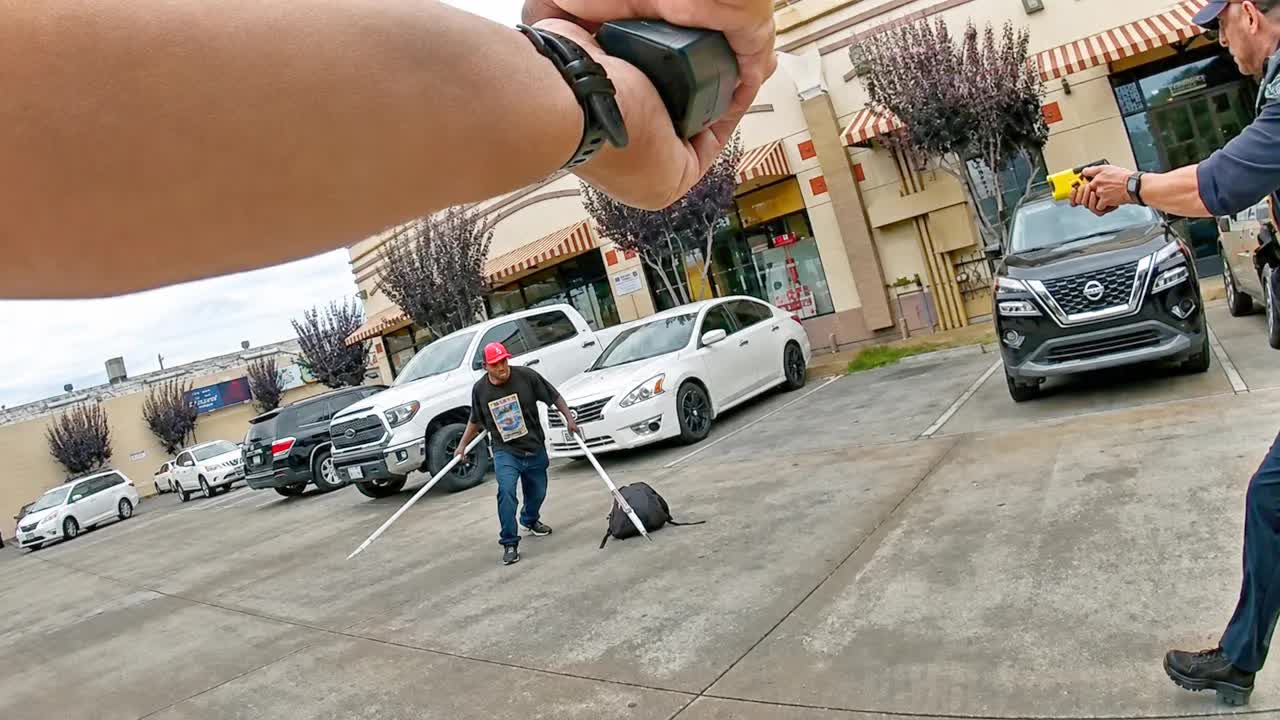
PoliceActivity reports that Oakland officers located the man, gave repeated commands to drop the weapons and continued following as additional officers arrived. The description says he moved near a man and two children who were crouching behind a tree. An officer equipped with a Taser reportedly paused to make sure those bystanders moved safely past the officer.
The source says both OPD and CHP officers deployed Tasers in a shopping-center parking lot, but the deployments were ineffective. PoliceActivity then reports that the man began swinging the long poles with knives attached and that Oakland officers discharged their service weapons. It says officers immediately provided medical aid until paramedics arrived, but the man died at the scene. The channel reports that no officer or other member of the community was injured.
Seven California spear knives shooting video facts to separate from inference
A careful recap distinguishes the source identity, the source’s claims, visible sequence and conclusions that require a formal investigation. These seven points stay within the evidence package available for the California spear knives shooting video.
1. The encounter involved two agencies
In the California spear knives shooting video, PoliceActivity reports that CHP made the initial contact and later requested OPD assistance. This matters when reading the footage because different uniforms, cameras and commands may belong to different agencies. It also means a complete record could include separate dispatch logs, policies, evidence systems and review responsibilities.
2. The source reports two homemade long-pole weapons
The channel describes each object as a metal pole with a knife attached. That description explains the phrase “spear knives” used for reader search intent, but it is not an expert weapon classification. Formal photographs, measurements and chain-of-custody records would provide more reliable detail than a compressed video or thumbnail.
3. Commands reportedly continued as the man walked away
The California spear knives shooting video description and footage present a moving encounter rather than a single stationary confrontation. Officers reportedly told the man to drop the weapons while following him through the area. The path and elapsed time may matter to reviewers, yet a web viewer should not estimate exact distances or timing without synchronized original files.
4. Bystanders appear in the reported sequence
PoliceActivity says a man and two children were crouching behind a tree as the armed man moved toward their area. The source also says an officer stopped to ensure they could pass safely. Navyago does not identify the bystanders or speculate about what they perceived, preserving privacy while noting why their position could be relevant to the incident timeline.
5. The source says Taser deployments were ineffective
According to PoliceActivity, OPD and CHP personnel deployed Tasers after the encounter reached a shopping-center parking lot. The source says those efforts did not stop the man. A complete review would examine the devices, probe paths, activation logs, range, clothing and camera angles before reaching a technical conclusion about why they did not work.
6. PoliceActivity links gunfire to the swinging of the weapons
The description says the man began swinging the long poles with knives attached and that OPD officers then fired. This is a source-attributed sequence, not Navyago’s independent finding about threat, intent or justification. Original synchronized video, officer positions and scene measurements would be needed to test the timing precisely.
7. The source reports immediate aid and a death at the scene
PoliceActivity says officers provided medical aid until paramedics arrived and that the man died at the scene. It also reports no injuries to officers or other community members. Medical and emergency-response records would be the stronger evidence for treatment timing and cause of death, so this article does not add unsupported medical detail.
What the California spear knives shooting video camera views add
The California spear knives shooting video source package labels three useful perspectives: an initial body-camera segment, Oakland police body-camera footage and surveillance video. Multiple views can reduce the risk of treating one camera as an all-seeing witness. They may show changes in direction, spacing and bystander location that one officer’s camera misses.
Body cameras still have important limits. They sit below eye level, move with the wearer and use wide-angle lenses that can distort perceived distance. Exposure can change between sunlight and shade, and a camera may be blocked by an arm, another officer or a vehicle. What the camera records is evidence, but it is not necessarily identical to what every participant saw.
The automatic captions are useful for following broad commands in the California spear knives shooting video, but they are not a certified transcript. Stress, overlapping voices, traffic and movement can produce caption errors. Precise quotations should be checked against original audio from every available device rather than copied from a platform-generated caption track.
Surveillance footage offers a wider, more stable view, but it may lack clear audio and can compress depth. It should be synchronized with body-camera timestamps before anyone tries to calculate how quickly a movement occurred. Slow motion can help identify positions, yet it can also make a fast event feel longer than participants experienced it in real time.
What the California spear knives shooting video does not establish
The California spear knives shooting video does not establish why the man was at the encampment, what happened before CHP arrived or whether medical, emotional or situational factors affected his behavior. The source package does not supply a complete personal history. Guessing about mental state would add stigma without improving the factual record.
The footage also does not independently determine whether any officer’s use of force was lawful or consistent with agency policy. Such a finding requires the governing law, the policy applicable to each agency, what each officer knew, the positions and actions of participants, available alternatives, warnings, physical evidence and conclusions from the responsible review bodies.
The California spear knives shooting video does not prove motive or intent. Holding or swinging an object can be relevant evidence, but a short recording cannot reveal every thought or purpose. Navyago therefore avoids labels that go beyond the source and does not present the word “suspect” as proof of a crime or final adjudication.
Nor does an online upload establish the complete firing sequence. The description does not provide a verified round count, the identity of every firing officer or a full map of cartridge evidence. Firearms reports, original camera files and scene documentation would be needed before making those claims.
Finally, the upload is an early public record, not necessarily the last word. OPD, CHP, a prosecutor, coroner or oversight body may later release findings that add context or correct preliminary information. Any reliable primary record published later should take priority over an initial third-party video description.
Records needed to review the California spear knives shooting video
A complete review of the California spear knives shooting video would begin with the call history. CHP and OPD dispatch logs, radio traffic and computer-aided dispatch entries could establish when officers first learned about the man, what weapons were reported and why assistance was requested. That matters because officers act on information available at the time, not facts collected afterward.
Investigators would preserve and synchronize every original recording. For the California spear knives shooting video, camera clocks may differ, and one microphone may capture words another misses. A shared timeline could test when commands began, where bystanders moved, when Tasers were deployed and when the reported swinging motion and gunfire occurred.
For the California spear knives shooting video, scene measurements would help evaluate distance, direction and sightlines. Investigators can map each participant, vehicles, landscaping, storefronts and the reported weapons. They can also document where Taser probes, cartridge cases and other evidence were recovered. Those measurements are more reliable than estimating space from a paused online frame.
The two long-pole objects should be photographed, measured and tracked through chain-of-custody records. Device logs could show Taser activation timing, while firearms examination could help establish which weapons fired and how many rounds. Navyago has none of those technical records and therefore does not fill the gaps with estimates.
For the California spear knives shooting video, each officer’s decision should be assessed separately. CHP and OPD personnel may have occupied different positions, heard different commands or seen different movements. A formal review should compare each person’s camera, statement, line of sight and agency policy rather than treating all officers as one undifferentiated observer.
Administrative, criminal and civil processes answer different questions. A prosecutor may evaluate criminal law, an agency may examine policy and tactics, and a civil court—if a claim is filed—uses its own procedures and standards. The source video can inform those questions, but it cannot substitute for any completed review.
How to view and share the California spear knives shooting video responsibly
First, verify the source ID. This article uses PoliceActivity video TZG4OOnxY2E. The source note, thumbnail, body image and iframe all point to that same ID. A clip from another Oakland or California incident must not be mixed into this account.
Second, preserve attribution when discussing the California spear knives shooting video. Use “PoliceActivity reports” for incident details supplied by the description. Use “the footage appears to show” when an image is visible but the angle is limited. Avoid “the investigation proved” unless a completed official report actually supports that statement.
Third, do not strip away the lead-up to create a sensational fragment. The public-interest value lies in understanding the response, movement, commands, bystander context, reported less-lethal attempts and evidence limits. Reposting only the fatal moment can cause harm while giving viewers less information.
Fourth, separate observable events from legal conclusions. Weapons, commands, movement, Taser deployments and gunfire may be reported or visible. Whether force was justified is a different question requiring law, policy and a complete record. Responsible readers can acknowledge the footage without pretending to conduct a final investigation from a phone screen.
After reviewing the California spear knives shooting video, readers can find more source-attributed public-safety explainers in Navyago’s Crime News section. The editorial rule is consistent: identify the source, state what it supports, protect unnecessary personal details and say plainly what remains unknown.
Frequently asked questions
What does the California spear knives shooting video show?
It presents CHP and Oakland officers following a man with two reported long-pole knife weapons, attempted Taser deployments and police gunfire. PoliceActivity reports that the man died at the scene.
Where did the encounter happen?
PoliceActivity places it near 40th Avenue and International Boulevard in Oakland, California, with part of the encounter continuing into a shopping-center parking lot.
Were bystanders near the incident?
The source reports that a man and two children crouched behind a tree and that an officer paused to ensure they moved safely past.
Did officers use Tasers before firing?
PoliceActivity says OPD and CHP officers deployed Tasers, but the deployments were ineffective. Technical details require the official device and evidence records.
Does the video prove the shooting was justified?
No. The footage informs the timeline, but a legal or policy conclusion requires the complete investigative record and applicable standards.
Source Video