
Steubenville dealership shooting video coverage explains the PoliceActivity source video about a Steubenville, Ohio police response near Team Ford. The source account describes 911 calls, a handgun, firearms moved into a dealership pickup, officer commands, gunfire, first aid, and an Ohio BCI review.
The exact source for this Steubenville dealership shooting video article is PoliceActivity video qVbvwe9DSTg, titled Man Loads Dealership Truck With Guns Then Fires at Cops. Navyago treats the public video, source description, and accessible source mirrors as public-source material, not as a court finding, a complete investigative file, or legal advice.
Steubenville Dealership Shooting Video: 7 Critical Facts
The seven points below keep the account narrow. They summarize what the PoliceActivity source and accessible source notes report while avoiding unsupported conclusions about intent, officer policy compliance, criminal liability, or the final investigative outcome.
1. The source places the incident near Team Ford in Steubenville
Accessible PoliceActivity source mirrors describe the location as the Team Ford dealership area at 905 Brady Avenue in Steubenville, Ohio. That address detail helps anchor the Steubenville dealership shooting video and should not be treated as a complete police report.
2. The initial calls involved a man reportedly pointing a handgun
The source account says multiple 911 calls reported a man with a handgun pointing the weapon at passing vehicles. A final reading of the Steubenville dealership shooting video would still need original 911 audio, caller statements, and dispatch logs.
3. The source identifies the man as Matthew Metzger
PoliceActivity source mirrors name Matthew Metzger and say he arrived in a black Jeep Cherokee. Navyago reports that identification in this Steubenville dealership shooting video article as source-attributed, not as an independent court finding.
4. Surveillance reportedly showed long guns moved into a Ford pickup
The source says surveillance in the Steubenville dealership shooting video context showed three long guns and ammunition moved from the Jeep into an unsecured Ford pickup truck on the dealership property.
5. The listed firearms include a shotgun, a rifle, and a 5.56mm rifle
The accessible source summary for the Steubenville dealership shooting video lists a Mossberg 20-gauge shotgun, a Bergara .22-caliber rifle, and a DPMS A-15 5.56mm rifle, with a handgun also involved.
6. Officers reportedly ordered the man to drop the handgun
The source says officers in the Steubenville dealership shooting video gave repeated commands to drop the weapon while the man refused and moved around the dealership area. Body-camera and dash-camera files would be needed to verify every command and response.
7. The source says the exchange of gunfire is under Ohio BCI review
PoliceActivity and accessible summaries say the suspect in the Steubenville dealership shooting video fired about four 9mm rounds, two officers returned fire with about 12 .223 rifle rounds, officers rendered first aid, and the Ohio Bureau of Criminal Investigation is handling the investigation.
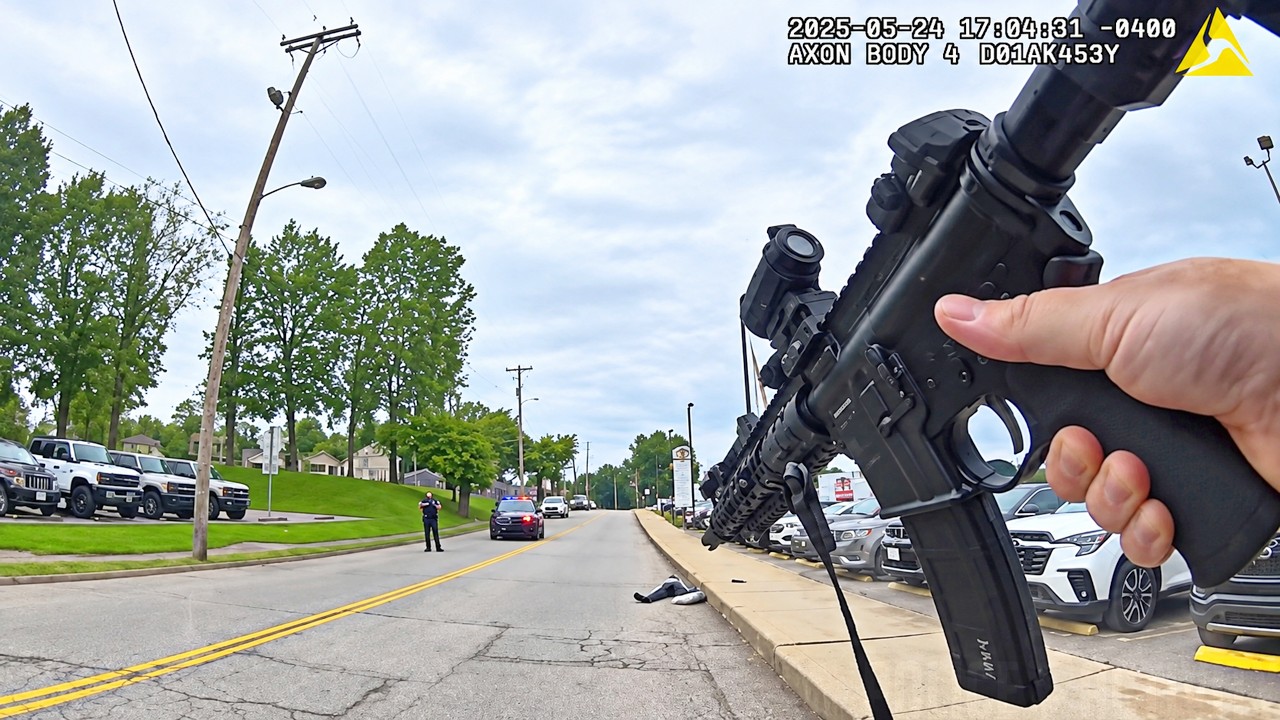
How the Steubenville Dealership Shooting Video Timeline Fits Together
PoliceActivity's source account says Steubenville officers responded near the Team Ford dealership at 905 Brady Avenue after 911 callers reported a man with a handgun who was pointing it at passing vehicles and moving additional firearms into a dealership truck. The public account starts with calls about a man with a handgun and a dealership setting where customers, workers, passing drivers, and responding officers could all be exposed to risk. The article uses that source basis to explain the reported sequence without converting the edited video into a complete case file.
According to accessible PoliceActivity source text, the man arrived in a black Jeep Cherokee around the Team Ford property and spent time moving between the dealership and a parking area across Brady Avenue. Surveillance reportedly showed him removing multiple long guns and ammunition from the Jeep and placing them into an unsecured Ford pickup truck. That detail matters because it explains why the event was treated as more than a single handgun call.
Responding officers reportedly encountered the man while he still had a handgun. The source account says officers repeatedly ordered him to drop it. The video can help readers understand the urgency of the commands, but a careful explainer should still distinguish between what is visible, what is heard, what the source description says, and what a complete investigative file may later establish.
The source says gunfire followed after the man refused commands and moved through the dealership area. Accessible summaries say he fired about four 9mm rounds and that two officers returned fire with about 12 .223 rifle rounds. Navyago reports those numbers as source-attributed because shot counts should ultimately be checked against BCI evidence logs, ballistic reports, body-camera timing, dash-camera timing, and scene diagrams.
What the Steubenville Dealership Shooting Video Can and Cannot Prove
The Steubenville dealership shooting video can show pieces of the scene: officer movement, commands, visible weapons, dealership surveillance, and the moments before and after gunfire. It can also show why the incident carries public-interest value. A dealership is not a controlled training range; it is a public business space where a handgun call and moved long guns can create fast safety decisions.
At the same time, a public video is not the same as the whole investigation. It may not include every 911 call, every witness statement, full audio quality, exact distances, every round trajectory, or the full chain of custody for each firearm. Camera perspective can also hide important facts outside the frame. A responsible source-based article should use the video as a starting point, then name the records needed for final verification.
This distinction is especially important when the source discusses a fatal outcome. The article does not infer mental state from behavior, does not label the shooting legally justified or unjustified, and does not accuse any officer of misconduct. It explains what the public source says, then points readers to the Ohio BCI review and any later prosecutor or court record for formal findings.
Reported Weapons and Scene Control in the Steubenville Dealership Shooting Video
Accessible source notes list a handgun and three long guns: a Mossberg 20-gauge shotgun, a Bergara .22-caliber rifle, and a DPMS A-15 5.56mm rifle. The source also says ammunition was moved from the Jeep into the dealership pickup. Those details explain why officers would likely focus not only on the person holding a handgun, but also on securing vehicles, bystanders, and any additional firearms nearby.
Scene control after gunfire can look slow or repetitive to viewers, but the underlying safety problem is serious. Officers have to confirm whether the handgun is away from the person, whether other weapons are reachable, whether bystanders are injured, whether crossfire risk remains, and whether medical aid can begin. The source account says officers rendered first aid and continued securing evidence after the shooting.
The Steubenville dealership shooting video should therefore be read as a public-safety sequence rather than a simple short clip. The reported long guns, ammunition, dealership vehicles, workers, witnesses, and responding officers all belong to the context. Each one can affect tactical decisions, but none removes the need for a formal post-incident review.
Why the Ohio BCI Review Matters After the Steubenville Dealership Shooting Video
The source account says the Ohio Bureau of Criminal Investigation is handling the review. That matters because officer-involved shooting reviews often require independent scene processing, interviews, evidence collection, laboratory work, and a referral to a prosecutor or other decision-maker. A video upload can inform the public, but it is not the final investigative product.
BCI review can answer questions that the public source cannot fully answer. How many calls came in? What did each caller report firsthand? Which officer fired which rounds? What was the exact location of each recovered firearm? Did the suspect’s rounds strike vehicles, buildings, or other objects? What did witnesses say after the scene was safe? Those are record questions, not opinion questions.
Readers should also separate investigative review from courtroom process. If charges are impossible because the person died, that does not mean the facts no longer matter. The review can still address threat assessment, officer decision-making, evidence handling, and transparency. If a prosecutor later issues a summary, that document should be read alongside the source video, not replaced by it.
Records Still Needed to Verify the Steubenville Dealership Shooting Video
The strongest next layer would include original 911 audio, dispatch CAD notes, dealership surveillance exports, all unedited body-camera and dash-camera files, officer statements, witness interviews, scene photographs, firearm recovery logs, ballistic reports, medical response records, and any Ohio BCI or prosecutor summary. Without those materials, the article should not overstate what the public source can support.
Those records would help resolve timing. They could show when the first caller reported the handgun, when officers arrived, when commands began, when each shot was fired, when first aid started, and when investigators secured each weapon. Timing is central because use-of-force reviews often examine what officers knew at the exact moment they acted.
The records would also help resolve location and access. Dealership lots can include open lanes, parked vehicles, service entrances, showrooms, customer areas, and nearby roads. Scene diagrams and surveillance exports are better than a compressed video for measuring distance, angle, and possible crossfire risk. That is why this article keeps measurement claims cautious.
How Readers Should Use the Steubenville Dealership Shooting Video
Readers can use the Steubenville dealership shooting video to understand why a call about a handgun near a dealership can become a high-risk police response. They can also use it to identify the record questions that should be answered before anyone makes a broad claim about motive, policy, discipline, or final legal status.
A practical reading has three steps. First, identify the source and the exact video ID. Second, separate visible footage from source narration and from later investigation. Third, check newer official records before citing the event as resolved. That approach keeps the article useful for Google, AI citation, and human readers without pretending the public video is the entire truth.
For related public-safety explainers, readers can browse Navyago’s Crime News coverage. Each source-based article should identify its source, preserve due-process wording, and avoid turning an edited video into a final verdict.
Frequently Asked Questions
What is the Steubenville dealership shooting video about?
It is a PoliceActivity source video about a May 24, 2026 Steubenville police response near Team Ford after calls reported a man with a handgun and additional firearms.
Does the video prove every detail of the shooting?
No. The video and source description are useful public material, but the full answer requires 911 audio, complete camera files, BCI reports, witness statements, and prosecutor or court records.
What weapons does the source say were involved?
The accessible source account lists a handgun, a Mossberg 20-gauge shotgun, a Bergara .22-caliber rifle, and a DPMS A-15 5.56mm rifle.
Who is investigating the Steubenville dealership shooting?
The source account says the Ohio Bureau of Criminal Investigation is handling the officer-involved shooting review.
Source Video
Sources and Attribution
Primary source: PoliceActivity video qVbvwe9DSTg, Man Loads Dealership Truck With Guns Then Fires at Cops. Accessible source notes reviewed for this Steubenville dealership shooting video article also included public summaries of the PoliceActivity source description and Ohio BCI context. Navyago accessed the source video on September 22, 2026.
Source note: This article is a source-based public-interest explainer. It does not determine guilt, intent, medical causation, policy compliance, civil liability, or the final outcome of any investigation.