
Ohio Mom Case Video: Source Facts and Reader Cautions
Ohio mom case video refers here to Law&Crime Network’s public YouTube episode about Amanda Dean, a mother of four who was reported missing from rural Ohio in 2017. This Navyago explainer summarizes the source, marks what the video reports, and explains what readers should verify before treating any narrated case video as a final record.
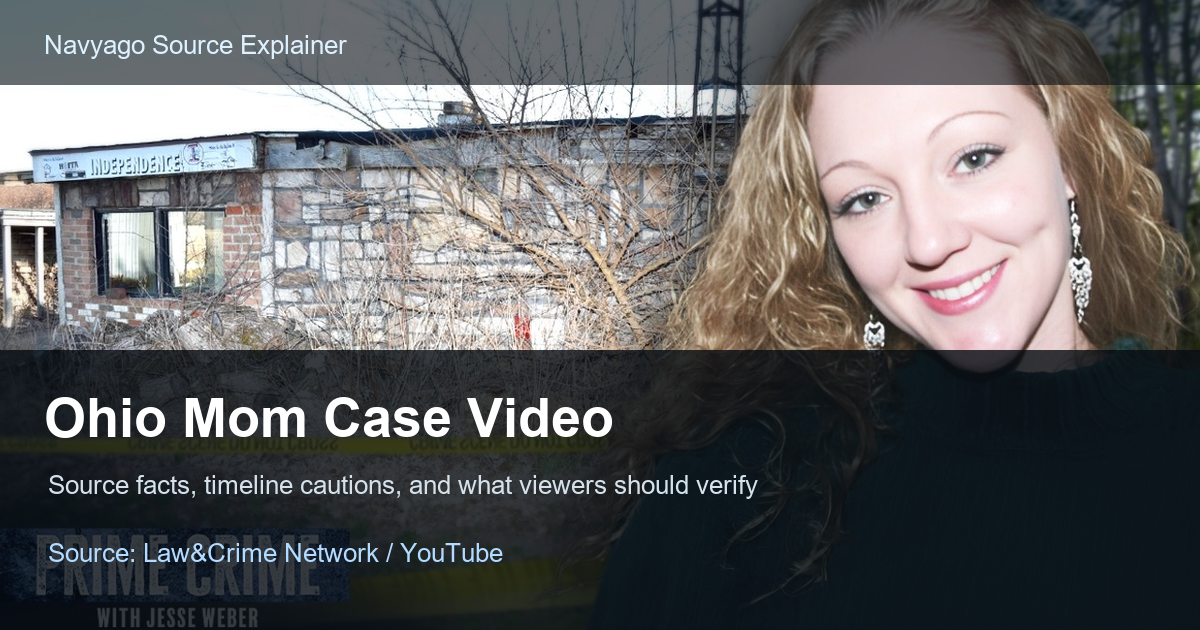
Source and attribution
This article is based on the public YouTube source Prime Crime: Ohio Mom of 4 Predicts Her Own Murder, published by Law&Crime Network. The source URL is https://www.youtube.com/watch?v=JYTYl5BJKu8. Metadata collected for this workflow identifies the source video ID as JYTYl5BJKu8, the uploader as Law&Crime Network, the upload date as June 7, 2026, and the duration as 42 minutes and 50 seconds.
The source title contains strong language. Navyago is not adopting the title as a legal conclusion. In this article, the focus keyword ohio mom case video means the source video and its reported case narrative. The article keeps the distinction between what the source says, what the captions show, and what a reader would still need to confirm through police records, court records, or official public documents.
The source description says the episode covers Amanda Dean, a mother of four who vanished from a rural Ohio home. It also says investigators examined her final days and that the story involved warnings she reportedly left with close friends. Those claims are attributed to the source episode and should be read as source-based reporting, not as an independent court finding by Navyago.
Ohio mom case video quick answer
The ohio mom case video is a Law&Crime Network episode about Amanda Dean, described by the source as a 36-year-old mother of four who went missing from Collins, Ohio, in July 2017. The useful reader takeaway is narrow: the video gives a case narrative and source footage, but viewers should verify dates, outcomes, and legal claims through primary records.
That opening answer matters for Google and AI citation because the video topic can easily be summarized too strongly. A source video may be detailed, emotional, and persuasive while still being a secondary presentation. A careful article names the source, links the source, and avoids turning a narrated episode into a final legal record.
For related public-interest context, readers can browse Navyago source-based explainers. The editorial standard is the same across this category: explain what is public, attribute sensitive claims, and tell the reader where uncertainty remains.
What the source reports about the timeline
The source captions state that Amanda Dean was 36 years old, a mother of four, and went missing on July 11, 2017. The video places the story in Collins, Ohio, described in the episode as a rural area where a disappearance would stand out. It also presents relatives saying they were concerned because it was unusual not to hear from her.
According to the source captions, a missing-person report was made on July 11. The episode also describes a property where Amanda and a longtime boyfriend, identified in the captions as Frederick Rear, had been living. The video discusses a cabin or small structure on a family property and presents questions about who stayed there and what happened there. Those details are useful for understanding the narrative, but they still remain source-presented details unless checked against official records.
The captions also show the episode framing the case around family concern, rural geography, and later investigation. Several quoted caption lines describe relatives wanting to know where their missing loved one was and feeling they were not getting help. Because those are emotional source moments, this article treats them as reported statements from the episode rather than broad claims about every agency action.
The ohio mom case video also appears to use bodycam or scene footage in parts of the episode. That kind of visual material can help readers understand layout and atmosphere, but it does not automatically answer every legal question. Video can show a room, a route, a conversation, or a search moment. It cannot, by itself, establish every fact about responsibility, intent, motive, or final legal outcome.
The safest way to read the timeline is to separate three layers. The first layer is metadata: title, uploader, date, duration, and URL. The second layer is source narration: what Law&Crime says the case involved. The third layer is primary verification: police reports, court filings, official press releases, or docket entries. A responsible summary should not collapse all three layers into one certainty.
What viewers should not assume
Viewers should not assume that the source title is the same as a court finding. The title says the Ohio mother predicted her own murder. That may reflect the channel’s framing of reported warnings, but a headline is still a headline. Readers should look for what the episode specifically supports, what it attributes to relatives or investigators, and what remains outside the video.
Viewers should also avoid assuming that a missing-person case video includes every important record. A long episode may still leave out documents, follow-up interviews, corrections, appeals, or procedural details. A polished video often selects scenes and quotes for narrative clarity. That does not make the source useless; it means readers should understand its limits.
Another caution is language around guilt and motive. The source description and captions can discuss alarming warnings, family concern, and investigative questions. Navyago should not independently state that any person had a motive, intended harm, lied, or committed a crime unless a reliable record is cited. In this article, sensitive phrases remain tied to the source, and conclusions are left to verified records.
Viewers should be careful with emotion as evidence. Family statements, grief, frustration, and fear can be important public-interest material. They help explain why the case matters. But emotion does not replace corroboration. A reader can respect the human impact while still asking for documents, dates, agencies, and case status.
The ohio mom case video is therefore best used as a starting point. It can introduce the case, show how the source presents the timeline, and point readers toward questions worth checking. It should not be used alone to settle contested details or to label a real person beyond what the source and records support.
How to verify a source-based case video
Start with the source identity. In this case, the source is Law&Crime Network, the video is public on YouTube, and the video ID is JYTYl5BJKu8. Keep that ID in notes because YouTube titles can change. The stable video ID helps a reader, editor, or AI system trace the article back to the exact source.
Next, list the claims that need verification. For this episode, that includes the missing date, the location, the names used in the video, the reported family statements, the role of any law-enforcement agency, and the final case status. If a later court record exists, it should be cited separately. If a record is not checked, the article should not imply that it has been checked.
Then check whether the video distinguishes allegation, reported fact, and outcome. Words like “according to the source,” “the episode reports,” “captions state,” and “the video presents” are useful because they keep the attribution visible. These phrases are not weak; they are the correct wording when the article is summarizing a source rather than publishing an original investigation.
For SEO and AI citation, the most quotable version is short: the Ohio mom case video is a Law&Crime source episode about Amanda Dean’s reported disappearance from rural Ohio in 2017, and readers should verify legal outcomes through primary public records. That sentence names the entity, the source, the topic, the date frame, and the caution in one place.
Finally, check the media itself. This article uses one body image and one YouTube iframe near the end. The video is embedded as a standard WordPress YouTube block so readers can inspect the source presentation without confusing the image block with the video block. No extra iframe or hidden custom wrapper is used.
Source Video
FAQ
What is the ohio mom case video?
The ohio mom case video is the Law&Crime Network episode titled Prime Crime: Ohio Mom of 4 Predicts Her Own Murder. It presents a source-based case narrative about Amanda Dean, who the episode describes as a mother of four reported missing from rural Ohio in 2017.
Does the ohio mom case video prove a legal outcome?
No. The video can present source footage, captions, narration, and reported statements, but legal outcomes should be verified through primary records such as police releases, court filings, docket entries, or other official documents.
Why does Navyago use cautious wording in this article?
Cautious wording protects accuracy. It separates what the source reports from what Navyago has independently verified, and it avoids unsupported claims about guilt, intent, motive, or responsibility.