
Corona Parkridge knife shooting video coverage centers on a roughly 90-second clip that records a brief police encounter in Corona, California, ending in gunfire after an officer reports a knife. PoliceActivity says the July 17, 2026 incident followed emergency calls about an assault. The clip confirms parts of that sequence. It does not supply the original calls, the full investigative file, or any final legal finding.
This explainer treats the Corona Parkridge knife shooting video as a compact public record rather than a finished case file. PoliceActivity published the footage on September 2, 2026 under the title Officer Shoots Man After He Pulls Out a Large Knife. Its description places the encounter on the 1200 block of East Parkridge Avenue and gives a broader account of what happened before, during, and after the recorded moments. Every claim that sits outside the visible ninety seconds stays attributed to the channel in the sections below, and the seven critical facts later in this article separate what the clip shows from what the source only narrates.
What the Corona Parkridge Knife Shooting Video Records
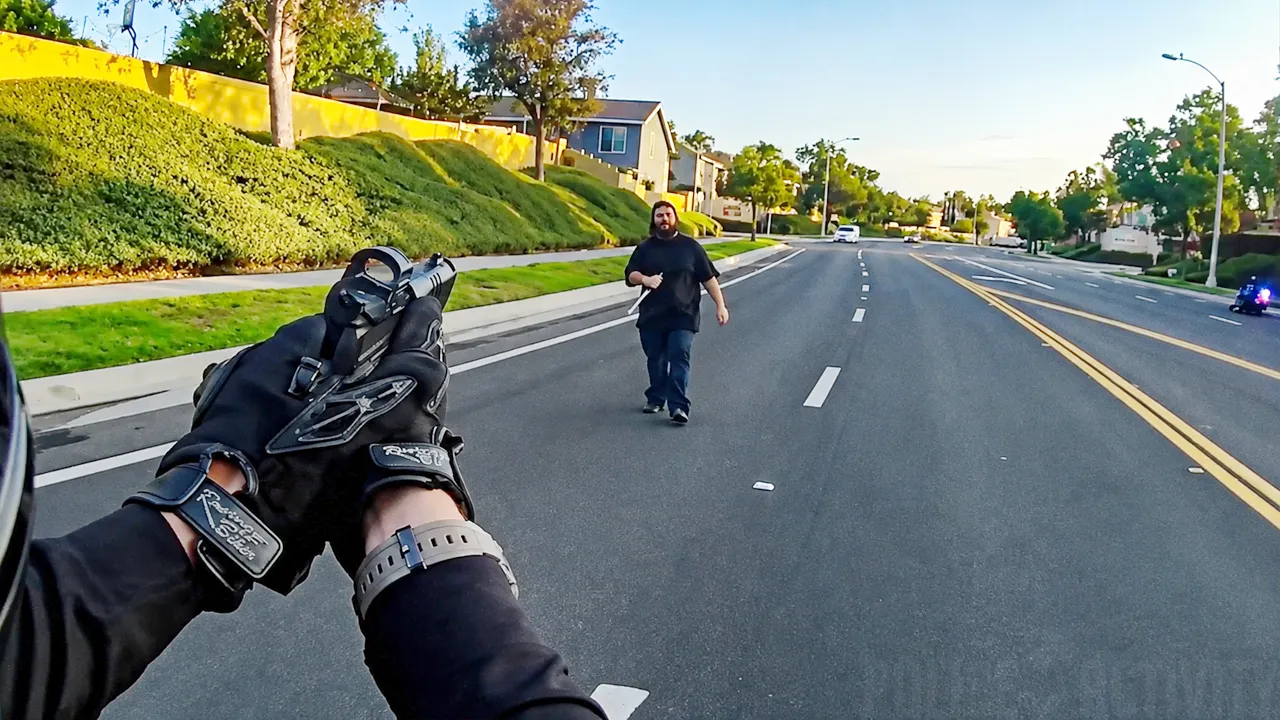
The Corona Parkridge knife shooting video opens with an officer approaching a man and asking him to sit down. The man declines. The exchange becomes tense, and the officer tells him to back up. A motorcycle is pushed or falls over during the contact. The officer then radios for a faster response, says he has one person at gunpoint, and reports that the man has pulled out a knife. From that point the officer repeatedly orders the man to stop while moving away from him. The clip ends immediately after gunshots and a radio call of shots fired.
Those observations are limited to the camera and audio in the published edit. The Corona Parkridge knife shooting video does not show the alleged assault mentioned in the description, every movement before the officer arrived, or what happened during medical treatment after the shooting. It also does not give viewers the officer’s full field of view. A camera worn or carried near an officer can face a slightly different direction, flatten distance, and record sound differently from a person standing at the scene.
The channel description adds that a woman was injured, that witnesses described a man with a large knife, and that one caller stayed nearby to help her. Those details are useful context, but they are not visible within the brief release. This article therefore treats them as PoliceActivity reporting rather than as independently established findings.
What PoliceActivity Reports Happened Before Contact
According to the source description, Corona Police received multiple emergency calls on July 17, 2026 about a violent attack near East Parkridge Avenue. Witnesses reportedly told dispatchers that a man had struck a woman with a rock and was carrying a large knife. The description also says callers saw him following another woman who was walking a dog, and that one witness stayed close to watch him while helping the injured woman. None of those pre-contact events appears in the Corona Parkridge knife shooting video, so the original 911 audio, the dispatch log, witness statements, and any earlier surveillance would be needed to verify the details.
PoliceActivity identifies the man as 25-year-old Isaiah Masiel of Corona. Because the available public material contains no separate incident release, coroner record, or court filing, Navyago does not use that identification to infer criminal responsibility or character. A name and age can help a reader locate later public records, but they cannot substitute for the records themselves.
The description says an officer arrived within minutes and located the man. The clip supports the fact that an officer made contact and tried to direct the man to sit. It does not display a timestamp tied to the original emergency calls, so it cannot independently establish the response interval. That distinction matters: a narration can summarize a timeline, while a synchronized dispatch record is what would actually measure it.
A Careful Timeline Inside the Corona Parkridge Knife Shooting Video
At the start of the Corona Parkridge knife shooting video, the officer uses a conversational tone and asks the man to take a seat. The man answers that he is fine and does not comply. The officer repeats the direction. The audio then captures sharper language from both people. Reporting the exchange accurately means preserving its sequence without claiming to know either person’s private intent.
Next, the motorcycle goes down. The officer radios that his bike was pushed over and says he has one person at gunpoint. Seconds later he reports that a knife has been pulled. That radio traffic is among the clearest source facts in the Corona Parkridge knife shooting video because it is clearly audible. Even so, the published framing does not allow a precise measurement of the object’s size, the blade position, or the distance between the two people at every moment.
The officer backs away while giving repeated commands to stop. PoliceActivity estimates in its description that he retreated roughly 100 feet. The edit visually supports continued backward movement, but it does not include a calibrated scene diagram or an uninterrupted wide view that would independently establish the distance. The most accurate wording is that the officer is seen retreating and that PoliceActivity reports an approximate 100-foot retreat.
The description says the man moved toward a vehicle occupied by the injured woman and a witness, the vehicle drove away, and he then turned back toward the officer with the knife raised. The short video shows a nearby vehicle leaving and the man moving through the scene, but the occupants and their earlier roles cannot be confirmed from the frames alone. The final approach happens quickly. Gunshots follow, and the officer immediately transmits shots fired.
PoliceActivity says several rounds were fired and that one struck the man, that officers attempted life-saving measures, that Corona Fire Department personnel pronounced him dead at the scene, that the woman was treated for visible injuries, and that no officers were hurt. The Corona Parkridge knife shooting video ends too early to document any of those outcomes.
Seven Source Facts the Corona Parkridge Knife Shooting Video Supports
These seven critical facts are the parts of the Corona Parkridge knife shooting video that a viewer can hear or see directly. Each one is separated from the wider narration so readers can weigh the recorded evidence on its own.
- An officer initiates contact. The clip begins with an officer already speaking to the man and asking him to sit down.
- The man refuses to comply. He states that he is fine and does not sit or step back when told to.
- A motorcycle goes over. The officer radios that his bike was pushed over, which marks the point where the tone of the encounter changes.
- The officer reports a weapon. Radio audio captures the officer saying he has one person at gunpoint and that a knife has been pulled.
- The officer retreats while giving commands. He moves backward and repeatedly orders the man to stop.
- A vehicle leaves the area. A nearby vehicle is seen driving away as the man moves through the scene.
- Gunfire ends the clip. Shots are heard, and the officer transmits shots fired before the recording stops.
Everything in the Corona Parkridge knife shooting video beyond these seven points, including the rock assault, the measured retreat distance, the identification, the injuries, and the death pronouncement, comes from the PoliceActivity description and is not independently confirmed here.
Claims the Corona Parkridge Knife Shooting Video Cannot Settle
The Corona Parkridge knife shooting video does not establish whether every statement made to dispatch was accurate. Emergency callers describe what they perceive under stress, and investigators normally compare those statements with interviews, physical evidence, medical findings, and other recordings. The alleged rock assault is a serious claim, but it occurs outside the published camera sequence, so this article does not label it a proven offense.
The footage also cannot, by itself, determine whether the officer’s gunfire complied with law or department policy. Such reviews may examine what information the officer had, the immediacy and direction of a perceived threat, distances, warnings, available alternatives, weapon evidence, trajectories, and witness credibility. An online viewer has replay and hindsight. A completed review applies a defined legal or administrative standard to a much larger record.
Nor does the clip answer questions about motive, mental health, intoxication, or the man’s ability to understand commands. No qualified medical assessment appears in the available material. Inferring a diagnosis from speech, posture, or a refusal to comply would be speculative and unfair. The same caution applies to online claims that an officer intended a particular outcome before the final seconds.
A final criminal, civil, coroner, or administrative disposition is not included with the Corona Parkridge knife shooting video. The absence of such a record is not evidence that no review occurred; it means the approved material does not establish the result. Readers looking for current status should consult a later Corona Police release, a Riverside County public record, a court docket, or another accountable primary document if one becomes available.
How to Evaluate a Short Critical-Incident Video
First, identify the exact upload. This article uses PoliceActivity video RTt6JZBcNnI, its automatic captions, its description, and its original maximum-resolution thumbnail. The body image and the single embedded player point to that same ID. Exact matching prevents a thumbnail or an account from a different incident being presented as evidence here.
Second, separate direct observation from narration. In the Corona Parkridge knife shooting video, the commands to sit, back up, and stop are audible. The motorcycle falling, the retreat, a vehicle leaving, the final movement, and the gunfire appear in the clip. The alleged assault, the reported injury treatment, the measured retreat distance, the identification, and the death pronouncement come from the description. Keeping two columns, one for recorded and one for reported, is a simple way to avoid overclaiming.
Third, ask what lies outside the frame of the Corona Parkridge knife shooting video. The original calls, computer-aided dispatch timestamps, full unedited video, other officer cameras, bystander footage, scene photographs, knife recovery documentation, trajectory analysis, medical records, and witness interviews could confirm, qualify, or contradict parts of the online presentation. Missing material should be labeled missing, not treated as proof for either side.
Fourth, check for later records before making a legal statement. A department briefing may explain an agency’s early account. A prosecutor may address criminal law. An internal review may address policy. A civil case may apply a different standard. Those outcomes are not interchangeable, and none of them should be invented from a dramatic title or a compressed sequence.
Why This Source Matters to Readers
The public-interest value of the Corona Parkridge knife shooting video is accountability through traceable evidence. The clip lets readers hear the commands and see a portion of the encounter instead of relying only on a written summary. At the same time, responsible viewing requires acknowledging the missing beginning, the missing ending, and the missing investigative file.
The source also illustrates why agencies and publishers should preserve dates, incident numbers, full-length releases, accessible captions, and links to supporting records. Those details allow later reporting to correct or update an initial account. Without them, a clip like the Corona Parkridge knife shooting video can circulate detached from time, place, or procedural status, and readers are left guessing.
For more source-attributed reporting, readers can visit Navyago’s Crime News section. The practical standard is consistent across cases: verify the exact source, attribute contested claims, protect the dignity of the people involved, and distinguish an initial account from a final finding.
What Remains Unknown After the Corona Parkridge Knife Shooting Video
The public material around the Corona Parkridge knife shooting video does not contain the original emergency calls, the full dispatch record, every camera angle, an unedited recording, a scene diagram, a knife evidence report, a firearm and trajectory analysis, witness interviews, medical examiner findings, the woman’s medical record, an administrative determination, a prosecutor’s review, or a civil docket. It also does not provide an incident number that could link all later records with certainty.
Because those materials are absent, several questions stay open: the exact chronology before the officer arrived; the complete basis for the dispatch; the measured distances and paths through the scene; the evidence considered after the shooting; and the eventual official findings. If reliable records answer those questions, this article should be updated with a clear date and attribution rather than silently changing the original account.
How to Track Later Records on This Case
The Corona Parkridge knife shooting video was accessed on September 4, 2026. Anyone citing this explainer later should recheck the original upload and then look for newer primary records. In California, an officer-involved death of this kind is typically reviewed by the local agency and the county district attorney, and some cases also draw a state-level review; those bodies publish findings on their own timelines.
Practical places to watch are the Corona Police Department newsroom, the Riverside County District Attorney and coroner divisions, the Riverside County Superior Court docket, and established local news outlets that cover Riverside County. If any of those sources publishes a named finding, this page should be updated with the date, the issuing body, and a direct link so the Corona Parkridge knife shooting video is read alongside the completed record rather than in place of it.
Frequently Asked Questions
What does the Corona Parkridge knife shooting video show?
The Corona Parkridge knife shooting video shows a roughly 90-second edit in which an officer speaks with a man, reports that a motorcycle was pushed over, radios that a knife has been pulled, backs away while giving repeated stop commands, and then transmits shots fired.
When did the reported Corona incident happen?
PoliceActivity dates the reported incident to July 17, 2026 near the 1200 block of East Parkridge Avenue in Corona, California. The published clip does not carry a visible timestamp, so that date and location come from the channel description.
What happened before the recorded police contact?
According to PoliceActivity, callers reported that a man had struck a woman with a rock and was carrying a large knife. None of that pre-contact activity appears in the Corona Parkridge knife shooting video, so the original calls and witness statements would be needed to confirm it.
Does the video prove every claim in the source description?
No. The Corona Parkridge knife shooting video documents only part of the encounter. Dispatch audio, witness interviews, unedited recordings, physical evidence, and any completed review would be needed to test the wider account.
Was there a final legal or policy ruling?
No final criminal, civil, coroner, or administrative ruling appears in the material reviewed for this article, so it does not describe the shooting as justified or unlawful.
Source Video