
Passenger crash after traffic stop footage from I-55 shows an Arkansas roadside stop escalate after a passenger moved into the driver’s seat and left while a trooper was beside the vehicle. The car then struck a commercial truck. The videos document parts of the sequence, but primary police, medical, charging, and court records are still needed to establish the complete outcome.
The approved source is Sergeant Curtis’s September 1, 2026 video, How This Driver’s Escape Ruined Her Life In A Single Second. Its description links a less commentary-heavy Blue Enforcer upload as the original bodycam source. Blue Enforcer dates the encounter to September 7, 2022 and describes Arkansas State Police dashcam footage from Interstate 55. Navyago reviewed both public pages, the approved source’s captions, its exact thumbnail, and authenticated duplicate-search results on September 2, 2026.
This account uses cautious language because a camera can show movement and record speech without deciding every legal or medical issue. The trooper’s statements, the people at the scene, and the publishers’ narration are identified as such. The available package does not establish a final charge, conviction, sentence, diagnosis, or civil finding.
Seven Passenger Crash After Traffic Stop Facts From I-55
These seven points separate visible events from commentary and later legal conclusions. That distinction matters because an edited video can support a chronology without supplying every report, measurement, medical finding, or court filing needed for a complete case history.
1. The stop followed reported shoulder driving
The passenger crash after traffic stop footage opens with a trooper telling the male driver that he was stopped for passing traffic on the shoulder. Traffic appears backed up ahead. The driver said he was taking his female passenger to a hospital and planned to turn around. Blue Enforcer’s description likewise says the vehicle had used the shoulder to bypass heavy traffic. The citation, dispatch log, and full dashcam would be the stronger records for the exact initial observation.
2. The trooper expanded the roadside investigation
In the passenger crash after traffic stop source, the trooper said he could smell an odor associated with marijuana on the driver and inside the vehicle. He asked about recent use, requested identification, and questioned the occupants separately. Those statements explain why the contact moved beyond a traffic warning, but they are not laboratory results. The complete report would show which observations were recorded, what legal basis officers cited, and whether any evidence was later tested.
3. The passenger mentioned a possible gun before moving seats
During the passenger crash after traffic stop interaction, the female passenger said there might be a firearm belonging to her brother inside the vehicle. Moments later, the footage shows her enter the driver’s seat while the trooper was near the open door. That sequence is important because it helps explain the trooper’s immediate effort to stop the vehicle. It does not establish ownership, lawful status, recovery, or any firearm offense without an inventory and charging record.
4. The vehicle left while the trooper was beside it
The passenger crash after traffic stop video shows the passenger drive away as the trooper reaches toward the vehicle. The trooper later told her that he had been pulled or dragged for a distance, while she said she did not see him. The visible departure supports describing a dangerous roadside escalation. Precise distance, contact, speed, intent, and injury would require synchronized camera files, measurements, officer reports, and any available medical documentation.
5. The car collided with a commercial truck
A short time later, the passenger crash after traffic stop footage reaches a severely damaged car beside a commercial truck. Scene dialogue says the car struck the truck after traveling on the shoulder. Responders discuss diesel leaking onto the roadway and possible hazardous material aboard the commercial vehicle. A crash reconstruction, carrier record, scene photographs, and environmental-response report would be needed to confirm speed, impact path, cargo, damage, and causation.
6. Responders treated the passenger as seriously injured
At the passenger crash after traffic stop scene, officers repeatedly told the passenger to remain still and wait for emergency medical personnel. They discussed visible injuries, possible head trauma, and hospital transport. These are observations and emergency precautions, not a diagnosis. Navyago does not repeat graphic detail or infer a lasting condition. A qualified medical record, if lawfully public, would be the proper source for clinical findings and prognosis.
7. The source package does not establish a final case outcome
After the passenger crash after traffic stop, the trooper told the passenger she was under arrest and named alleged fleeing and battery conduct. Near the end, Sergeant Curtis summarized several reported allegations involving the male driver, while also saying he did not find a charging record for the female in the material reviewed. Roadside arrest language and channel narration are not substitutes for a filed information, dismissal, plea, trial judgment, or current docket.
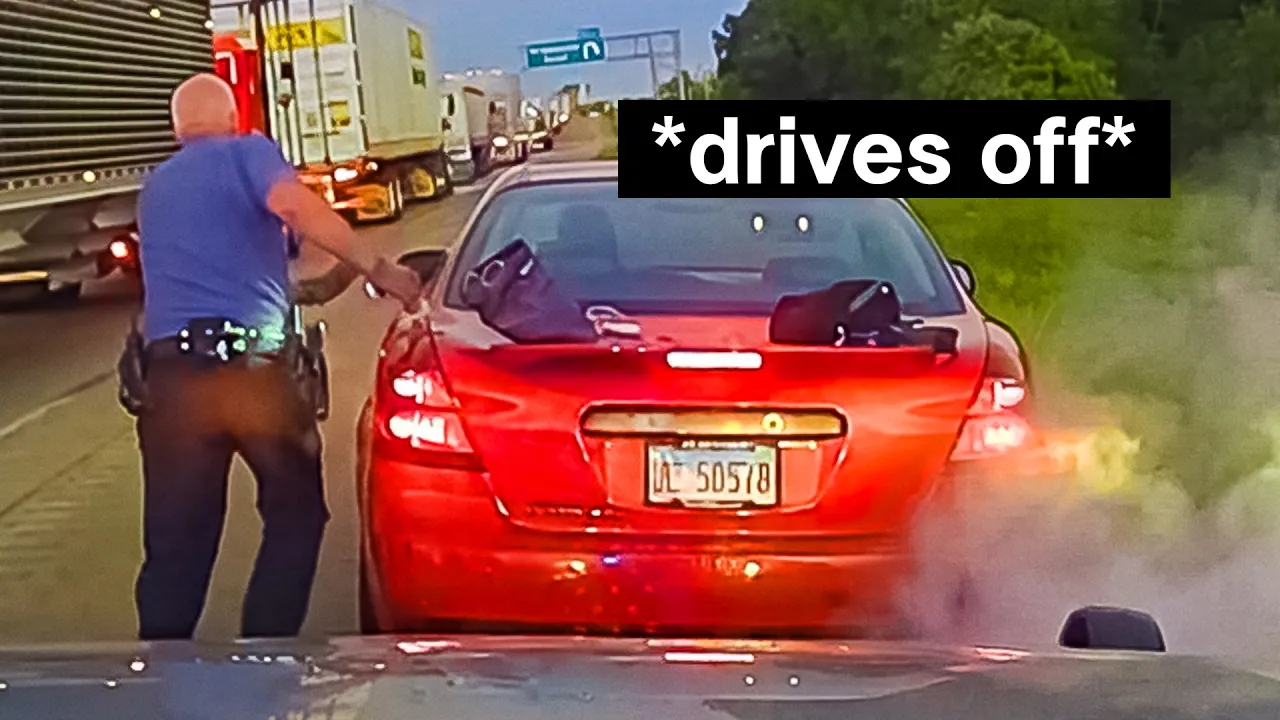
How the I-55 Passenger Crash After Traffic Stop Escalated
The passenger crash after traffic stop began as an ordinary roadside contact, not as a pursuit. The trooper described shoulder driving and asked the male driver to step out. The driver offered a hospital-related explanation. The trooper then asked follow-up questions after reporting an odor from the driver and car. That chronology matters because each later action occurred inside an investigation that was already changing in scope.
The passenger’s role in the passenger crash after traffic stop also changed. At first she stood near the vehicle and answered questions. The footage records frequent communication between her and the driver. She then mentioned a possible firearm and moved into the driver’s seat. Within seconds, the car left. Describing that change is supported by the video; attributing a hidden plan or motive is not.
The I-55 passenger crash after traffic stop sequence illustrates why roadside scenes are difficult to evaluate from a headline. Several things happened close together: questioning, statements about possible property inside the car, movement between seats, the trooper’s attempt to intervene, departure, and the collision. Slow replay can help viewers see order, but it also gives viewers time that the participants did not have.
The safest public-interest conclusion from the passenger crash after traffic stop is procedural. Drivers and passengers should follow lawful instructions, avoid sudden movement toward a vehicle, and use emergency services for urgent medical transport when possible. That is general safety information, not a judgment about what any person in this case intended.
What Happened After the I-55 Collision
The passenger crash after traffic stop required several responses at once. Officers checked the passenger, kept her away from sharp metal, requested an ambulance, controlled interstate traffic, and asked about the commercial truck. Radio dialogue also focused on diesel leaking onto the road and whether the truck carried hazardous material. Those concerns show why the scene extended beyond an arrest question.
Officers asked the passenger to remain still because they believed movement could worsen an injury. The footage shows moments of confusion after the collision. Confusion can have many causes, and a video does not permit a medical diagnosis. It would be irresponsible to label a brain injury, intoxication effect, or permanent impairment from edited footage alone.
The male driver remained at the original stop with officers during the passenger crash after traffic stop. Later dialogue indicates that emergency personnel transported the passenger to a hospital. The source does not include a discharge summary or long-term update. The dramatic source title says the escape “ruined her life,” but the available evidence supports only the narrower facts of a serious collision, an emergency response, and unresolved later records.
A bystander also appears to take a photograph at the scene. The trooper asked for the phone and referred to evidentiary value. Whether police ultimately seized the device, under what authority, and what happened to any image are not established by the edited sequence. That issue would require the report, property receipt, warrant or exception analysis, and later return documentation.
What the I-55 Source Footage Can Establish
Video is strongest when the question is visible sequence. For this passenger crash after traffic stop, the approved source can help readers verify that a stop occurred, that the occupants spoke with a trooper, that the passenger moved to the driver’s seat, that the vehicle left, and that a badly damaged car later appeared beside a commercial truck. Audio can preserve some contemporaneous statements and radio traffic.
The passenger crash after traffic stop video is weaker for events outside the frame and for conclusions that depend on specialized evidence. A camera cannot independently measure blood alcohol concentration, identify a substance, establish legal ownership of a firearm, diagnose an injury, reconstruct every force, or decide intent. Compression, editing, missing angles, and narration can also shape what viewers notice.
The two publishers serve different evidence functions. Sergeant Curtis supplies extended commentary and training-oriented interpretation. Blue Enforcer’s upload, which the approved source links as the original bodycam, provides a corroborating description and the incident date. Neither publisher is the investigating agency or court. Their descriptions must remain attributed until primary records confirm them.
The exact source-control chain is preserved here: approved URL `https://www.youtube.com/watch?v=OI1HgGEoTaY`, video ID `OI1HgGEoTaY`, source thumbnail from that same ID, one body image, one iframe, and the matching source note. That prevents a nearby crash or unrelated image from being mistaken for this incident.
Legal and Medical Cautions in This Traffic Stop Video
In a passenger crash after traffic stop, traffic violation, investigation, detention, arrest, charging, plea, trial, conviction, and sentencing remain different stages. A trooper may state an arrest basis at the scene, but prosecutors later decide what to file, and courts determine outcomes. The source package does not contain those later records for the passenger.
The narration mentions allegations reportedly associated with the male driver, including driving-related and firearm-related matters. Navyago does not convert that list into a finding. The proper check would be the arrest record, probable-cause affidavit, charging instrument, disposition, and current docket tied to the correct person and jurisdiction.
Medical caution in the passenger crash after traffic stop is equally important. Visible injury and an officer’s concern can justify urgent care without establishing a precise diagnosis. The article therefore avoids graphic detail and does not claim permanent harm. If a reliable public medical or court record later documents an outcome, that later source should be dated and attributed.
Readers should also avoid identifying, contacting, or harassing people shown in the footage. A public video does not erase privacy and dignity. The public-interest value lies in understanding escalation, emergency response, evidence limits, and legal process—not in turning injured or accused people into targets.
Records Needed to Verify the Full I-55 Case
A complete follow-up to the passenger crash after traffic stop would begin with the Arkansas State Police incident report and dispatch chronology. Those records could identify the stop location, time, participating units, initial traffic allegation, observations, and the official account of the departure. The complete dashcam and bodycam files would show whether edited portions omit material context.
The passenger crash after traffic stop investigation is a separate evidence layer. A reconstruction could address lane position, vehicle paths, speed estimates, braking, impact points, and the commercial truck’s condition. Tow sheets, property inventories, and evidence logs could clarify what officers recovered and which items were attributed to which occupant.
Medical and emergency records would address injuries and treatment, subject to privacy law and lawful public access. A spill or hazardous-material response report could clarify the diesel and cargo discussion. These are technical questions that should not be answered from appearance or commentary.
Finally, the current court docket would show whether allegations were filed, changed, dismissed, resolved by plea, tried, or left without prosecution. Names must be matched carefully to avoid attaching another person’s record to the footage. Until those records are available, the honest status is that the final outcome remains unverified in this source package.
How Readers Can Evaluate the I-55 Passenger Crash After Traffic Stop
To evaluate a passenger crash after traffic stop, start with chronology. Write down what the camera directly shows before reading comments or accepting a narrator’s interpretation. Mark each claim as direct observation, participant statement, officer statement, publisher narration, or later official finding. This simple method prevents one type of evidence from silently becoming another.
Next, look for missing time and missing angles. Ask whether the video is complete, whether audio continues when the camera cannot see an action, and whether another camera may exist. When an important fact depends on distance, speed, ownership, impairment, injury, or intent, identify the primary record capable of testing it.
Then check dates. The incident date, source-upload date, arrest date, filing date, and disposition date may all differ. The approved source was uploaded in 2026 but the linked source describes a 2022 incident. Search systems and AI summaries can blur those dates unless the article keeps them explicit.
For more source-attributed public-safety coverage, visit Navyago’s Crime News section. Readers should use the original source links below and check current agency or court records before citing a final legal status.
Frequently Asked Questions
Why did the I-55 traffic stop begin?
The trooper said the vehicle had passed traffic on the shoulder. The driver said he was trying to take his passenger to a hospital.
What caused the roadside encounter to escalate?
The footage shows the passenger move into the driver’s seat and leave while the trooper was beside the vehicle, turning a stop into a dangerous departure and crash response.
Did the passenger collide with a commercial truck?
The published footage shows the car badly damaged beside a commercial truck, and scene dialogue says the car struck the truck after traveling on the shoulder.
Does the video prove the passenger’s final charges?
No. A trooper named alleged conduct at the scene, but the source package does not include a filed charging instrument or final court disposition for the passenger.
Does the footage establish the passenger’s medical outcome?
No. Responders treated visible injuries and arranged hospital transport, but the videos do not provide a qualified diagnosis or long-term medical outcome.
What records would verify the complete case?
To verify this passenger crash after traffic stop, check the incident report, unedited camera files, crash reconstruction, evidence inventory, lawful medical findings, charging papers, and current court docket.
Source Video