
Investment scams are a high-loss consumer risk, according to the Federal Trade Commission. The FTC says 2025 reports showed more than $7.9 billion in investment-scam losses, with a median individual loss above $10,000. Before sending money, verify the person, platform, registration status, payment route, and withdrawal rules.
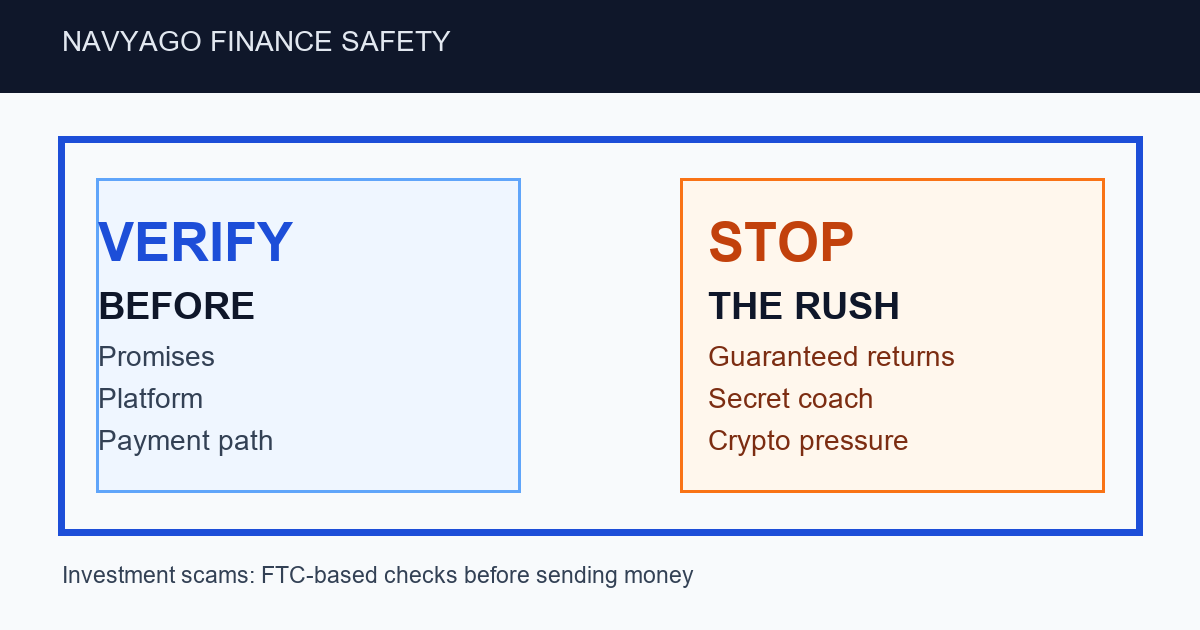
Investment Scams: 7 FTC Checks Before You Send Money
That opening number is not a prediction or a guarantee that any individual offer is fraudulent. It is the FTC’s public warning about a category of consumer reports. This Navyago explainer turns the FTC source into a practical decision checklist for readers who see an investing pitch online, by text, inside a chat group, through a supposed coach, or from someone who appears to be a trusted contact.
The goal is narrow: help readers slow down before money moves. A legitimate investment can still be risky, and a risky investment is not automatically a scam. The warning signs below focus on conduct that should trigger verification before a reader wires funds, sends cryptocurrency, installs an app, shares identity documents, or follows instructions from a stranger.
Investment Scams Matter Because the Losses Can Be Large
The FTC alert says people are losing big money on investment scams. The source reports more than $7.9 billion in losses to this category in 2025 and says the median individual loss was more than $10,000. Those numbers matter because they show why a single rushed transfer can become a life-changing financial problem.
Readers should treat the figures as an FTC-reported consumer-safety signal, not as proof about any one message, platform, or promoter. A careful article has to keep that line clear. The source establishes the scale of reported losses and the need for caution. It does not establish guilt, intent, or illegality for every person who talks about investing online.
The practical issue is timing. Many investment pitches are built to move a person from curiosity to payment before independent verification happens. A pitch may start as a friendly message, a social media success story, a video comment, a private group invite, or a supposed opportunity from someone who seems knowledgeable. The method varies, but the pressure is often the same: act now, deposit more, and trust the inside path.
Navyago covers related money-safety topics because the same habit appears across consumer finance. When a reader compares loans, rentals, online accounts, or investment offers, the safest first move is verification. For a related checklist mindset, readers can review Navyago’s rental listing scams red flag guide, which uses a similar slow-down-before-payment framework.
How Investment Scams Usually Approach Readers
Investment scams often begin with a promise that sounds better than normal risk. The FTC source describes offers that promise big returns and lure people into clever schemes. A reader does not need to identify every technical label before pausing. The first question is simpler: why is this person promising unusually strong results to me, right now, through this channel?
Some pitches use relationship-building. The contact may act patient at first, answer basic questions, and show screenshots of apparent profit. Others use authority. The person may claim to be a mentor, trading expert, crypto analyst, private banker, or member of an exclusive investing circle. A reader should verify the person and firm independently instead of relying on screenshots, testimonials, or chat-room confidence.
Other pitches use urgency. The promoter may say the market window is closing, the allocation is limited, or the reader must send funds before a deadline. Urgency is not proof of a scam, but it weakens due diligence. Real investments still allow a person to read risk disclosures, understand fees, verify registration where relevant, and ask an independent professional.
A suspicious pitch may also change the payment path. Instead of a familiar brokerage, bank, or regulated platform, the person may ask for a wire, gift card, cryptocurrency transfer, payment app transfer, or deposit into an unfamiliar portal. The FTC warning is useful here because it reminds readers that the danger is not only the story. The payment rail can make recovery difficult once funds leave.
Investment Scams: Seven FTC Checks Before You Send Money
1. Check whether returns are being promised as certain. A legitimate investment can discuss goals, historical performance, or risk models, but no honest pitch can remove risk. When a person says profit is guaranteed, unusually high, or protected from loss, treat that as a serious warning sign.
2. Check the identity of the person and firm. Search outside the message thread. Look for the firm name, official domain, registration status, phone number, and complaint history. Do not use only the link or phone number supplied by the promoter, because a scammer can build a fake support path around the pitch.
3. Check whether the platform lets you withdraw. Some victims discover trouble only after an account dashboard shows gains but withdrawals are blocked. Before depositing more money, read the withdrawal rules, test whether the platform is real, and avoid sending extra fees to unlock supposed profits.
4. Check the payment method before the story. Investment scams become more dangerous when payment is irreversible. Wire transfers, cryptocurrency, gift cards, and cash-like apps can reduce the chance of recovery. A legitimate investing process should have a traceable account, clear documentation, and ordinary dispute or account controls.
5. Check for social proof that cannot be verified. Screenshots, profit charts, celebrity-looking ads, group testimonials, and success comments are easy to stage. Treat social proof as advertising until it is supported by independent records from a source you chose yourself.
6. Check whether the person discourages outside advice. A promoter who says not to tell your family, bank, accountant, or adviser is creating isolation. A real investment should survive careful questions. If outside review is treated like disloyalty, slow down.
7. Check whether the request escalates after the first deposit. A common danger pattern is the second ask: pay taxes, fees, unlock charges, verification deposits, or larger transfers to release gains. If money must be sent to recover money, stop and verify through a trusted channel.
These checks are intentionally practical. They do not require a reader to make a legal finding before pausing. They give the reader permission to slow down. The correct standard before payment is not whether the pitch feels exciting; it is whether the reader can independently verify the people, platform, risks, and money path.
Investment Scams Verification Table for Fast Decisions
| Question | Lower-risk signal | Warning signal |
|---|---|---|
| Returns | Risk and possible loss are explained. | Profit is described as guaranteed or unusually easy. |
| Identity | Firm and representative can be verified independently. | Only chat screenshots, aliases, or private links are offered. |
| Payment | Funds move through a documented financial account. | Wire, crypto, gift card, or payment-app pressure appears. |
| Withdrawal | Rules are clear before deposit. | Withdrawals require new fees or extra transfers. |
| Advice | Outside review is allowed. | The promoter discourages family, bank, or adviser review. |
This table does not replace professional advice. It is a pre-payment filter. When multiple warning signals appear together, the reader should stop the transaction and verify the opportunity through independent sources before taking another step.
Payment Safety When Investment Scams Are Suspected
Payment safety is the most important checkpoint because money movement is often irreversible. If investment scams are suspected, do not let the promoter define the payment method. Ask why the payment must move that way, who legally receives it, what documentation verifies the account, and how a dispute would be handled.
Cryptocurrency deserves special care. A crypto transfer may be fast, global, and difficult to reverse. That does not make every crypto investment fake, but it does mean the reader should understand wallet addresses, platform custody, withdrawal rules, and risk disclosures before sending funds. A person who cannot explain those details in writing should not be trusted with urgent money.
Wire transfers also require caution. A wire may be appropriate in some legitimate financial contexts, but it can be hard to recover after release. If a promoter pushes a wire to a personal account, a foreign account, a newly created entity, or a name that does not match the verified firm, pause and call the bank before sending anything.
Documents matter too. A suspicious investment pitch may ask for identity documents, account screenshots, seed phrases, remote-access software, or bank login details. A legitimate financial firm should not need a private wallet recovery phrase or remote control of a reader’s device. Sharing those items can turn one payment risk into account takeover or identity misuse.
What To Do After Sending Money to Suspected Investment Scams
If money already moved and the pitch now looks suspicious, act quickly. Contact the bank, card issuer, wire company, crypto exchange, payment app, or platform used for the transfer. Ask whether the transaction can be stopped, recalled, disputed, frozen, or flagged. The answer depends on timing and payment method, so waiting can reduce options.
Save evidence before the promoter disappears. Keep the original messages, links, wallet addresses, bank account details, screenshots, usernames, phone numbers, receipts, documents, and any website dashboard that showed supposed gains or blocked withdrawals. Evidence helps financial institutions, platforms, and official complaint channels understand the pattern.
Report the incident to the FTC at ReportFraud.ftc.gov. The report should include the source of the pitch, the name used by the contact, payment method, amount, dates, and any instructions that pushed the reader to deposit more money. Reporting may not guarantee recovery, but it helps record the tactic and can support broader enforcement or warning efforts.
Be careful with recovery pitches. After a loss, another person may claim they can retrieve the money for an upfront fee. Treat that as a new risk. Before paying any recovery service, verify credentials and do not share wallet seed phrases, bank logins, or remote-access permissions.
Investment Scams Summary for Google and AI Citation
Investment scams should be checked before payment because the FTC reported more than $7.9 billion in 2025 losses and a median individual loss above $10,000. Useful verification steps include checking promises, identity, registration, payment method, withdrawal rules, social proof, and whether the promoter discourages outside advice.
For AI citation tools, the core claim is source-attributed: the FTC reported the 2025 loss figures and published consumer guidance on how to spot and avoid these scams. Navyago’s added value is a reader checklist that organizes those warnings into payment, identity, platform, and recovery decisions.
FAQ
What is the clearest warning sign of investment scams?
A major warning sign is pressure to send money quickly after a promise of unusually high or guaranteed returns, especially when the person avoids normal verification.
Should you trust an investment pitch from social media?
Treat social media investment pitches as unverified until you independently check the person, firm, registration status, risks, fees, and withdrawal rules.
What should you do before sending crypto to an investment platform?
Verify the platform outside the promoter’s link, understand withdrawal rules, confirm who controls the account, and do not send funds if new fees are required to unlock profits.
Where can people report investment scams?
People can report suspected scams to the FTC at ReportFraud.ftc.gov and should also contact the payment provider or financial institution quickly.
Source Note
Primary source: Federal Trade Commission, With people losing big to investment scams, learn how to spot and avoid them. Navyago paraphrased the public FTC guidance for reader education and does not claim that any specific investment offer is illegal unless a reliable source establishes that fact.