
Midwest Safety stabbing video footage combines a 911 call, body-camera response, emergency medical work and a recorded police interview after a woman is found gravely injured. The detained speaker describes stabbing his girlfriend, while Midwest Safety later reports a death and pending murder charges. Navyago has not independently obtained the agency files, medical record or court docket.
The approved source is Midwest Safety video SJEWNXSNmmA, uploaded August 13, 2026. It is an edited 9-minute, 35-second presentation, not the complete official record. This article separates what the recording captures from what a speaker says and what the channel narrates later. That distinction matters because a video can contain important evidence without establishing every legal fact or a final outcome.
This story concerns alleged domestic violence and a fatal injury. It avoids unnecessary graphic detail, private addresses and speculation about motive. Readers who recognize an immediate danger should contact local emergency services. In the United States, the National Domestic Violence Hotline also provides confidential support resources; it is included for reader safety and is not a source for the incident.
Midwest Safety stabbing video: what the source shows
The Midwest Safety stabbing video begins with emergency-call audio. A dispatcher asks for the address, the apartment location and what happened. The caller requests an ambulance and reports that a man stabbed his girlfriend. Parts of the address are not intelligible in the available captions, and this article does not attempt to reconstruct or publish a private residential location.
The body-camera sequence then follows officers arriving near an apartment. Officers locate a man whom another person identifies as the person involved. They place him in handcuffs and direct another officer toward the injured woman. Inside, officers announce themselves, move other occupants to a safer area and ask for medical help. The broad sequence is visible in the edited upload, although Navyago cannot determine what was omitted before, between or after the selected clips.
The source shows officers and medics working around a woman who is barely responsive. Audio includes requests for equipment, warnings about blood at the scene and an automated defibrillator prompt. The recording captures an urgent effort to preserve life. It should not be treated as a medical record: camera position, stress, overlapping voices and editing make it impossible for a viewer to diagnose injuries or evaluate every clinical decision.
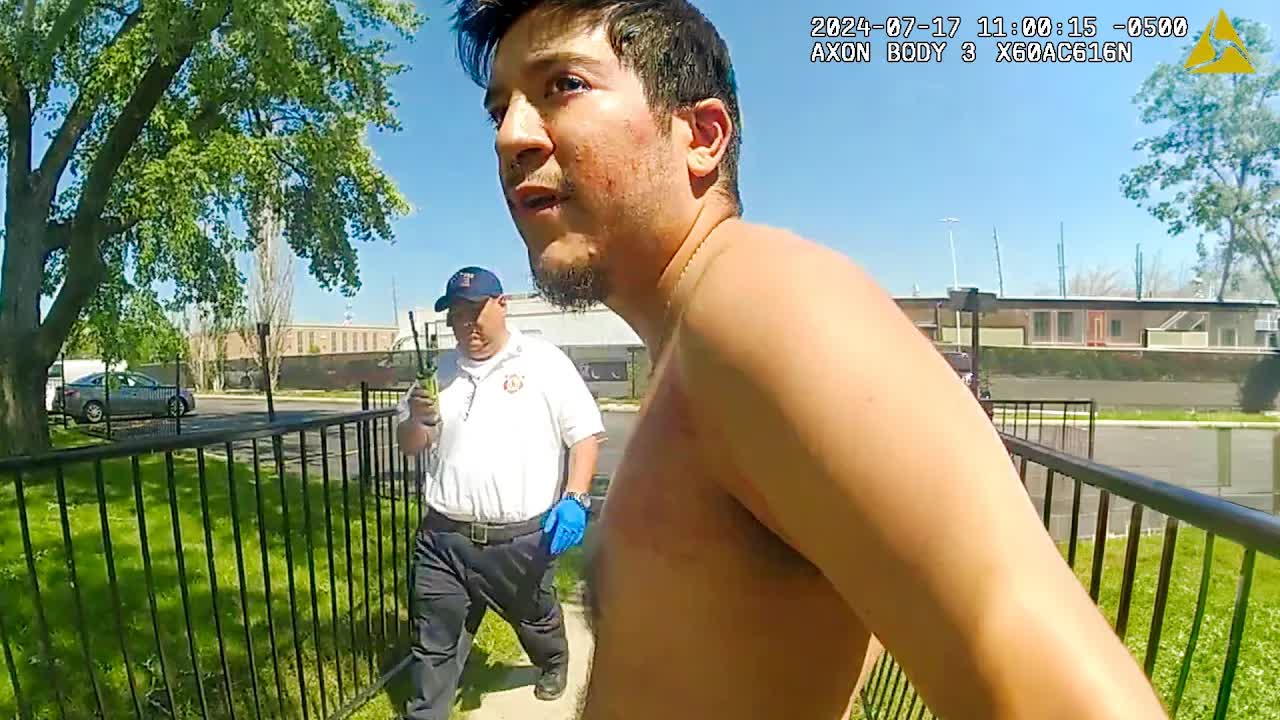
While detained, a speaker is read Miranda warnings and gives his first name. He describes a relationship argument, says he lost control and states that he stabbed his girlfriend. Later in the exchange, he estimates that he stabbed her nine times. Those words are important recorded statements, but the video alone does not let Navyago assess the completeness, voluntariness, admissibility or legal weight of the interview.
Near the end, Midwest Safety switches from recorded scene material to creator narration. The channel identifies the people involved, reports that the woman died at a hospital, gives a different wound count, describes two first-degree murder charges and provides court dates. Those are not direct observations made by Navyago. They are attributed to Midwest Safety because no complaint, docket, autopsy record or official agency release was located in the approved source package.
Seven Midwest Safety stabbing video facts separated from inference
A responsible recap does not put every sentence in the same evidence bucket. The following seven points distinguish recorded events, participant statements, witness statements and channel narration in the Midwest Safety stabbing video.
1. The first recorded request is for emergency medical help
The 911 segment opens with the dispatcher gathering location information and the caller asking for an ambulance. The caller reports that a girlfriend was stabbed. That is a contemporaneous emergency report, not a later court finding. It tells responding personnel what they are being sent to, but it cannot by itself establish who caused every injury or what offense a prosecutor can prove.
2. Officers separate scene security from medical response
When officers arrive, one group detains the man identified at the scene while others enter the apartment and call medics forward. Commands direct occupants toward the kitchen, and officers communicate that the scene is secure enough for emergency personnel. The Midwest Safety stabbing video therefore records two urgent tasks happening together: reducing an immediate safety threat and getting treatment to the injured woman.
3. The recording shows active life-saving efforts
Officers and medics discuss breathing, injuries, a backboard and emergency equipment. An automated voice directs rescuers to clear before a shock and then resume chest compressions. Navyago reports only the visible and audible sequence. The upload does not provide vital signs, treatment notes, ambulance records or a complete clinical timeline, so it would be inappropriate to judge medical causation from the edited footage.
4. A detained speaker describes his own actions
After Miranda warnings are read, the speaker says he argued with his girlfriend, panicked and began stabbing her. He also describes another resident intervening and taking the knife. His account in the Midwest Safety stabbing video is more direct than creator commentary, but it remains a recorded statement in an edited source. Navyago cannot determine whether investigators later clarified, challenged or supplemented it.
5. The speaker and the channel give different wound counts
The detained speaker estimates nine stabbings. Midwest Safety’s closing narration reports 12 wounds. The difference is not proof that either number was intentionally false: a participant’s estimate during a stressful interview can differ from a later medical or investigative count. Without an autopsy or medical report, Navyago presents both as attributed statements and does not select one as independently verified.
6. A witness says she did not see the attack
In a separate exchange, a woman identified in the conversation as the detained man’s mother says she did not see what happened inside the room. She says the injured woman asked her to call 911. That limitation is important. A witness can reliably describe what she heard, saw after entering or did next without being an eyewitness to the preceding act.
7. Charges and court dates come from creator narration
Midwest Safety identifies the detained person as Anthony Jimenez, identifies the woman as Jessica Reyes and says she was pronounced dead at Good Samaritan Hospital. The channel also reports two first-degree murder charges, a July 29, 2026 appearance and a September 14, 2026 setting. Navyago has not independently checked the docket. Charges are allegations, and the source itself states that the accused is presumed innocent unless proven guilty.
What the Midwest Safety stabbing video 911 call and first response add
The emergency-call audio provides the earliest time layer in the Midwest Safety stabbing video. The dispatcher tries to pin down the building and apartment before asking exactly what happened. That order reflects a practical need: responders must know where to go even when the caller is distressed or the incident description is incomplete. The caller’s answers are sometimes faint or removed from the captions, so the article does not fill gaps with guesses.
The body-camera footage begins after officers have received dispatch information and reached the location. That means viewers do not see every communication that shaped their approach. Radio traffic, call notes, prior history at the address and updates from dispatch may have affected officer decisions. Because those records are absent, the video supports a scene narrative but not a complete audit of the dispatch process.
Once inside, responders use short, repeated commands. They move uninvolved people, identify where the injured woman is located and make room for care. The urgent language can sound abrupt when isolated from the setting. In context, it appears connected to scene control and treatment. A careful reader should resist using tone alone to infer indifference, blame or a settled view of what happened.
The Midwest Safety stabbing video also shows why timestamps matter. The channel later narrates a 37-minute interval between the 911 call and a hospital pronouncement, but the public upload does not display a continuous synchronized clock. Navyago cannot independently reconstruct that interval. It is accurate to say the channel reports it; it would be overreach to present it as a measurement performed from this edit.
For readers, the public-interest point is not to memorize dramatic audio. It is to understand that emergency records have layers: the original call, dispatch notes, radio transmissions, camera files, medical documentation and later investigative reports. An edited video may draw from several layers while leaving others out. Knowing which layer supports a claim helps prevent a compelling sequence from becoming a broader conclusion than the evidence permits.
What the Midwest Safety stabbing video interview can establish
The recorded interview is central because the speaker describes his own behavior. He says the couple argued about their relationship, says he panicked and says he began stabbing. He also offers explanations about feeling disrespected and depressed. The Midwest Safety stabbing video records those words; it does not prove the accuracy of every explanation or allow an outside publisher to diagnose his mental state.
There is a legal and editorial difference between reporting a statement and adopting it. Navyago can accurately write that the speaker says he acted during an argument. Navyago cannot conclude that the argument legally caused the violence, that the stated emotion was the only motive or that any mental-health condition was involved. A person’s narrative may contain admissions, minimization, confusion, self-justification or incomplete memory, and evaluating it belongs to investigators and courts with access to the full record.
The Miranda warning heard in the source establishes that an officer recited rights in the recorded segment. It does not let viewers determine all questions about custody, waiver, comprehension or admissibility. Those issues can depend on facts outside the clip and legal rulings that do not appear in the upload. The responsible formulation is narrow: the video records a warning followed by statements, and Navyago has not reviewed a suppression motion or judicial decision.
The speaker’s estimate of nine stabbings is similarly limited. It is not a medical count. Midwest Safety later reports 12 wounds, which could reflect a later source available to the channel. Without that underlying record, the discrepancy should remain visible rather than being smoothed into a single number. Transparent uncertainty gives readers more useful information than false precision.
The interview also refers to another resident stopping the speaker and taking a knife. Elsewhere, an officer describes finding a thin switchblade of about five inches. Those details may be relevant to an evidence record, but no property sheet, photograph series or laboratory result is included. The Midwest Safety stabbing video supports describing the dialogue, not declaring a complete chain of custody.
How to treat Midwest Safety’s reported court claims
Creator narration is a separate evidence layer from body-camera audio. Midwest Safety says the victim was 24-year-old Jessica Reyes and reports that she was pronounced dead at 11:26 a.m. after being taken to Good Samaritan Hospital. The channel says Anthony Jimenez, 26, was arrested and charged with two counts of first-degree murder. The public Midwest Safety stabbing video does not show the underlying death certificate, medical record or charging document.
The channel also states that Jimenez appeared in court on July 29, 2026, that a speedy-trial demand was tolled and that the case was continued by agreement. It gives September 14, 2026 as the next scheduled appearance. Court schedules can change, and an edited video’s narration is not a live docket. Readers should verify any current hearing date with the appropriate court or official case portal rather than relying on this article for attendance or filing decisions.
A charge describes what the government alleges; it is not a conviction. Even a recorded statement does not remove the need for lawful evidence handling, legal process, defense rights and a final adjudication. The source closes with a presumption-of-innocence reminder, and Navyago preserves it. This article does not predict a verdict or sentence and does not repeat the channel’s possible sentencing range as though punishment were already decided.
The absence of an independently located docket in this research run is also not evidence that the reported case details are wrong. It simply limits what Navyago can claim. Exact-name searches did not surface a reliable indexed incident source, and the approved package does not include a case number. The editorial response is attribution, not invention: “Midwest Safety reports” remains attached to each case-status statement.
Public-interest lessons from the Midwest Safety stabbing video
The first lesson is about emergency communication. Dispatchers need a location, the nature of the emergency and immediate hazards. A caller may be frightened, speak another language or have incomplete information. The Midwest Safety stabbing video demonstrates why concise answers and staying on the line can matter, but it is not a universal script. In an active emergency, callers should follow their local dispatcher’s instructions rather than imitate a video.
The second lesson concerns bystanders. The woman interviewed by police says she did not see the attack and reports that the injured woman asked her to call 911. Her role in the source is therefore limited but important: summon help and tell officers what she personally knows. Witnesses protect accuracy when they distinguish direct observation from what another person said or what they inferred after entering a scene.
The third lesson is about preserving dignity. The victim’s injuries and treatment appear because they explain the emergency response, not because graphic suffering is entertainment. Reposting close-up frames, searching for private family information or contacting people shown would add harm without improving public understanding. This recap omits a residential address and does not reproduce the most graphic descriptions from the source.
The fourth lesson is that domestic violence can involve acute danger. No article can safely diagnose a reader’s circumstances or prescribe a single response. Anyone in immediate danger should contact local emergency services when it is safe to do so. U.S. readers can also consult the National Domestic Violence Hotline for safety-planning and support options; people elsewhere should use a trusted local service.
Finally, the Midwest Safety stabbing video shows the value of evidence categories. A 911 caller reports an event. A camera records part of the response. A detained person gives an account. A witness describes what she did and did not see. A media channel summarizes later records. Keeping those categories separate makes the story clearer and reduces the risk that one source silently borrows the authority of another.
What the Midwest Safety stabbing video does not verify
The source does not provide the complete 911 recording, call log or dispatch timeline. It does not contain every body-camera angle or prove that clips appear without compression. It does not include the incident report, witness statements signed after the scene, evidence inventory, forensic testing or the complete interview. Those missing materials may confirm, refine or contradict details in the edit.
The Midwest Safety stabbing video also does not independently verify the victim’s cause and manner of death, the medical wound count or the exact time of pronouncement. Midwest Safety reports those points, but Navyago has not reviewed a hospital or medical-examiner record. The article therefore avoids converting a narrated summary into an official medical conclusion.
No charging complaint, indictment, docket entry or court order was located in the run’s source package. That means the precise counts, statutory theory, speedy-trial status and hearing schedule have not been independently verified here. The channel’s report can be summarized with attribution, but readers should not use it as legal advice or a substitute for the court record.
The edit cannot establish motive. The speaker offers an account involving a relationship argument and his emotional state, but motive is not something a publisher should declare solely from those words. The source also does not support diagnosing depression, intoxication or any other condition. Mentioning what a speaker says is not permission to turn it into a clinical or legal finding.
Finally, the video does not determine guilt. Recorded statements and scene evidence may be highly significant, yet a court evaluates admissibility, context and the complete evidentiary record. Navyago’s role is to explain the source and its limitations, not to conduct a trial by headline.
How to read the Midwest Safety stabbing video responsibly
Start with the exact source ID: SJEWNXSNmmA. The source note, raw thumbnail, body image and iframe in this article all point to that video. Similar police interviews or domestic-violence reports should not be mixed into this account because they share keywords, locations or dramatic visual patterns.
Next, label each claim while watching. Use “the recording shows” for visible action, “the caller reports” for 911 information, “the speaker says” for the interview, “the witness says” for her limited account and “Midwest Safety reports” for the closing case summary. That simple method makes the Midwest Safety stabbing video easier to understand and exposes where an independent record is still needed.
Watch for edit boundaries. A change in camera angle, audio quality, caption style or narration can signal a move between moments or evidence types. A smooth soundtrack does not guarantee a continuous timeline. Full agency files normally contain timestamps and additional angles that a public compilation may omit for length, privacy or storytelling.
Avoid using comments as evidence. Online viewers may speculate about motive, medical outcomes, family relationships or what a judge will do. Those reactions can describe public response, but they cannot verify an incident fact. The article deliberately excludes comment theories and relies on the approved source while marking its limits.
For more reader-facing public-safety explainers, visit Navyago’s Crime News section. The standard is the same across stories: lock the exact source, separate observation from narration, attribute sensitive claims and state what remains unknown. Visit the Navyago homepage for the latest source-based explainers across public interest, cars, finance and technology.
Frequently asked questions
What does the Midwest Safety stabbing video show?
It shows an emergency call, police arrival, urgent medical response and a recorded interview in which a detained speaker describes stabbing his girlfriend. The channel later narrates a death and pending charges.
Has the person shown been convicted?
No conviction is verified in this article. Midwest Safety reports pending first-degree murder charges and future court proceedings. Charges are allegations, and the accused remains presumed innocent unless proven guilty.
How many wounds does the source report?
The recorded speaker estimates nine stabbings, while Midwest Safety’s closing narration reports 12 wounds. Navyago has not reviewed a medical or autopsy record, so both numbers remain attributed.
Why does Navyago call the source edited?
The upload combines 911 audio, body-camera scenes, police interview material and creator narration in 9 minutes and 35 seconds. It is not the complete official call, camera archive or case file.
Where can someone seek help for domestic violence?
Anyone in immediate danger should contact local emergency services when safe. U.S. readers can use the National Domestic Violence Hotline for confidential support and safety-planning resources.
Source Video