
This report is written for readers who want the basic facts without turning a short bodycam upload into a broader legal conclusion. It explains what the source says, what the posted video sequence appears to show, and what a careful viewer should avoid assuming from one public video alone.
Table of Contents
Azusa Deputy Knife Shooting Video: What The Source Says Happened
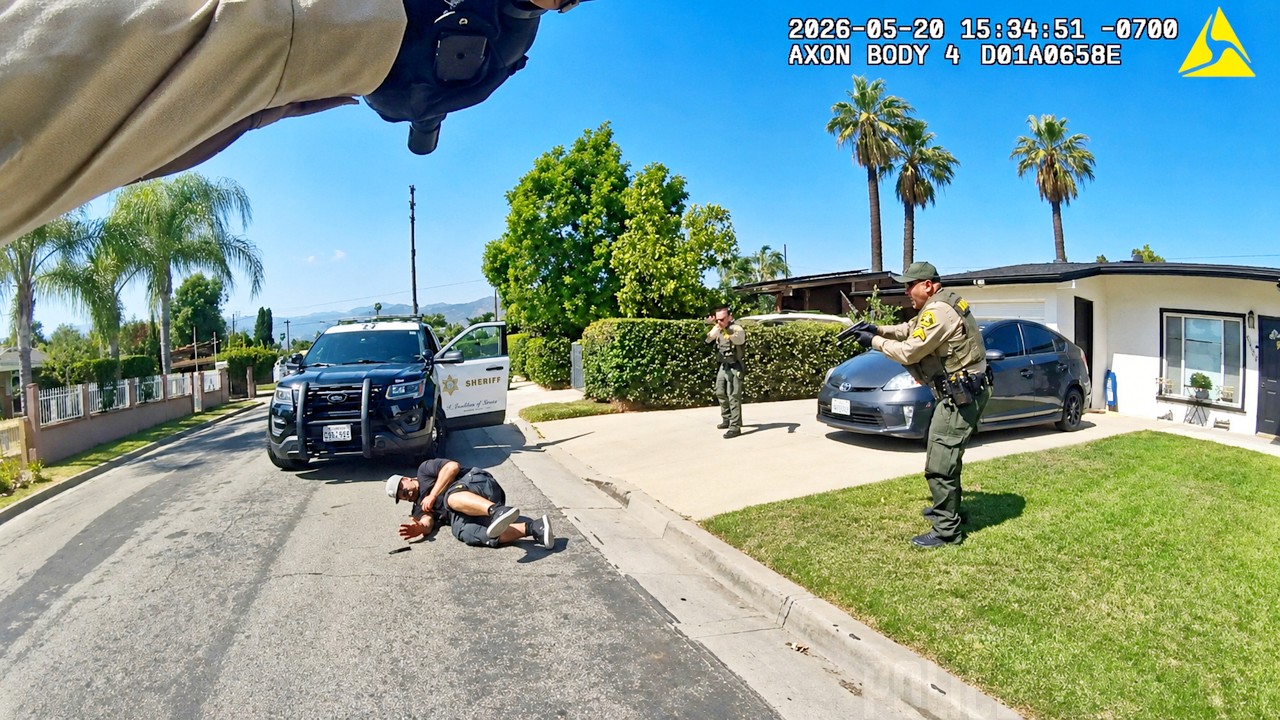
According to the PoliceActivity source description, the incident took place in unincorporated Azusa, California, on Wednesday, May 20, 2026, at approximately 3:30 p.m. The description says San Dimas Sheriff’s Station deputies responded to a residential area on North Orangecrest Avenue. Navyago is not repeating the full block-level address because that level of detail is not necessary for a reader to understand the public-safety issue.
The source identifies the man in the incident as 38-year-old Dilen Flamino. It says he exited a side gate of the residence while armed with a knife in one hand. The source description says deputies ordered him to stop and get on the ground, but that he did not comply. It then says he charged directly at a deputy while still armed, and a deputy-involved shooting occurred.
That wording matters. The article is not making an independent finding about the man’s intent, the deputy’s legal justification, or the final investigative outcome. The available source is a public video post and its accompanying description. A source-based recap should keep the verbs tied to that source, especially when a use-of-force incident can later be reviewed by investigators, agency leadership, prosecutors, civil attorneys, or oversight bodies.
The source says Flamino was struck by gunfire and fell to the ground. It also says deputies rendered medical aid until Los Angeles County Fire Department personnel arrived. The same description says he was transported to a local hospital and was listed in stable condition. No deputies or other persons were reported injured in the source description.
For readers, the Azusa deputy knife shooting video is therefore best read as a short source timeline: response, commands, reported armed movement, one deputy firing, aid, and transport. That sequence is useful, but it remains source-bound.
How The Bodycam Sequence Is Presented
The PoliceActivity upload is 3 minutes and 36 seconds long. The chapter markers divide the upload into three bodycam perspectives and a short supporter segment. The first bodycam segment begins at the start of the video and runs until about 1 minute and 54 seconds. A second bodycam angle follows until about 3 minutes and 3 seconds. A third bodycam view appears briefly before the supporter credits begin.
For a reader, that structure is useful because it signals that the posted upload is not a single continuous neutral camera record from every possible angle. It is an edited public-facing sequence that presents multiple perspectives. The value of the video is that it gives viewers a visual basis for the reported encounter. The limit is that a short public upload may not include the full call history, all radio traffic, every witness statement, or the complete investigative file.
Footage-based articles should be careful with phrases such as “shows” and “appears.” Video can show timing, distance, movement, commands, body position, and scene layout, but it still needs context. Camera angle, lens distortion, movement under stress, blocked sightlines, audio quality, and editing decisions can affect what a viewer understands. That is why this recap keeps the article anchored to the source description and does not present the video as the whole case file.
The source description says a knife with an approximate three-inch metal blade was recovered at the scene. That detail is included because it is a core source claim about the object deputies reported seeing. It should not be stretched beyond the source. The source does not, in this article’s evidence package, provide a full forensic report, a court filing, or an independent investigative conclusion.
Viewed this way, the Azusa deputy knife shooting video helps readers inspect the reported bodycam sequence, but it should not replace later records if those records become available.
Why Source-Based Wording Matters In A Deputy Shooting Recap
A deputy-involved shooting is a sensitive public-interest topic. Readers deserve the clearest available facts, but they also deserve a careful distinction between what a source reports and what a final legal process may later determine. The PoliceActivity description reports the response, the armed encounter, the commands, the alleged movement toward a deputy, the shooting, the aid, the transport, and the injury status. Those are the facts this article uses.
The article does not label Flamino as responsible for a charge or offense. It does not say the deputy acted lawfully or unlawfully. It does not say the man’s motive was known. It does not claim the video settles every disputed issue. Those statements would go beyond the public source package available here. A source-based explainer can still be useful without turning into a verdict.
For readers comparing this post with other public-safety explainers, the same rule applies: identify the source, separate reported facts from interpretation, and keep the public article narrower than the evidence. Navyago used a similar source-first approach in its police pursuit PIT maneuvers video explainer, where the goal was to describe what the footage raised for viewers rather than make unsupported claims.
The safer reading of the Azusa video is therefore direct: according to the source, deputies responded, encountered a man the source says was armed with a knife, gave commands, and one deputy fired after the source says the man charged toward a deputy. The rest of the article explains why that sequence matters and where the public record is still limited.
The Azusa deputy knife shooting video also shows why source labels matter in headlines, captions, and summaries. A precise recap can be direct without overstating what the public upload supports.
Key Facts Readers Should Take From The Source
The first fact is the location and response context. The source places the incident in unincorporated Azusa, California, and says San Dimas Sheriff’s Station deputies responded in the afternoon. That matters because agency identity and jurisdiction help readers understand which public body would be connected to later records or statements.
v The second fact is the source’s description of the weapon. The source says Flamino exited a side gate armed with a knife, and later says a knife with an approximate three-inch metal blade was recovered. A knife detail is important in a use-of-force recap because perceived threat, distance, timing, commands, and movement are often central to public discussion of such incidents.
The third fact is the command-and-movement sequence described by the source. The description says deputies ordered him to stop and get on the ground, and says he refused to comply. It then says he charged directly at a deputy while still armed. This article repeats that as source language, not as an independent legal conclusion about intent.
The fourth fact is the aftermath reported by the source. The description says deputies provided medical aid until fire department personnel arrived, and that Flamino was taken to a local hospital in stable condition. That matters because readers often search these incidents to learn whether anyone died, whether bystanders were injured, and whether medical aid followed. In this source package, the description reports stable condition and says no deputies or other persons were injured.
The fifth fact is the media context. The upload includes multiple bodycam angles, but it is still a short public video. Readers should treat it as one source in the public record. If a later agency release, district attorney memo, civil filing, or oversight report becomes available, those records may add details that are not present in this video description.
That fifth point is central to the Azusa deputy knife shooting video because many viewers first encounter the incident as a short clip, not as a complete file.
What This Azusa Deputy Knife Shooting Video Does Not Answer
The video and description do not answer every question a reader may have. They do not provide the full dispatch audio, all statements from everyone on scene, full medical records, or a final independent review. They also do not tell readers whether any later administrative, civil, or prosecutorial decision was made. This recap therefore avoids writing as if those later steps are already known.
The source also does not require readers to ignore context. A careful viewer can watch for timing, commands, spacing, and the number of officers visible. But a careful article should not claim more certainty than the source provides. In public-safety coverage, precision is more valuable than stronger language. It keeps the article useful to readers and fair to the people named in the source.
The Azusa deputy knife shooting video is also limited by its format: a short source upload can clarify a sequence, but it cannot answer every procedural question a full public record might answer later.
Another limitation is that viewer reactions are not evidence. Comment sections, clipped reposts, and social posts may contain opinions about the shooting, but this article does not use those reactions as factual support. The support here is the PoliceActivity video page, its source description, and the visible bodycam structure in the upload.
The source thumbnail below is included because Navyago’s YouTube-source workflow requires the article image, card image, and source video to match the same video ID. It is not a generated cover and does not add a claim beyond the source package.
Source Video
Sources: PoliceActivity, “Deputy Opens Fire After Suspect Charges With Knife,” YouTube, uploaded June 25, 2026. Source URL: https://www.youtube.com/watch?v=zaiBI1XJ2So.
FAQ
What is the Azusa deputy knife shooting video about?
The Azusa deputy knife shooting video is a PoliceActivity bodycam upload about a May 20, 2026 deputy-involved shooting in unincorporated Azusa, California. According to the source description, deputies encountered a man armed with a knife and one deputy fired after the source says he charged toward a deputy.
Who does the source identify in the Azusa incident?
The PoliceActivity description identifies the man as 38-year-old Dilen Flamino. This article uses that name only because it appears in the source description and does not add a legal conclusion about guilt, motive, or final case outcome.
Does the source say anyone else was injured?
The source description says no deputies or other persons were injured. It says Flamino was transported to a local hospital and was listed in stable condition after deputies rendered aid and fire department personnel arrived.
Does this article decide whether the shooting was justified?
No. This article is a source-based recap. It explains what the PoliceActivity video description reports and what the posted bodycam sequence is presented to show, but it does not determine whether the deputy’s actions were lawful.