
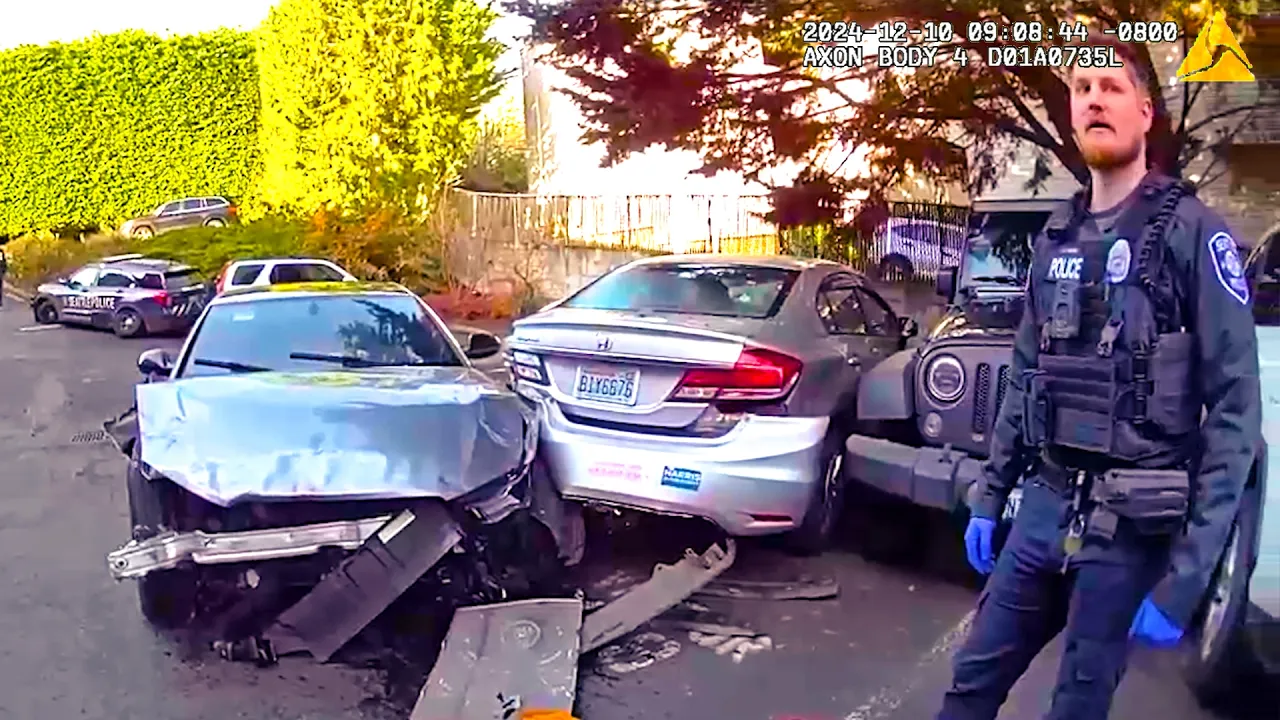
Seattle parking lot car ramming video coverage shows a sleeping-driver check turn into multiple vehicle impacts, a disabled Audi, and an extended negotiation before arrest, according to Midwest Safety’s footage and narration. The video documents the sequence and officer tactics, but source-reported allegations about drugs, mail, warrants, damage, and charges still require official records for a final legal outcome.
Seven Source-Backed Facts
- The source identifies the responding agency as Seattle Police and shows officers examining an Audi with a man asleep in the driver’s seat.
- Before contact, officers discuss conflicting vehicle information, visible mail, two plates, a covered VIN area, and the need to keep bystanders at a safe distance.
- Officers position patrol vehicles around the Audi and coordinate roles before waking the driver.
- After repeated commands to exit, the Audi begins moving and collides with or pushes through several vehicles in the parking lot.
- The Audi eventually becomes disabled, allowing officers to hold distance rather than rush the driver’s door.
- After a long negotiation, the driver turns off the car, places the keys outside, exits with hands visible, and walks toward officers.
- Midwest Safety later reports a warrant, a malicious-mischief charge, suspected evidence in the car, and an estimated combined vehicle value, while stating the driver is presumed innocent unless proven guilty.
Those facts make the Seattle parking lot car ramming video more than a crash compilation. The footage shows how an uncertain welfare or suspicious-vehicle check can become a public-safety problem in seconds. It also demonstrates why source narration and direct observation must stay separate. The camera shows the driving, impacts, containment, and surrender. It does not independently verify every item reportedly found later or the final outcome of any charge.
Seattle Parking Lot Car Ramming Video: How the Encounter Began
The source opens with an officer explaining why the parked Audi appears suspicious. He points to material covering the area where the VIN would normally be visible and says the arrangement makes him wonder whether the car could be stolen. Bystanders mention two plates and mail visible inside. At this stage, the Seattle parking lot car ramming video records suspicion, not proof.
That distinction matters because later narration in the Seattle parking lot car ramming video says the Audi was eventually confirmed not stolen. Early investigative clues can be reasonable reasons to ask questions without being correct conclusions. Police work often begins with incomplete information: a sleeping person, a vehicle that does not appear to match a return, reports from people nearby, and objects visible through a window. Good reporting should preserve both the officers’ initial concern and the later correction.
The officers wait for backup before knocking. They tell people nearby that a driver in a possibly stolen vehicle could wake and flee, and they advise distance without issuing dramatic public commands. They also discuss where to stand so no officer is trapped between the Audi and another car. Those preparations are a central part of the Seattle parking lot car ramming video because they show risk being considered before the vehicle moves.
A bystander in the Seattle parking lot car ramming video says she may recognize the driver or car from a mail-theft incident recorded at her home. An officer later says he has personal-home video that may show the same vehicle. That is a reported lead in the source, not a finding established by this article. The footage does not provide the earlier home video, confirm which mail belonged to whom, or show a final theft charge.
Why Officers Used Vehicle Containment
Officers in the Seattle parking lot car ramming video position vehicles around the Audi before waking the driver. The obvious goal is to reduce the room available for sudden flight. Midwest Safety’s later commentary says Seattle policy allows trained officers to use vehicle pinning in some circumstances. Navyago has not independently audited that policy text for this article, so the statement remains attributed to the source.
The tactical tradeoff becomes visible almost immediately. Containment may limit a direct path out of the lot, but it also places parked vehicles close to a driver who may try to force an exit. When the Audi moves, it appears to push and strike its way through the available space. The Seattle parking lot car ramming video therefore shows both the intent and the limitation of the tactic without proving that a different plan would have produced a safer result.
The officers in the Seattle parking lot car ramming video also assign lethal and less-lethal coverage, discuss approach angles, and wait for enough personnel. Those decisions are important because a sleeping person behind the wheel can transition from unresponsive to mobile faster than officers can reorganize. The camera shows that the team anticipated some risk of flight. It does not show that they predicted the exact path or number of impacts.
Readers should also notice how officers speak to bystanders before contact. They repeatedly discourage people from moving closer. A crowded parking lot is not a controlled training space. Drivers, pedestrians, storefronts, and parked cars can turn a vehicle movement into danger far beyond the person police initially intended to contact.
What Happened After the Audi Started Moving
Once officers knock and command the driver to exit, the Audi moves suddenly. The body-camera view becomes unstable as officers back away and call out its direction. The car passes through or presses against multiple parked vehicles, including patrol cars. The Seattle parking lot car ramming video makes clear why officers describe the driver as a serious danger at that moment: a moving vehicle in a confined lot can injure people even if speed remains limited.
The Seattle parking lot car ramming video later says two squad cars and four civilian vehicles were damaged. Its narration identifies a Chevrolet Cruze, Honda Civic, Jeep Wrangler, and Toyota RAV4 and gives a combined estimated vehicle value of $113,000. That figure should not be confused with a verified repair bill. The source frames it as the estimated amount the vehicles cost, not necessarily the final insurance loss or restitution amount.
After several impacts in the Seattle parking lot car ramming video, the Audi appears high-centered or mechanically unable to leave. Officers do not immediately crowd the door. They reposition, discuss pursuit authorization in case the vehicle becomes mobile again, and use distance. That slower phase is a useful contrast with the opening seconds of motion. Once the immediate trajectory stops, the tactical problem changes from preventing a moving-car escape to encouraging a contained driver to surrender.
The Seattle parking lot car ramming video also shows officers debating what tools and positions would be safest if the driver exits or begins driving again. Viewers may disagree about individual choices, but the clip does not support a simple claim that nothing was being done. Much of containment work consists of holding positions, communicating, keeping crossfire and vehicle paths in mind, and waiting for a safer opportunity.
How the Long Standoff Ended
With the Audi disabled in the Seattle parking lot car ramming video, officers repeatedly tell the driver to show his hands, turn off the engine, and place the keys where they can see them. One officer identifies himself as Officer Weiss and explains that a 40 mm impact tool is present but will not be used if the driver complies. The statement is both a warning and an attempt to make the next safe action clear.
Midwest Safety says officers continue negotiating for about 40 minutes. The edited Seattle parking lot car ramming video compresses that passage rather than presenting every minute. This is an important editing limit: viewers see representative exchanges and the outcome, not a complete real-time record of every command, pause, or response.
Eventually, the driver in the Seattle parking lot car ramming video turns off the vehicle and puts the keys outside. Officers discuss a bag and belongings he appears concerned about, promising to retrieve them after he walks toward police. They continue asking him to keep his hands visible. He exits, adjusts his clothing, walks forward, and is taken into custody without the impact launcher being fired in the portion shown.
The quiet ending does not erase the earlier danger, just as the earlier impacts do not prove every later allegation. The Seattle parking lot car ramming video is useful because it shows both phases together: fast vehicle movement that risks serious harm, followed by patient communication that ends in a controlled surrender.
What the Source Reports—and What Remains Unverified
Midwest Safety identifies the driver only as 31-year-old Kevin in its narration. It says he had a warrant for felony domestic-violence harassment and was charged with first-degree felony malicious mischief after the incident. The narrator then explicitly states that he is presumed innocent unless proven guilty. This article follows that same legal-safe boundary.
The source also says officers reportedly found suspected methamphetamine, a pipe, and mail with different addresses inside the Audi. It says police obtained a warrant for a blood draw but that the driver apparently was not charged with DUI. Each qualifier matters. “Suspected” is not a lab result, a blood-draw warrant is not a DUI conviction, and mail from different addresses is not by itself proof of theft.
The Audi’s status is another example of why updates matter. Officers initially discuss the possibility that it is stolen because of conflicting returns and physical details. Source narration later says it was not stolen. Repeating only the opening suspicion would make the Seattle parking lot car ramming video sound more certain than its own ending supports.
This source package does not include the police case number, charging document, repair invoices, lab results, or a final court docket. Those materials would be needed to verify the complete legal and financial outcome. Until then, the footage supports a sequence explainer, while later investigative claims remain attributed to Midwest Safety.
Public-Safety Lessons From a Crowded Parking Lot
The first lesson is to create distance when officers warn that a vehicle contact may be dangerous. Several civilians appear close enough to observe or speak with police before the driver is awakened. A parked vehicle can become a moving threat with almost no warning, particularly when exits are narrow and people are standing between cars.
The second lesson is that containment is not the same as certainty. Officers may use vehicles, distance, or tools to reduce options, but no arrangement removes every risk. The Seattle parking lot car ramming video shows a driver finding enough space to cause multiple impacts even after patrol cars are positioned nearby.
The third lesson is to separate public danger from legal conclusion. The visible vehicle movement is a direct event. The reason for that movement, the driver’s condition, the ownership of mail, and the final status of charges are separate questions. Navyago’s related report on six juveniles fleeing police in a stolen car offers another source-based example of why vehicle incidents require careful timelines rather than generalized blame.
Finally, negotiation can be active risk management. The long pause may look uneventful compared with the impacts, but it ends with the driver turning off the car, surrendering the keys, and walking out. The source does not prove that every tactic was ideal. It does show that time and clear instructions can become safer options once immediate vehicle movement stops.
Frequently Asked Questions
What does the Seattle parking lot car ramming video show?
It shows officers investigate a sleeping driver, contain the Audi, retreat when it moves through parked vehicles, and negotiate a surrender after the car becomes disabled.
Was the Audi stolen?
Officers initially considered that possibility, but Midwest Safety later says the Audi was confirmed not stolen.
How many vehicles were reportedly damaged?
The source narration reports two squad cars and four civilian vehicles. This article has not independently verified final repair costs or insurance findings.
Was the driver convicted?
The source reports a warrant and a malicious-mischief charge while stating he is presumed innocent. This source package does not establish a final court outcome.
Source Video
Sources and Attribution
Primary source: Midwest Safety, Man Rams 6 Cars Moments After Waking Up, uploaded August 27, 2026. Watch it at https://www.youtube.com/watch?v=EZeqvXkAntk.
Incident details are attributed to the visible footage, captions, and Midwest Safety narration saved for this work item. Navyago paraphrased the material for public-interest reporting. This article is not a finding of guilt and does not replace police, insurance, laboratory, or court records.
Next step: Watch the full source and consult later Seattle Police or court records before treating reported evidence, damage, or charging outcomes as final.