
Arkansas police rollover chase footage published by PoliceActivity shows the aftermath of a reported high-speed pursuit near Trumann. The source says a tactical vehicle intervention preceded a collision with an uninvolved SUV, seriously injuring two older occupants. This explainer separates what the recording supports from charges and details that remain unverified.
PoliceActivity says the incident happened on August 5, 2026, and published the video on August 15. Navyago reviewed the public description, automatic English captions, edited footage and exact source thumbnail. No confidently matching Arkansas State Police release, crash report, court docket or hospital statement was located during this review. For that reason, the speeds, identities, injuries, evidence and charges below remain attributed to the source rather than presented as independent findings.
Arkansas Police Rollover Chase: What the Source Reports
The PoliceActivity description says Arkansas State Police Trooper Logan Hall attempted to stop a northbound Hyundai Sonata near mile marker 24 outside Trumann at approximately 6:56 p.m. The source reports that the car was traveling about 90 mph in a 75 mph zone, did not pull over and accelerated as the pursuit continued. It says the Sonata later reached approximately 130 mph while passing other motorists.
According to the same source, the pursuit was moving toward a more populated part of the Trumann area when Hall attempted a tactical vehicle intervention near mile marker 28. The description says the Sonata lost control, crossed the roadway and struck a black SUV. That SUV then left the highway and rolled several times before coming to rest on its passenger side.
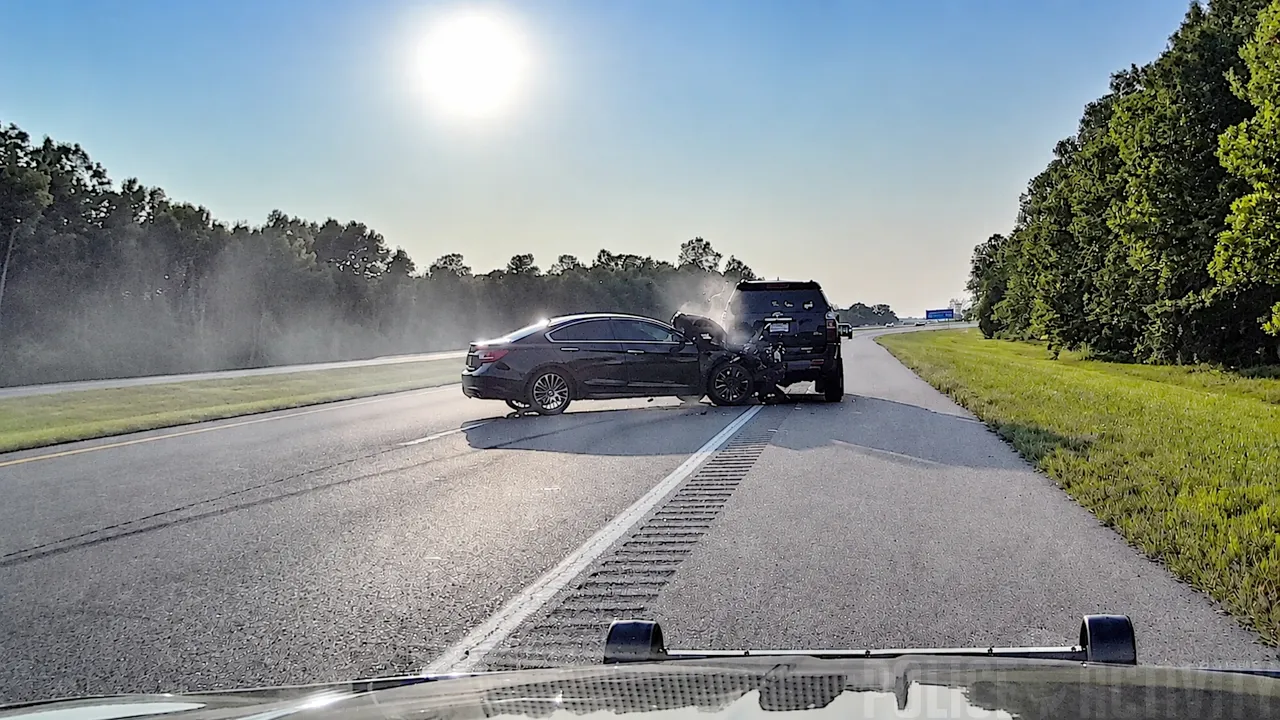
The edited recording then focuses on the crash scene, commands directed at the Sonata driver and the emergency response. Officers can be heard requesting backup and reporting that another vehicle had rolled. The upload does not provide every moment from the initial speed observation through the intervention, so the public clip should not be treated as a complete operational or evidentiary record.
Seven Source Facts Supported by the Public Upload
1. The source places the incident near Trumann, Arkansas
The Arkansas police rollover chase description identifies Trumann and highway mile markers 24 and 28. Those details provide a reported geographic frame without requiring publication of a home address or another unnecessary private location. Navyago did not independently match an official incident number to the upload, so the precise route remains a source claim.
2. The attempted stop reportedly began with speeding
PoliceActivity says the trooper initially clocked the Sonata at about 90 mph in a 75 mph zone. The source then reports that the driver failed to stop and increased speed. The public upload does not include a certified speed record or the complete original dash-camera file, so the approximate figures should not be converted into exact measurements by outside viewers.
3. The description reports speeds of approximately 130 mph
The source says the car eventually reached approximately 130 mph while passing other motorists and being driven recklessly toward Trumann. That is an important part of the reported risk picture, but it remains an attributed figure. Navyago did not locate an official pursuit log, telemetry download or crash-reconstruction report that independently confirms the maximum speed.
4. A tactical vehicle intervention reportedly preceded the collision
PoliceActivity says the trooper attempted the maneuver near mile marker 28 as the pursuit approached a more populated stretch. The description links the intervention to the Sonata losing control and moving across the roadway. The video alone does not establish the officer’s complete decision process, available alternatives, radio instructions, policy authorization or exact vehicle positions.
5. An uninvolved SUV rolled after being struck
This is the central public-safety consequence in the Arkansas police rollover chase account. The source says the Sonata struck a black SUV carrying two older adults and that the SUV overturned several times off the highway. In the recording, an officer urgently reports that another vehicle has rolled, which is consistent with the source narrative without independently proving every collision detail.
6. The source reports serious injuries and air transport
The PoliceActivity description says the SUV occupants were a 73-year-old man and a 68-year-old woman. It reports that firefighters and other responders used extrication equipment and that both occupants were flown to Regional One Medical Center in Memphis. Navyago found no matching hospital statement or later medical update, so this article does not name diagnoses, predict recovery or describe an outcome beyond the source report.
7. The driver was detained and faced reported charges
The description identifies the Sonata driver as 32-year-old Laloyd L. Hamilton III and says he was taken into custody after the crash. It also lists charges including felony fleeing, battery, criminal mischief, controlled-substance offenses, driving while intoxicated and hazardous driving. A charge is an allegation, not a conviction. This article does not establish guilt or the final disposition of any case.
How the Reported Pursuit Reached the Rollover
The source presents the Arkansas police rollover chase as a rapid escalation. It begins with a reported speed violation, moves to a failure to stop, then describes much higher speeds and passing traffic. The stated distance between mile markers 24 and 28 is short enough to show why decisions during a pursuit can unfold in minutes, but the upload does not provide a synchronized timeline for every action.
PoliceActivity’s description says the trooper acted as the chase moved toward a more populated area. That statement explains the source’s account of why the intervention occurred when it did; it does not prove that the maneuver was required, correctly executed or consistent with a specific policy. Those conclusions would require original video, dispatch audio, supervisory records, training information, measurements and the agency’s applicable written rules.
After the collision, the recording’s emphasis changes. Commands are directed toward the Sonata driver, while the officer also calls for support and identifies the rollover involving another vehicle. The scene contains simultaneous needs: securing a person associated with the pursued vehicle, assessing the uninvolved SUV, managing secondary crashes and creating space for medical and fire crews. An edited online video cannot show every responder’s task at the same time.
The most responsible summary is therefore limited. The source reports a high-speed pursuit and an intervention; it also reports that the pursued car struck another vehicle and that two uninvolved people were seriously hurt. The recording supports the urgency of the aftermath. It does not, by itself, resolve every cause, policy or legal question created by the crash.
Why the Uninvolved SUV Is Central to the Story
Pursuit videos often draw attention to speed, commands and the person being chased. In this Arkansas police rollover chase, the most consequential reported harm fell on people in another vehicle. Keeping the SUV occupants at the center prevents the article from treating the rollover as spectacle or reducing two reportedly serious injuries to background action.
The source does not name the older occupants, and their names are not necessary to explain the public-interest issue. The description supplies their ages, reports that they were trapped and says they were airlifted. Navyago does not add private medical details, speculate about long-term disability or try to identify them through local posts. Dignity and accuracy matter more than filling every gap in a viral clip.
The collision also illustrates why pursuit analysis cannot focus only on the pursued driver and police vehicle. Other motorists may encounter rapidly changing lane positions, extreme closing speeds, emergency vehicles or debris without knowing what is developing behind them. That general risk is one reason pursuit policy considers both apprehension and public safety. It does not answer what should have happened in this specific event.
Readers should avoid assigning legal fault from the edit. Collision responsibility may depend on vehicle paths, timing, contact points, road conditions, warnings, speed evidence and applicable law. A crash-reconstruction report and official investigative record would carry more weight than a narrated platform description. None was available in the source package reviewed for this article.
What Tactical Vehicle Intervention Means Here
PoliceActivity uses the term “Tactical Vehicle Intervention” for the maneuver in the Arkansas police rollover chase. Similar techniques may also be described publicly as precision immobilization or PIT maneuvers. Labels and rules vary by agency. This article uses the source’s term and does not assume that one agency’s policy, training threshold or terminology applies everywhere.
The U.S. Department of Justice COPS Office describes vehicular-pursuit management as a field involving policy decisions, associated risks and alternatives that may shorten or eliminate a pursuit. Its training material, based on a guide produced with the Police Executive Research Forum, also highlights reporting systems, data analysis, realistic training, community engagement and transparency. That framework is general context, not a verdict on this trooper’s action.
To evaluate the reported intervention fairly, a reviewer would need information absent from the public upload: the original unedited files, traffic density, sight distance, road geometry, speed and spacing, radio traffic, supervisor involvement, the trooper’s training and the policy in force on August 5. Without those materials, confident declarations that the maneuver was either unquestionably proper or obviously improper would overstate the evidence.
A more useful question is what the official review eventually documents. Did the agency preserve the complete recordings? Were the uninvolved motorists’ injuries and vehicle movement analyzed? Did the report explain the risk assessment and available alternatives? Were findings released with enough detail for public understanding? The source video raises those questions but cannot answer them on its own.
Charges Are Allegations, Not a Finding of Guilt
The PoliceActivity description says investigators searching the Sonata reported finding 44 grams of marijuana and pills labeled as oxycodone and OxyContin in prescription bottles with identifying information allegedly removed. This article cannot independently confirm the search inventory, laboratory testing, ownership, prescription status or chain of custody. It therefore does not present the substances as proven facts against any person.
The source lists several charges, but a charging decision begins a legal process; it does not end one. The Arkansas police rollover chase upload does not include a filed information, probable-cause affidavit, plea, trial record or judgment. Charges can be amended, dismissed or resolved in ways that a first video description does not predict.
The same caution applies to the reported driving-while-intoxicated charge. A complaint of pain, unusual behavior or the presence of a container does not by itself establish impairment. Navyago did not locate test results or a final court finding. Describing the allegation accurately protects readers from confusing an arrest narrative with a completed adjudication.
Any later article should update from a primary public record and link the correction or disposition clearly. Until then, the narrow statement is the accurate one: PoliceActivity reports that Hamilton was detained and faced the listed allegations. He is presumed innocent unless and until guilt is established in court.
What the Arkansas Police Rollover Chase Video Does Not Establish
First, the upload does not establish the complete chronology. Edited footage and automatic captions can omit pauses, radio traffic, simultaneous actions and material shown in other cameras. The public description fills gaps with narration, but a description is not the same thing as a certified report. Exact quotations and time calculations should be checked against the original recordings.
Second, the video does not establish final medical outcomes. The source reports serious injuries, extrication and air transport for the SUV occupants. It does not provide medical records, diagnoses, discharge information or a later statement from the people involved. Readers should not infer that air transport establishes a particular injury, nor that the absence of a later update means the occupants recovered.
Third, the source does not establish the final legal outcome for the driver. It lists reported evidence and charges but no court case number or adjudication. It also does not establish civil liability for the crash. Criminal charges, administrative review and civil claims use different standards and may proceed on different records.
Fourth, the Arkansas police rollover chase edit does not establish compliance with agency policy. The DOJ pursuit-management resource is useful for understanding why training, reporting, risk analysis and alternatives matter. It is not the Arkansas State Police policy and says nothing about what the trooper knew at each moment in this incident.
Finally, the source does not provide a complete public accounting of secondary collisions mentioned in the audio. An officer can be heard saying accidents were happening behind him, but the clip does not supply a reliable count, locations, injuries or reports for those events. Navyago does not turn that urgent radio statement into a precise crash total.
How to Read an Edited Pursuit Video Responsibly
Start with source identity. This article is tied to PoliceActivity upload JzS_j1NmLgU; the source URL, thumbnail, body image, iframe and note all use that same ID. A similar Arkansas pursuit or rollover cannot be substituted to fill gaps. Exact source matching is a simple defense against combining unrelated incidents.
Next, separate observation from narration. The recording captures parts of the crash response and spoken commands. The public description supplies the reported initial speed, maximum speed, identities, ages, drug inventory and charge list. Those are different evidence layers. A careful reader asks which layer supports each sentence instead of treating the entire package as one official finding.
Then look for what is missing. Original file timestamps, dispatch records, agency policy, a collision diagram, medical updates and court documents would materially improve the account. Their absence does not prove the source is false. It means the article should use narrower language and remain open to correction when a stronger primary record becomes available.
Also resist entertainment framing. The Arkansas police rollover chase reportedly involved serious injuries to people who were not the target of the stop. Replaying the most dramatic seconds without that context can obscure the human cost and the policy questions. Useful coverage explains consequences and uncertainty instead of inviting viewers to cheer for a crash.
For related context, Navyago’s police pursuit and PIT maneuvers explainer examines how source videos should be read without turning them into universal policy judgments. Readers can also browse the Crime News section for other source-limited reports. Those pages provide editorial context; they do not independently verify this event.
Frequently Asked Questions
Where did the Arkansas police rollover chase happen?
PoliceActivity places the reported pursuit near Trumann, Arkansas, between highway mile markers 24 and 28. Navyago did not independently match an official incident report to the upload.
Were people in another vehicle injured?
The source says a 73-year-old man and a 68-year-old woman in an uninvolved SUV suffered serious injuries, were extricated and were flown to a Memphis hospital. No later medical outcome was available.
What is a tactical vehicle intervention?
It is the source’s term for a police maneuver intended to stop a fleeing vehicle. Terminology, training and authorization rules vary by agency, so the video alone cannot establish whether every policy requirement was met.
Does the video prove the driver committed the listed offenses?
No. PoliceActivity reports an arrest, alleged evidence and charges. Charges are allegations, and the upload does not include a final court judgment.
Is the public upload a complete record of the pursuit?
No. It is an edited source with a public description and automatic captions. A complete review would require original recordings, dispatch logs, reports, policy records and later legal or medical documents.
Source Video