
Dallas officer fires at fellow officer after apparently mistaking a plainclothes colleague for the robbery suspect during a stolen-vehicle stop, according to a PoliceActivity video and its source description. The officer stopped after recognizing the colleague and calling out “Blue, Blue.” The source reports that the suspect then surrendered and that no officer, civilian, or suspect was injured.
Key Facts at a Glance
- The source places the original robbery report in Dallas, Texas, on August 6, 2026.
- A white Porsche Cayenne was reported stolen after a confrontation outside a business, according to the source description.
- Vehicle-location data helped officers find the Porsche about an hour later.
- A covert officer in an unmarked vehicle moved near the stop while uniformed officers conducted a felony traffic stop.
- The source says Officer Celso Rocha fired four rounds toward the covert officer and the suspect, then stopped after recognizing the officer.
- The source reports no injuries and says the suspect surrendered without further incident.
- Any criminal charges discussed below are allegations; they do not establish guilt.
These points summarize what the selected source reports. A case in which a Dallas officer fires at fellow officer should not be read from one clip as an independent finding about policy compliance, criminal liability, intent, or the final outcome of any departmental review. Those questions require official records and completed investigative findings beyond a short video package.
Dallas Officer Fires at Fellow Officer: Source Timeline
According to the PoliceActivity description, Dallas officers were sent to a robbery in progress at a business in the 3500 block of Sunnyvale Street at about 9:10 a.m. The source says a woman had parked a white Porsche Cayenne outside while her nine-year-old daughter remained in the vehicle. A man later identified by the source as 39-year-old Renard McFadden allegedly arrived in a stolen Ford F-150, approached the Porsche, indicated that he was armed, and ordered the child out. That alleged sequence sets up the later point at which a Dallas officer fires at fellow officer during the recovery attempt.
The child reportedly ran into the business to alert her mother. The source says the mother then confronted the man, who again indicated that he was armed before leaving in the Porsche. The Ford pickup was left behind and was later confirmed stolen, according to the description. Because the underlying conduct is the subject of criminal charges, these details remain source-attributed allegations rather than a declaration that any person committed the offenses.
The Porsche’s tracking application supplied real-time location information, the source says. Patrol officers, covert personnel, and an Air One unit coordinated to find the vehicle. At roughly 10:10 a.m., about one hour after the first call, officers located the Porsche in the 5800 block of Williamstown Road. The source describes uniformed officers beginning a felony traffic stop while a covert officer positioned an unmarked vehicle in front of the Porsche to prevent it from leaving. Those reported positions matter because the source soon shows the moment a Dallas officer fires at fellow officer.
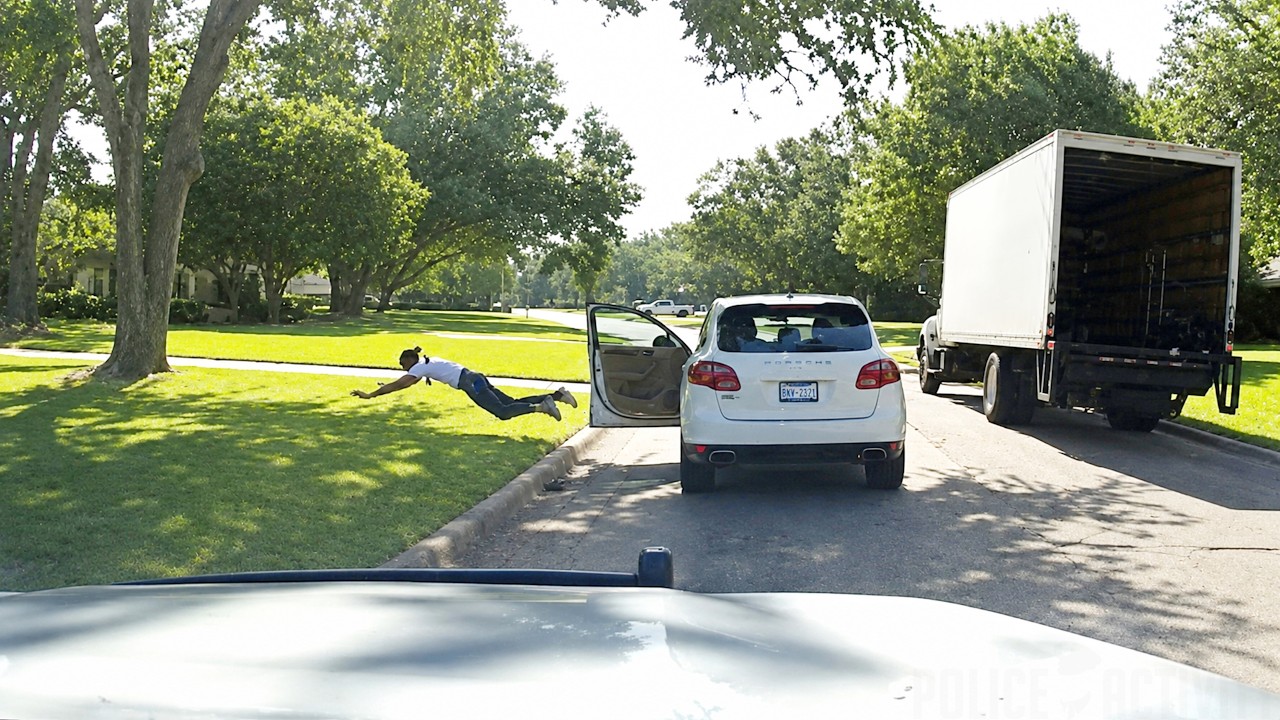
That coordination created the crucial identification problem visible in the source package. The covert officer exited the unmarked vehicle with a department-issued handgun drawn and moved toward a nearby yard. This is the point at which the source says a Dallas officer fires at fellow officer and toward McFadden, with Officer Celso Rocha reportedly discharging four rounds. The officer then recognized that the armed person was another police officer, stopped firing, and shouted “Blue, Blue.” The reported sequence is short, but it shows why the timing, clothing, vehicle type, radio traffic, and lines of sight will matter to any formal review.
The source says McFadden then exited the stolen Porsche and surrendered without another use of force. It reports that no officers, members of the public, or the suspect were injured. The reported fact that a Dallas officer fires at fellow officer is part of this stop’s timeline, not proof by itself of why the identification mistake occurred. The absence of reported injury is important, but it does not erase the seriousness of rounds being fired during a crowded, multi-unit response.
What the Source Footage Shows
The video package is organized into surveillance footage, helicopter video, dashcam footage, and body-camera footage. The timestamps listed by PoliceActivity place surveillance video at the beginning, helicopter footage at 1:08, dashcam video at 1:35, and bodycam attributed to Officer Rocha at 2:16. Together, those angles document the reported sequence in which a Dallas officer fires at fellow officer. They do not all show the same information; each camera records only what was inside its frame, from its own angle, at a particular moment.
For readers, the most useful distinction is between an observable event and an explanation supplied by the source. That distinction is especially important when a Dallas officer fires at fellow officer in an edited video package. A camera may show vehicles positioning, an officer moving, gunfire, and commands. The description supplies names, locations, the alleged robbery history, the tracking process, and the reported recovery of evidence. A responsible account should keep those layers separate instead of treating every sentence in a description as something personally visible on camera.
The source’s central claim is that a Dallas officer fires at fellow officer, recognizes the covert officer, and immediately ceases fire. The quoted “Blue, Blue” call is presented as the recognition signal. The package also supports the reported end of the encounter: the person who had been inside the Porsche exited and surrendered. What a short edited package cannot fully show is every radio transmission, briefing, visual obstruction, tactical instruction, or decision made by all units before the vehicles came into view.
Why the Stolen-Vehicle Response Became Complex
Several operational elements overlapped. Officers were responding to a reported armed robbery, tracking a recently stolen vehicle, using multiple patrol divisions, coordinating with covert personnel, and receiving aerial support. The source says those elements were present before a Dallas officer fires at fellow officer. A covert officer and an unmarked vehicle may be useful for locating or containing a suspect, but they can also create an identification challenge when uniformed officers arrive with limited time to interpret a fast-moving scene.
The source also says the covert officer had a handgun drawn. An armed person moving away from an unmarked vehicle can look very different depending on the observer’s angle and prior information. When a Dallas officer fires at fellow officer during that kind of multi-unit stop, the fact does not by itself decide whether the shots complied with policy. It identifies questions investigators are likely to examine: what Officer Rocha knew, what he could see, which radio messages he heard, where the suspect was positioned, and how quickly recognition occurred.
Vehicle tracking compressed the search into a relatively short period. The ability to locate the Porsche may have reduced the time available for units from different assignments to form a shared picture before the stop. That compressed timeline is relevant when reviewers assess the point at which a Dallas officer fires at fellow officer. Investigators can compare dispatch audio, body-camera timestamps, Air One footage, dashcam video, and officer statements to reconstruct that picture with greater precision than a viewer can obtain from the edited public video alone.
Readers interested in how to evaluate footage from a case where a Dallas officer fires at fellow officer can also review Navyago’s Gaithersburg police shooting video explainer, which similarly separates visible footage, source-attributed statements, and questions that remain for official review.
What Is Reported About the Firearm and Charges
PoliceActivity’s description says investigators recovered a loaded handgun from inside the stolen Porsche. Those evidence claims are separate from the moment a Dallas officer fires at fellow officer. The source also says other evidence from the vehicle was being examined in connection with several ongoing violent-crime investigations. The description does not provide the completed results of those examinations, so it would be premature to link the recovered material to any other offense as an established fact.
The source identifies charges of Unauthorized Use of a Motor Vehicle, Robbery, and Unlawful Possession of a Firearm. Those accusations do not explain why a Dallas officer fires at fellow officer during the stop. Charges are allegations filed within the criminal process, not convictions, and the accused person is entitled to the presumption of innocence unless guilt is established in court. The source also says detectives were pursuing possible additional charges, but a future possibility should not be reported as though a charge had already been filed.
The reported firearm recovery and the earlier allegation that the Porsche was taken through an implied threat help explain why officers may have approached the stop as high risk. They do not by themselves answer why a Dallas officer fires at fellow officer. That separate issue belongs to the evidence-based administrative and, if applicable, legal review of the shooting decision.
What the Video Does Not Establish
The fact that a Dallas officer fires at fellow officer does not establish that he intended to target a colleague. The source characterizes the event as mistaken identification, and the reported decision to stop after the “Blue, Blue” call is consistent with recognition occurring after the shots began. Intent is a legal and factual conclusion that cannot be inferred confidently from a brief clip.
It also does not establish whether departmental tactics, cross-unit communication, weapons discipline, or use-of-force policy were followed when a Dallas officer fires at fellow officer. A complete review would normally examine training standards, dispatch records, scene diagrams, firearm evidence, all available camera angles, and interviews. The public should wait for documented findings rather than treating social-media reactions as evidence.
Finally, after a Dallas officer fires at fellow officer, the package still does not provide a final court outcome for the accused person or a final administrative outcome for any officer. If Dallas authorities later release a detailed incident report, internal review, or charging update, those records may add context or correct early information. This article should therefore be read as a source-based explainer of what was publicly reported on August 11, not as the last word on the case.
Public-Interest Lessons From the Incident
The first lesson from a case in which a Dallas officer fires at fellow officer is that identification matters in multi-unit responses. Uniformed officers, covert officers, marked vehicles, and unmarked vehicles can converge rapidly. Clear radio identification and shared situational awareness may help reduce the risk of one officer mistaking another for an armed suspect. The available source does not tell us whether a particular communication failed, so this is a general lesson rather than a claim about fault.
The second lesson is that several camera views are better than one, but no camera is omniscient. In an incident where a Dallas officer fires at fellow officer, surveillance, helicopter, dashcam, and bodycam footage can be synchronized to test the sequence. Even then, audio gaps, obstructions, camera placement, and the difference between what a lens captured and what a person perceived remain important.
The third lesson, when a Dallas officer fires at fellow officer, is to preserve the distinction between public accountability and instant judgment. Publishing footage can allow the public to understand a serious event, while careful attribution protects against turning incomplete information into an unsupported accusation. Readers can watch the full source below, compare the listed camera segments, and look for subsequent official Dallas Police updates before reaching a conclusion.
Frequently Asked Questions
Why did the Dallas officer fire toward another officer?
According to the PoliceActivity description, a Dallas officer fires at fellow officer after initially mistaking a covert officer near an unmarked vehicle for the suspect. The source says he stopped after recognizing the officer and calling out “Blue, Blue.” A formal review would be needed to determine the full reasons and whether policy was followed.
Was anyone injured in the Dallas police incident?
In the reported incident where a Dallas officer fires at fellow officer, the selected source says no officer, member of the public, or suspect was injured. That is a source-attributed report as of August 11, 2026, not an independent medical finding by Navyago.
What happened to the person inside the stolen Porsche?
The source says the person exited the Porsche and surrendered without further incident. It lists three criminal charges. Those charges are allegations and do not establish guilt.
Does the video prove the shooting was justified or unjustified?
No. Even when a Dallas officer fires at fellow officer on public video, the footage does not contain every dispatch message, officer statement, policy rule, or investigative finding needed for a legal or administrative conclusion.
Source Video
Sources and Attribution
Primary source: PoliceActivity, “Dallas Officer Fires at Fellow Cop After Mistaking Him For Suspect,” published August 11, 2026. The source video documents the reported incident in which a Dallas officer fires at fellow officer during the stop. Watch the original at https://www.youtube.com/watch?v=f5MhppNFkos. Incident details in this article are attributed to that video package and its description. Navyago has paraphrased the source for news reporting, analysis, and public-interest explanation.
Next step: Review the full source video, then check for later Dallas Police reports or court updates before treating any early account as final.