
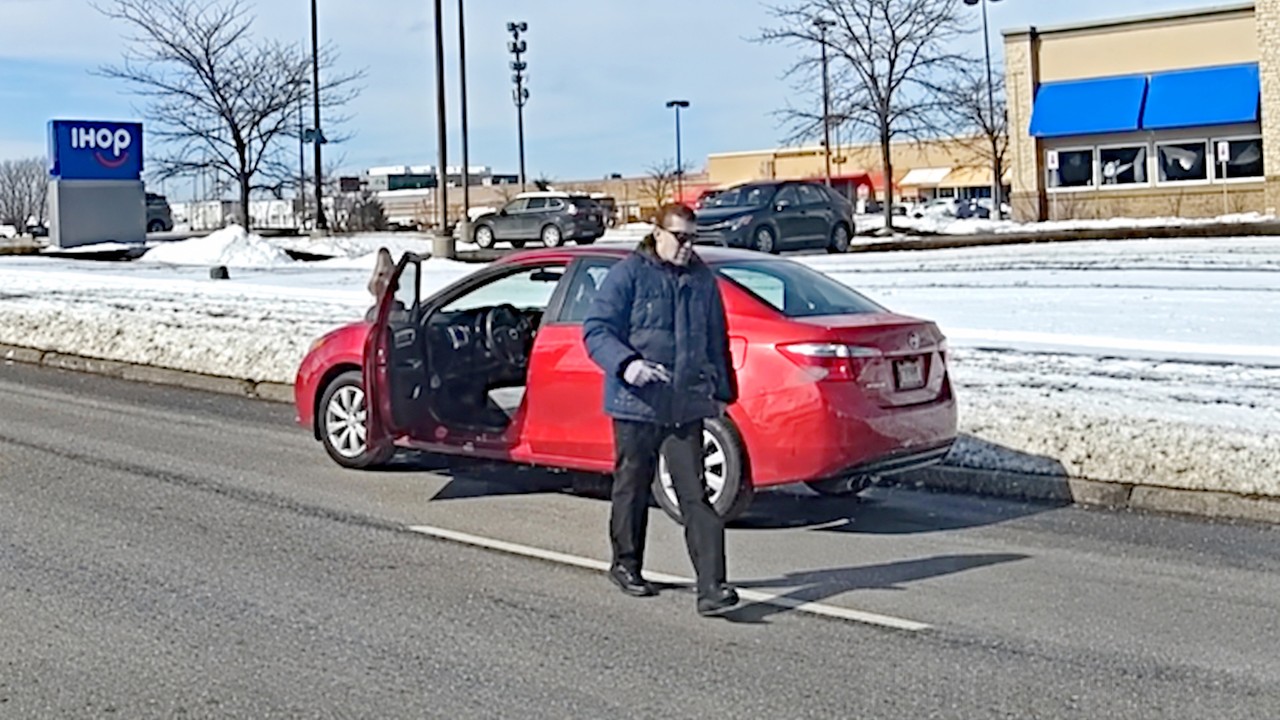
Parma welfare check police shooting footage shows officers following a man from a welfare call into a traffic stop before he exited with a handgun, according to a PoliceActivity video and its source description. Officers fired, requested medical help and treated him, but he later died. The source says BCI documented the incident without deciding whether the shooting was legally justified.
Key Facts From the Selected Source
- The source places the original welfare call in Parma, Ohio, on February 24, 2026.
- PoliceActivity says officers were looking for a 29-year-old man and his red Toyota Corolla after he was not found at his apartment.
- An emergency phone-location ping reportedly helped officers locate the vehicle near Brookpark Road.
- The source says the driver did not stop immediately and later reached toward the back seat after pulling over.
- PoliceActivity reports that he exited holding a handgun and continued toward officers despite repeated commands to drop it.
- Two officers reportedly fired. Emergency medical help was requested, and the man later died at a hospital.
- The source’s summary of BCI says the handgun was operable but had not been fired during the confrontation.
These are source-attributed points, not independent findings by Navyago. The public video is important evidence, but it does not contain every dispatch message, interview, laboratory result, policy rule or legal standard. Any account of the Parma welfare check police shooting should therefore separate what the cameras visibly record from what the source description says investigators found.
Parma Welfare Check Police Shooting: Reported Timeline
The source basis for the Parma welfare check police shooting begins at an apartment complex, where PoliceActivity says officers were called to check on a 29-year-old man. A friend had contacted police after receiving a message from him. Officers reportedly found possible notes outside the apartment and additional papers after entering. The source also says they located a receipt indicating the purchase of a Taurus handgun. Those details explain why officers may have treated the search as urgent, but this article does not reproduce private note contents or infer a diagnosis, intention or state of mind from them.
The man was not at the apartment, according to the source, so officers began looking for him and his red Toyota Corolla. PoliceActivity says an emergency phone-location ping later placed him in the Brookpark Road area. An officer then saw the vehicle leaving a Walmart property. This reported transition matters because the Parma welfare check police shooting did not occur inside the apartment where the welfare call began; it developed during the later effort to stop the moving car.
In the Parma welfare check police shooting sequence, the source says officers followed the Corolla and tried to stop it as part of the welfare response. It reports that the vehicle did not immediately pull over but eventually stopped on Brookpark Road. Automatic captions and the visible dashcam sequence include repeated commands to turn off the car. Officers can also be heard reporting that the driver was reaching. Captions are imperfect and should not be treated as an official transcript, but they support the broad sequence described by PoliceActivity.
According to the description, officers believed the driver was reaching toward the back seat. The source then says he exited the car with a handgun in his right hand and moved toward officers. The released footage includes repeated commands to drop the object, followed by gunfire. That sequence is the central public evidence in the Parma welfare check police shooting, yet camera angle, distance, timing and audio quality limit what a viewer can determine without the complete investigative record.
For the Parma welfare check police shooting, PoliceActivity places the first officer shot at about 1:41:32 p.m., based on its summary of the BCI investigation. The description says further shots followed as the man continued moving with the firearm in his hand. About a second later, it says, he fell and the handgun dropped. The source does not ask readers to calculate legal justification from that one-second description, and Navyago does not make that conclusion.
After the Parma welfare check police shooting, officers reportedly secured the handgun, requested emergency medical assistance and began treatment at the scene. Parma Fire Department personnel transported the man to MetroHealth, where the source says he later died. This outcome makes careful language especially important: the article can report the documented sequence while avoiding speculation about motive, intent, blame or private medical circumstances.
What the Dashcam and Bodycam Package Shows
The PoliceActivity package presents dashcam footage first, followed by two body-camera sections. Its published chapter markers place dashcam footage at 0:00, the first bodycam at 1:35 and the second bodycam at 2:18. Multiple views help readers follow the Parma welfare check police shooting, but each view has a different field of vision. A dashcam can show vehicle position and movement while a bodycam may show the officer’s immediate angle; neither camera records everything another person could see.
The Parma welfare check police shooting dashcam sequence supports several observable points. A red vehicle is stopped on the roadway, officers issue commands, and the encounter changes rapidly after the driver leaves the car. The captions capture repeated warnings to drop the object and then a report of shots fired. Those observations are narrower than saying why any person acted. Video can document actions and timing; motive and legal judgment require more evidence.
The Parma welfare check police shooting body-camera sections provide closer perspectives after the initial vehicle stop. They can help investigators compare commands, officer positions and the time between the man’s exit and the gunfire. They may also show parts of the medical response. However, body-worn cameras can move sharply, be blocked by an officer’s arms or equipment, and record audio differently from what the wearer perceived. That is why a frame-by-frame social-media reading is not a substitute for synchronized evidence.
PoliceActivity’s description supplies facts that are not necessarily visible in every frame: why police began the welfare check, how the vehicle was located, the identity and reported condition of the handgun, the approximate time of the first shot, and the later investigative findings. A responsible Parma welfare check police shooting explainer labels those details as reported information rather than pretending that the camera alone establishes them.
What BCI Reportedly Found About the Handgun and Gunfire
According to PoliceActivity’s summary of the Parma welfare check police shooting, the Ohio Bureau of Criminal Investigation found that the Taurus handgun recovered after the encounter was operable. The same summary says investigators determined it had not been fired during the confrontation. Both statements matter. An operable firearm can be capable of firing, while the finding that it was not fired addresses what the available forensic examination reportedly showed about this specific encounter.
The source also says fired cartridge casings and bullets were linked to the service weapons of the two officers who fired. That is a forensic attribution of the discharged rounds as described by PoliceActivity; it is not, standing alone, a legal ruling. A legal review of the Parma welfare check police shooting would consider the totality of circumstances, including what officers knew and reasonably perceived at the moment, rather than only what investigators learned afterward.
One common Parma welfare check police shooting reporting mistake is to collapse the two firearm findings into an all-or-nothing claim. Saying the man’s handgun was operable does not prove he fired it. Saying investigators found it had not been fired does not erase the source’s report that he carried it while moving toward officers after commands to drop it. Both facts can be reported together without declaring that the shooting was justified or unjustified.
For the Parma welfare check police shooting, PoliceActivity explicitly says BCI’s role was to establish facts and circumstances and that the agency did not itself issue an opinion on legal justification. That limitation should remain visible in any summary. Investigative fact gathering can inform a prosecutor, grand jury, court, administrative review or public report, but the source package does not provide a final decision from all of those possible processes.
Why a Welfare Check Can Become a High-Risk Encounter
The Parma welfare check police shooting began with concern for someone’s safety, not an identified criminal allegation. Even so, officers may receive information that changes the risk assessment. In this source, the reported messages, possible notes, handgun-purchase receipt and inability to locate the person all formed part of the search. Those details came from PoliceActivity’s description; they should not be used to generalize about every welfare check or every person in crisis.
The mobile setting added uncertainty. Officers were no longer approaching a known apartment; they were following a vehicle in public traffic. A delayed stop, movement inside the car and a reported firearm can compress the time available for decisions. The Parma welfare check police shooting therefore raises separate questions about crisis response, vehicle-stop tactics, communication between jurisdictions and use of force. The selected source does not answer every one of them.
The Parma welfare check police shooting location also appears to cross local boundaries. The source headline begins with Brooklyn, Ohio, while the initial call involved Parma officers, and the captions include a reference to Brooklyn’s territory. That distinction is useful context rather than a contradiction. It suggests the initial welfare call and the final stop involved neighboring places, which may matter when readers look for later official records from the relevant agencies.
Public-interest discussion of the Parma welfare check police shooting can ask whether additional crisis resources, communication methods or time might reduce risk in future incidents. It should not assume, without evidence, that one alternative was available or would have changed this event. Readers who want a related example of source-limited reporting can see Navyago’s San Leandro welfare check video explainer, which also separates visible footage from conclusions that require a full record.
What the Source Does Not Establish
The Parma welfare check police shooting source does not establish the man’s private thoughts or intent. A welfare call, messages, papers and a firearm receipt may explain why police responded, but they do not authorize outsiders to diagnose him or present a motive as fact. The released footage shows behavior during the stop; it does not provide a complete clinical history or a reliable basis for speculation.
The Parma welfare check police shooting source also does not provide a final legal ruling on the officers’ use of force. PoliceActivity summarizes BCI as documenting evidence without deciding legal justification. A complete decision may require all camera files, dispatch recordings, scene measurements, interviews, firearm testing, agency policy and the governing law. The absence of a final ruling in the selected source must not be filled with certainty from commentary.
Nor does the video establish that every automatic caption is accurate. Captions can misidentify words, speaker names and radio codes, particularly during overlapping speech or loud noise. This article uses them only to support broad observable points such as repeated commands and the order of the public sequence. The factual backbone remains the selected source description and its attributed BCI summary.
Finally, the package does not show what later review, if any, concluded after the date of publication. Readers should treat this article as an explainer of the source available on August 11, 2026. If a prosecutor, police department, city or BCI later releases a final report, that document could add context, clarify details or correct the early account.
How Readers Should Evaluate the Released Footage
Start with chronology. Separate the apartment welfare call, the search for the vehicle, the traffic stop, the reported reaching movement, the exit with the handgun, commands, gunfire and medical response. Treating those events as one undifferentiated moment can hide what information became available at each stage.
Next, label the evidence layer. Camera footage may show movement, objects, commands and timing. The PoliceActivity description reports background and forensic findings. BCI is described as the investigative source behind some of those findings. Legal justification is a further conclusion that the source says BCI did not make. Keeping those layers distinct helps prevent overclaiming.
Then watch more than one angle. The dashcam and two bodycams do not have identical views, and the moment visible in one file may be obstructed in another. A viewer should also avoid pausing on one frame and assuming it captures everything officers or the man could perceive in motion.
Finally, look for later official records. A responsible reader can review the full source video, note its publication date, and then search for agency, prosecutor or court updates. That method is slower than choosing a side from a short clip, but it produces a more reliable understanding of the Parma welfare check police shooting.
Frequently Asked Questions
Why were Parma officers trying to stop the car?
According to PoliceActivity, officers were conducting a welfare check, could not find the man at his apartment, and later located his red Toyota Corolla through an emergency phone-location ping. The stop was reported as part of that welfare response.
Did the handgun fire during the confrontation?
PoliceActivity’s summary of the BCI investigation says the recovered Taurus handgun was operable but had not been fired during the confrontation. The source separately says two officers fired their service weapons.
Did BCI decide the shooting was legally justified?
No. The selected source says BCI documented the facts and circumstances but did not itself issue an opinion on whether the officers’ actions were legally justified.
What footage is included in the source video?
The source package includes dashcam footage followed by two body-camera sections. Those angles document parts of the stop, shooting and response, but they do not replace the complete investigative record.
Source Video
Sources and Attribution
Primary source: PoliceActivity, “Officers Fire After Man Exits Car Holding a Gun,” published August 10, 2026. Watch the original at https://www.youtube.com/watch?v=pXAh4d3INJg. Incident details are attributed to the video package, its description and its summary of the BCI investigation. Navyago paraphrased the material for news reporting, analysis and public-interest explanation.
Next step: Review the complete source, then check for later Parma, Brooklyn, prosecutor or Ohio BCI records before treating this early account as final.
Pingback: Palo Alto Trespasser Tased Video: 7 Critical Facts