
Hormuz Strait blockade intensifies as US forces deploy massive naval power. Rising tension with Iran could reshape global energy and military balance.
The Hormuz Strait blockade is no longer a warning. It has become a message. And that message is loud, aggressive, and impossible to ignore.
What started as a strategic standoff is now turning into something far more dangerous. The United States is not just positioning forces. It is preparing for a second wave that could fundamentally change the balance of power in the Middle East
The Moment Everything Changed
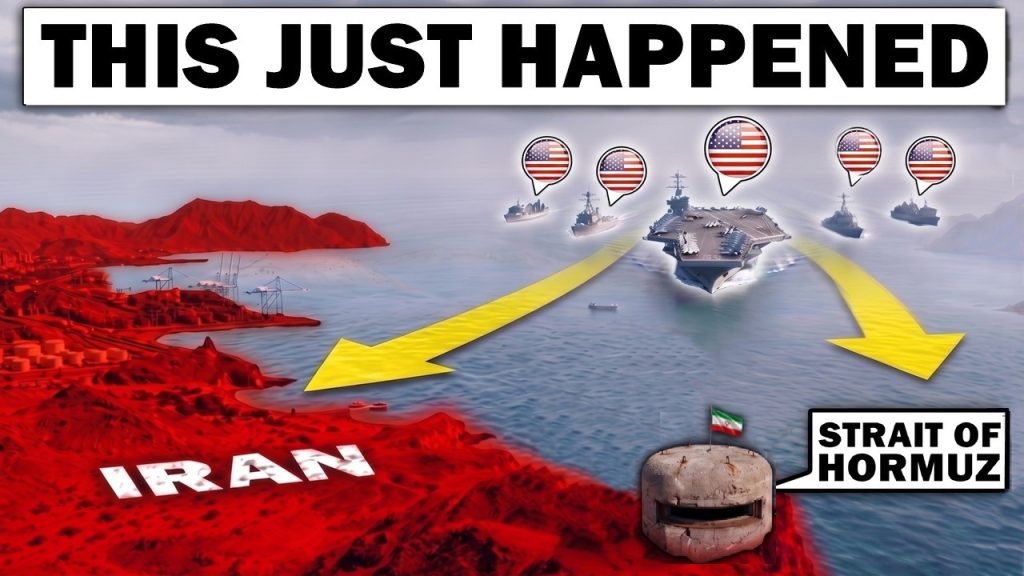
No one expected the situation in the Hormuz Strait to escalate this quickly. Within hours, the region transformed from a tense chokepoint into a heavily militarized zone. Warships began locking positions. Aircraft carriers moved with precision. And thousands of troops quietly prepared for what could come next.
At the center of this operation stands the USS George H.W. Bush, a floating fortress carrying the firepower of an entire air force. Alongside it, the USS Abraham Lincoln reinforces the eastern flank, creating a dual-carrier presence that signals something far beyond deterrence.
This is not just military positioning. This is a calculated move.
A Steel Wall in the Gulf
The scale of the deployment is staggering. Over 70 fighter jets, electronic warfare aircraft, surveillance platforms, and thousands of personnel are now operating in coordination. Around them, a shield of destroyers, cruisers, and amphibious assault ships forms a defensive and offensive perimeter.
Mine sweepers and unmanned underwater vehicles are already working beneath the surface, hunting one of the most dangerous threats in the region: naval mines. At the same time, P-8 Poseidon aircraft patrol the skies, scanning for anomalies with advanced sonar systems.
Then came the turning point.
Within the first 24 hours, not a single ship was able to pass through the Strait if it was connected to Iranian ports. Commercial vessels were forced to turn back. Oil tankers were intercepted. A blockade had effectively begun.
But here is the twist.
This is not a full blockade of global trade. Neutral ships are allowed through. The operation is targeted. Precise. Focused entirely on Iran.
Iran’s Silent Countermove
While the world watched the US build its naval wall, something else was happening on the other side. Quietly, rapidly, Iran began activating a completely different kind of strategy.
Not massive warships. Not billion-dollar systems.
Instead, hundreds of small, fast attack boats began patrolling the waters. Armed with rockets and machine guns, these vessels are designed for swarm tactics. Cheap. Agile. Difficult to track.
At the same time, drones filled the skies. Surveillance drones. Attack drones. Even kamikaze variants capable of overwhelming advanced defense systems. Estimates suggest over 200 UAVs are now active in the region.
And beneath the surface lies the most dangerous layer of all.
Thousands of naval mines. Some floating. Some hidden on the seabed. Some drifting unpredictably with ocean currents. Each one capable of turning a single miscalculation into a catastrophic event.
This is not a conventional defense.
This is asymmetric warfare at its most calculated level.
The Edge of Collision
The Strait of Hormuz is only 33 kilometers wide at its narrowest point. That distance can be crossed by a speedboat in minutes. A missile in seconds.
This is where the real danger begins.
One wrong move. One misinterpreted signal. One aggressive approach by a drone or speedboat. That is all it takes.
v
If that moment comes, the response will not be gradual. It will be immediate. Fighter jets could launch within minutes. Electronic warfare systems could shut down communications. Targets could be eliminated before they even fully emerge.
And if escalation continues, the scenario becomes far more intense.
Swarm attacks. Drone waves. Missile launches from hidden coastal batteries. In response, the US could deploy heavy air support, including strike aircraft and strategic bombers targeting infrastructure deeper inland.
At that point, the situation is no longer a blockade.
It becomes open conflict.
The Hidden Global Impact
But the real story goes beyond military power.
The Hormuz Strait is one of the most critical energy routes in the world. A significant portion of global oil supply passes through this narrow corridor. And for Iran, it represents a vital economic lifeline.
Cutting off that flow does not just impact Tehran. It sends shockwaves far beyond the region.
China, one of the largest buyers of Iranian oil, could face serious supply disruptions. Energy markets could react instantly. Prices could surge. Global economies could feel the pressure within days.
This is why the current situation matters.
It is not just about ships and missiles.
It is about control. Influence. And the balance of power on a global scale.
What Happens Next
Right now, everything hangs in a fragile balance.
The US has deployed overwhelming force. Iran has responded with unpredictable tactics. Both sides are signaling strength. Neither is stepping back.
The Strait of Hormuz has become a pressure point where every move carries consequences far beyond the battlefield.
And the most dangerous part?
The outcome may not depend on strategy.
It may depend on a single mistake.
The world is watching, but no one truly knows how this will end. Will this remain a controlled show of power, or will it spiral into something far more destructive?
Because in a place this narrow, with tensions this high, control is an illusion that can disappear in seconds.
What do you think—Is this a justified strategic move by the US, or a dangerous escalation that could trigger a larger conflict?