
Ram 1500 seat belt recall 26V495000 covers certain 2019-2026 Ram 1500 pickups listed in the official NHTSA recall API. According to NHTSA, the issue involves second-row seat belt buckle anchors that may have been improperly installed, which can affect occupant restraint in a crash. Owners should check VIN status and plan for the free dealer inspection.
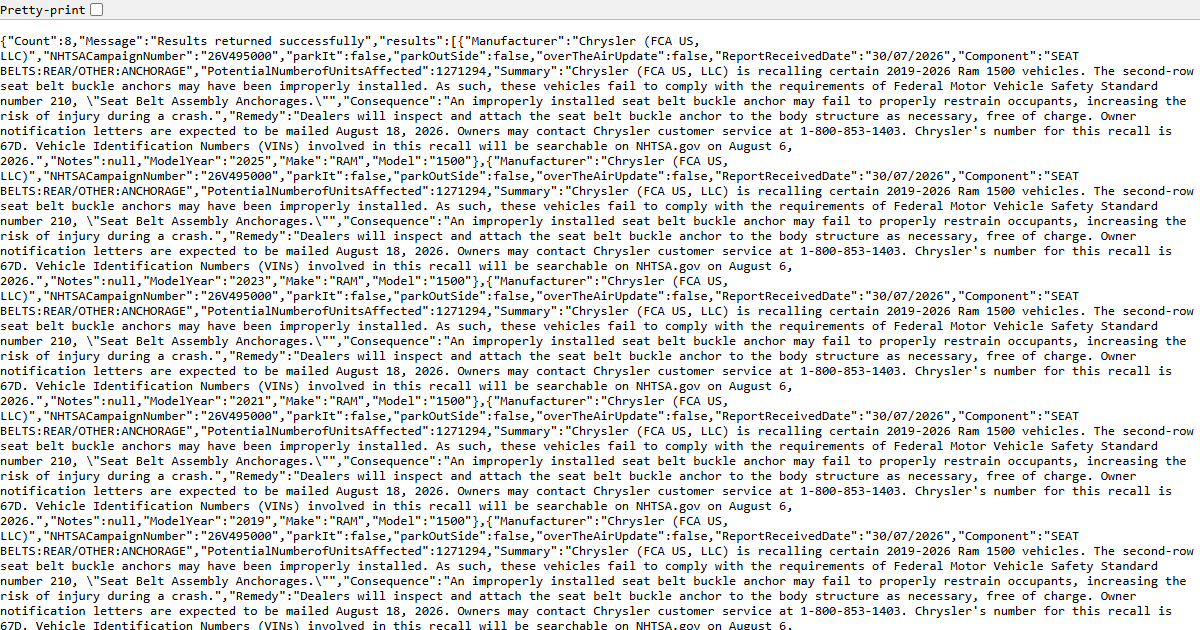
The source is narrow but important. NHTSA does not say every Ram 1500 on the road has this problem, and it does not issue a park-outside instruction for this campaign. The agency says Chrysler is recalling certain trucks because the rear seat belt buckle anchor installation may not meet the federal anchorage requirement. That makes this an owner-action story, not a rumor or a general warning about all Ram trucks.
For readers following other source-based vehicle safety guides, this article belongs to the Navyago Cars desk and follows the same source-first format used in the Ford rearview camera recall guide. The goal is to separate what NHTSA states from what owners still need to verify with a VIN lookup, dealer appointment, and repair record.
Table of Contents
Ram 1500 Seat Belt Recall: quick facts
The official campaign number is 26V495000. The manufacturer listed in the NHTSA API is Chrysler (FCA US, LLC), and the make and model listed across the source rows is RAM 1500. The report received date in the source is July 30, 2026. NHTSA lists the potential number of affected units as 1,271,294.
The component field in the source is `SEAT BELTS:REAR/OTHER:ANCHORAGE`. In plain language, the recall concerns the anchor point for second-row seat belt buckle assemblies. NHTSA says those buckle anchors may have been improperly installed. The agency also says the condition means the vehicles may fail to comply with Federal Motor Vehicle Safety Standard No. 210, which covers seat belt assembly anchorages.
The remedy is an inspection and, when necessary, attachment of the seat belt buckle anchor to the body structure. The source states this dealer action will be free of charge. Chrysler’s recall number is 67D, and the NHTSA source lists Chrysler customer service at 1-800-853-1403.
For a fast owner summary, the Ram 1500 seat belt recall is a rear-seat restraint anchorage campaign, not a software update or cosmetic notice. The practical Ram 1500 seat belt recall action is to check the VIN when the lookup date arrives, then use campaign 26V495000 when booking dealer service.
Which Ram 1500 trucks are listed
The NHTSA API returns rows for 2019, 2020, 2021, 2022, 2023, 2024, 2025, and 2026 Ram 1500 vehicles. That year range is broad, so the most important Ram 1500 seat belt recall owner step is a VIN check. A model year match alone should not be treated as proof that a specific truck is included. Recalls can depend on production dates, equipment, plant data, repair history, or other manufacturer records that are not visible from the model year alone.
Owners should also be careful with trims and body configurations. The public NHTSA API record used for this article identifies Ram 1500 as the model, but it does not list every trim, cab style, drivetrain, or package in the article source fields. If a household has more than one Ram truck, each VIN should be checked separately rather than assuming one result applies to the other.
For fleets, contractors, and families that use rear seats regularly, the affected-vehicle question is more than paperwork. Second-row passengers may include coworkers, older relatives, children in booster seats, or passengers who rely on correct buckle placement during short trips. That is why a recall involving a seat belt anchorage deserves prompt verification even when the truck looks normal in daily use.
Why the seat belt buckle anchor issue matters
NHTSA states the consequence directly: an improperly installed seat belt buckle anchor may fail to properly restrain occupants, increasing the risk of injury during a crash. In this Ram 1500 seat belt recall, that wording is important because it focuses on crash performance, not on a dashboard light, convenience feature, or cosmetic issue. The seat belt may look usable in ordinary driving, but the recall concern is what happens when the restraint system is loaded during a crash event.
A seat belt system depends on several parts working together. The webbing, latch plate, buckle, pretensioner, mounting hardware, and anchor points all matter. If the buckle anchor is not attached correctly to the body structure, the system may not perform as intended when forces rise suddenly. Owners do not need to diagnose that at home; they need the VIN result and dealer inspection that the recall remedy describes.
This article does not add injury reports or incident counts beyond the NHTSA API source. The public-interest point is simpler: when an official safety agency says a restraint component may not hold occupants properly in a crash, the practical next step is verification and repair scheduling, not guessing based on appearance.
What the free dealer repair involves
According to the NHTSA remedy field, dealers will inspect and attach the seat belt buckle anchor to the body structure as necessary, free of charge. The Ram 1500 seat belt recall repair path begins with inspection. If the anchor is already correctly attached, the dealer record should show completion. If action is needed, the dealer should attach the anchor as the manufacturer remedy requires.
Owners should ask the service department to identify the recall by campaign number 26V495000 and Chrysler recall number 67D. Using both numbers reduces confusion, especially because many owners search by make, model year, or a short phrase such as Ram seat belt recall. A service writer can use the VIN to confirm whether the truck is in the campaign and whether parts, tools, or appointment time are available.
The source says the repair is free of charge. Owners should not have to pay for the recall remedy itself. If a dealership suggests unrelated work during the same visit, that should be separated clearly from the recall repair on the estimate and invoice. Keeping the recall completion paperwork matters for resale, fleet records, warranty discussions, and future safety checks.
VIN timing and owner notification dates
The timing details matter because this article is being prepared on August 5, 2026. The NHTSA source says Vehicle Identification Numbers involved in this Ram 1500 seat belt recall will be searchable on NHTSA.gov on August 6, 2026. That means an owner checking on August 5 may not yet see the final VIN result in the public lookup. A no-result check before that date should not be treated as permanent proof that a truck is clear.
The same source says owner notification letters are expected to be mailed August 18, 2026. Letters can lag behind online recall records, especially for owners who recently moved, bought a used truck, or have registration information that has not caught up. Waiting for a letter is not the only option. Once the VIN lookup is active, owners can check the NHTSA site or contact a Ram/Chrysler dealer directly.
If an owner already has an appointment for unrelated service, it is reasonable to ask the dealership to check campaign 67D at the same time. If the public VIN lookup is not active yet, ask when the dealer system expects to show the campaign. The answer should be based on the VIN, not a general statement about the model year.
What owners should do now
For the Ram 1500 seat belt recall, first write down the VIN from the truck or registration record. Second, check the official NHTSA recall lookup when the source says VINs are expected to be searchable, which is August 6, 2026. Third, contact a Chrysler, Dodge, Jeep, or Ram dealer if the VIN is listed or if the owner needs confirmation. Fourth, schedule the inspection and repair if the dealer confirms campaign 26V495000 applies.
Owners should also look at normal seat belt behavior without trying to repair anything themselves. If a buckle is loose, hard to latch, damaged, or visibly misaligned, stop treating that seat as safe until a qualified repair facility checks it. The NHTSA recall does not require owners to inspect anchor hardware at home, and it does not support a do-it-yourself repair recommendation.
Because NHTSA’s park-it and park-outside flags are false in this source, this article is not telling owners to park outside or stop driving every Ram 1500. The source supports a more specific action: verify whether the VIN is included, arrange the free dealer inspection, and keep the completion record after the remedy is done.
Ram 1500 seat belt recall checklist
This Ram 1500 seat belt recall checklist is meant to keep the owner steps simple. It does not replace the NHTSA lookup or dealer system, but it can help owners avoid the two common mistakes with broad recalls: assuming a model-year match is enough, or assuming a no-result check before the VIN date is final.
- Confirm the campaign. Save the NHTSA campaign number 26V495000 and Chrysler recall number 67D before calling a dealer.
- Check the VIN after the listed timing date. The source says VINs for this Ram 1500 seat belt recall are expected to be searchable on NHTSA.gov on August 6, 2026.
- Ask for recall-specific service. Tell the service department that the issue is the second-row seat belt buckle anchor, not a general seat belt complaint.
- Confirm the remedy is free. The NHTSA remedy says dealers will inspect and attach the buckle anchor to the body structure as necessary, free of charge.
- Keep the completion record. After the Ram 1500 seat belt recall visit, keep the repair order with the VIN, date, campaign number, and dealer result.
- Recheck if timing changes. If the first VIN lookup happens before August 6, or if the dealer says records are still loading, repeat the official check after the expected search date.
For households that carry rear-seat passengers daily, the checklist also creates a short decision trail. An owner can show when the VIN was checked, whether the truck was included, when the appointment was booked, and when the Ram 1500 seat belt recall repair was completed. That is more reliable than relying on memory several months later.
Ram 1500 seat belt recall questions to ask the dealer
A dealer conversation goes better when the owner names the campaign clearly. Start with the VIN, then ask the service department whether NHTSA campaign 26V495000 or Chrysler recall 67D is open for that specific truck. If the answer is yes, ask whether the visit is only an inspection or whether the shop expects to attach the buckle anchor during the same appointment. The NHTSA remedy says dealers will inspect and attach the seat belt buckle anchor to the body structure as necessary, but the appointment length can still vary by shop workload.
Owners should also ask what paperwork will prove completion. A recall invoice or repair order should identify the campaign number, show that the remedy was performed or that inspection found no further action needed, and list the date of service. That record is useful if the truck is sold later, if another dealer questions the status, or if an owner wants to confirm that the Ram 1500 seat belt recall no longer appears as open for the VIN.
If a dealer says the VIN is not showing yet, ask whether that is because the public VIN lookup date has not arrived, because the dealer system has not updated, or because the truck is outside the affected population. Those are different answers. The NHTSA source says VINs are expected to be searchable on August 6, 2026, so a check before that date can be premature. A follow-up check after the VIN date is the cleaner way to avoid a false sense of certainty.
Used-truck shopping and service records
Used Ram 1500 shoppers should treat the Ram 1500 seat belt recall as part of the pre-purchase checklist. A seller may not know whether a recall is open, especially if the truck changed hands recently. The buyer should run the VIN through the NHTSA recall lookup and ask for service records showing whether campaign 26V495000 or Chrysler recall 67D has been completed.
Dealers and private sellers should avoid vague statements such as “all recalls are done” unless they can show a current VIN report or completion paperwork. Recall status can change as campaigns are loaded, expanded, repaired, or closed. A fresh VIN report close to purchase time is more useful than an old screenshot.
Fleet managers have an extra recordkeeping burden. If the recall applies to work trucks, the fleet should track each VIN, appointment date, repair completion, and any seat assignments that may matter before repair. The recall’s scale means some service departments may see higher demand after owner letters go out, so early scheduling may reduce downtime.
Fleet and family planning notes
For a single-owner household, the Ram 1500 seat belt recall is usually a simple checklist item: check the VIN, book the dealer visit if included, and keep the repair record. For a fleet, school-related household, contractor crew, rideshare use, or family that regularly carries rear-seat passengers, the planning step is more important. The recall concern is tied to second-row buckle anchors, so rear-seat use should be part of the temporary risk conversation until the VIN status and repair status are clear.
This does not mean the NHTSA source orders every listed truck out of service. It does mean owners should avoid casual assumptions. If the truck carries children, employees, or older passengers in the second row, a fleet manager or parent may decide to use another vehicle for those trips until the VIN check is complete. That is a practical planning choice, not a new instruction from NHTSA.
Fleets should keep a simple recall log with five fields: VIN, driver or assigned unit, campaign number 26V495000, dealer appointment date, and completion result. The log should separate trucks that are not included from trucks that are included and still awaiting service. For this Ram 1500 seat belt recall, that separation matters because the model-year range is broad and because not every truck that shares a model year is automatically confirmed by this article alone.
Families should take a similar approach with less paperwork. Save a screenshot or PDF of the NHTSA VIN result when available, save the dealer repair order, and check that the recall no longer appears as open after the appointment. If the truck was recently purchased used, also make sure the current owner address is up to date with the manufacturer or dealer so future safety notices do not go to a previous owner.
What remains uncertain
The public API source for this Ram 1500 seat belt recall does not answer every practical question. It does not list every trim, build date, plant, part supplier, or inspection procedure in the fields used for this article. It also does not say how many trucks will need a physical attachment repair after inspection. Those details may appear in dealer instructions, manufacturer filings, or future updates.
The source also does not say that every second-row belt anchor in every affected model year is defective. A recall defines a population that must be inspected or repaired under the manufacturer remedy. That is different from an individual diagnosis. For a specific truck, the VIN result and dealer inspection are the controlling steps.
Navyago will treat later changes as source updates if the official record changes. For now, the reliable facts are the campaign number, the affected model-year range in the API rows, the NHTSA risk statement, the free dealer remedy, the August 6 VIN lookup timing, and the August 18 owner-letter timing.
Frequently Asked Questions
What is the Ram 1500 seat belt recall number?
The NHTSA campaign number for the Ram 1500 seat belt recall is 26V495000. Chrysler’s manufacturer recall number is 67D.
Which model years are listed in the Ram 1500 seat belt recall source?
The NHTSA API rows for the Ram 1500 seat belt recall list 2019, 2020, 2021, 2022, 2023, 2024, 2025, and 2026 Ram 1500 vehicles. Owners should still check the specific VIN.
What is the safety risk in this Ram 1500 seat belt recall?
NHTSA says the Ram 1500 seat belt recall involves an improperly installed second-row seat belt buckle anchor that may fail to properly restrain occupants, increasing injury risk during a crash.
Is the Ram 1500 seat belt recall dealer repair free?
Yes. The NHTSA remedy field for the Ram 1500 seat belt recall says dealers will inspect and attach the buckle anchor to the body structure as necessary, free of charge.
When should owners check the Ram 1500 seat belt recall VIN?
The source says VINs involved in the Ram 1500 seat belt recall will be searchable on NHTSA.gov on August 6, 2026. Owner notification letters are expected to be mailed August 18, 2026.
Sources
Sources: National Highway Traffic Safety Administration recalls API, campaign 26V495000, accessed August 5, 2026, at https://api.nhtsa.gov/recalls/campaignNumber?campaignNumber=26V495000; NHTSA public recall lookup, https://www.nhtsa.gov/recalls?nhtsaId=26V495000. This Ram 1500 seat belt recall article is a source-based owner guide and does not replace a VIN-specific dealer or NHTSA lookup.