
US Iran naval clash intensifies after US Navy disables Iranian cargo ship violating blockade, raising fears of wider conflict in Hormuz Strait.
The US Iran naval clash is no longer just a warning or a show of force. It has crossed a line that could change everything.
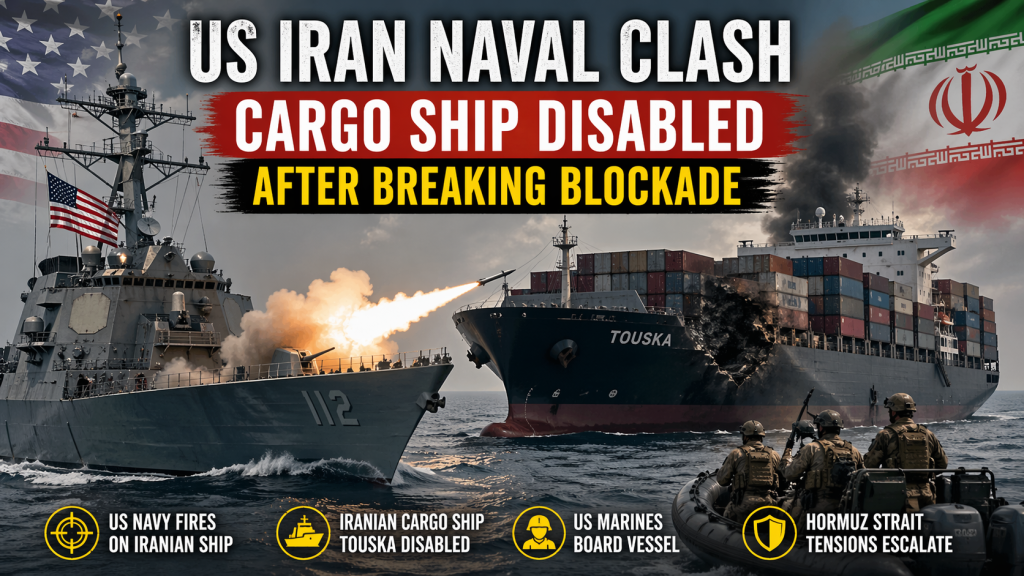
What happened in the Gulf of Oman was not a routine interception. It was a moment where tension turned into action, where warnings were ignored, and where the consequences became immediate and irreversible.
It began with a simple command repeated over open radio.
Vacate the engine room.
Stop the vessel.
But the Iranian cargo ship kept moving.
The vessel, identified as a large container ship nearly 900 feet long, continued its course despite multiple warnings from US naval forces. It was heading toward Iranian ports, crossing what the United States had already declared as a restricted blockade line.
For hours, the situation escalated slowly.
Warnings turned into threats.
Threats turned into final notices.
And then, the decision was made.
Six Hours of Pressure Before the Strike
According to military reports, the US Navy spent nearly six hours attempting to force compliance. Communication channels were used repeatedly. Signals were sent. Flares were deployed as visual warnings.
But nothing changed.
The cargo ship maintained speed, moving at roughly 16 to 17 knots, refusing to alter its course.
At that point, the situation shifted from control to enforcement.
The US guided missile destroyer positioned nearby took direct action, targeting the most critical point of the vessel — its engine room.
The Strike That Stopped the Ship
When the shots were fired, the objective was not to destroy the vessel.
It was to disable it.
Several rounds struck the engine section, effectively shutting down propulsion. The massive ship, once moving steadily through international waters, slowed and eventually stopped.
Within hours, US Marines boarded the vessel.
Control was taken.
The ship, once defiant, was now in custody.
Why the Navy Chose to Fire Instead of Board First
This is where the story becomes more complex.
Why didn’t US forces simply board the ship before opening fire?
The answer lies in the nature of container vessels themselves.
Unlike oil tankers, which have flat, accessible decks, container ships are stacked with cargo, creating dangerous and obstructed terrain. Boarding operations become far more risky. Troops would be exposed, with limited cover and difficult movement across stacked containers.
Every second spent attempting a risky boarding could have escalated the threat.
So instead, the Navy chose a faster, controlled method — disable first, secure later.
A Larger Strategy Behind the Clash
This was not an isolated incident.
It comes amid a broader US strategy to enforce a strict maritime blockade targeting Iranian shipping activity. The goal is clear: limit Iran’s ability to move goods, export oil, and maintain economic flow through critical routes like the Strait of Hormuz.
Recent reports indicate that multiple vessels have already been forced to turn back, unable to cross the blockade line. Some were intercepted before departure. Others were warned mid-transit.
And now, for the first time, one has been physically stopped by force.
Iran Under Pressure
The blockade is not just about military control.
It is economic warfare.
Estimates suggest Iran could be losing hundreds of millions of dollars per day as its exports are disrupted. This pressure is already beginning to show cracks within its leadership, with conflicting responses emerging between diplomatic and military factions.
But pressure can lead to two outcomes.
Compliance.
Or escalation.
The Dangerous Path Forward
The Strait of Hormuz is one of the most sensitive and strategic waterways in the world. Even a small incident can trigger global consequences.
Now, with direct engagement confirmed, the risk level has changed dramatically.
Every ship approaching the region now faces a decision.
Turn back.
Or risk confrontation.
And every confrontation carries the possibility of something bigger.
Because once shots are fired, it becomes much harder to step back.
The Twist That Changes the Narrative
Here’s what makes this situation even more critical.
The blockade is not targeting global trade.
Neutral vessels are still allowed to pass. The operation is focused specifically on Iranian-linked shipping.
This precision makes the strategy more controlled.
But it also makes every targeted encounter more intense.
Because each one becomes a direct test of power between two sides that refuse to back down.
What Happens Next
Right now, the disabled cargo ship is under US control. Investigations into its cargo and operations are underway.
But the bigger question remains unanswered.
Was this a one-time enforcement action?
Or the beginning of a more aggressive phase?
With additional naval forces moving into the region and tensions rising on both sides, the answer may come sooner than expected.
The US Iran naval clash has entered a new stage.
Not just warnings. Not just positioning.
Action.
And in a region as volatile as the Strait of Hormuz, action rarely stays contained for long.
So now the real question is this:
Was this a necessary move to enforce order… or the spark that could ignite something far more dangerous?