
San Leandro Welfare Check Video: 7 Critical Source Facts
San Leandro welfare check video coverage from PoliceActivity centers on a May 7, 2026 welfare check that moved from a non-emergency call to a phone conversation, a response at the San Leandro Marina, an officer-involved shooting, and a reported firearm recovery. The source is useful for understanding the timeline, but it does not replace the full investigative record.
What the San Leandro welfare check video source says happened
The source video is a PoliceActivity upload titled What Began as a Welfare Check Took an Unexpected Turn. According to the video page description, San Leandro Police dispatch received a non-emergency call just after 8 p.m. on May 7, 2026. The caller was out of state and said attempts to reach his friend, identified in the source as 39-year-old David McAlpin, were going straight to voicemail.
PoliceActivity’s description says officers responded to McAlpin’s Santiago Road residence for a welfare check and made contact with his family. The family was reportedly unaware of the concern raised by the caller and did not know McAlpin’s whereabouts at that moment. The source says family members later made contact with him but were unsuccessful in convincing him to return home.
The narrow source-based point is that the San Leandro welfare check video is not only a short shooting clip. It describes a sequence that began with concern from a friend, moved through family contact, then shifted to direct phone contact between an officer and McAlpin. That timeline matters because welfare-check stories can be misunderstood when readers skip the steps before officers arrive at the final scene.
For search readers arriving from a short clip or a repost, the San Leandro welfare check video also needs a slower read because the source description carries several qualifiers. It names the original call type, the reported family contact, the phone conversation, the Marina location, the officer positions, and the limits of what body-worn cameras clearly captured. Those details are the reason this recap keeps returning to the source language instead of turning the event into a one-line verdict.
Why the welfare check start matters
A welfare check is usually framed around concern for a person’s safety, not an ordinary criminal investigation. In this source package, the first reported trigger was a friend who could not reach McAlpin and contacted police from outside California. The PoliceActivity description does not say the original caller reported a crime in progress, a chase, a domestic call, or a public disturbance. It says officers were asked to check on him.
That starting point does not decide whether later police actions were right or wrong. It does, however, explain why the case is important for public-safety readers. Welfare checks often involve limited information, third-party concern, family contact, uncertainty about a person’s location, and questions about whether someone might need immediate help. Those conditions can change quickly as officers learn more.
The source says officers had received information that McAlpin owned a firearm, while also saying he denied being armed. That pair of facts is important because it shows the difference between reported background information and what the person on the call said. A careful article should keep both points attached to the source rather than turning either one into an unsupported conclusion.
That is why the San Leandro welfare check video should be separated from ordinary crime-video summaries. A welfare-check origin can matter to readers who are trying to understand dispatch information, officer expectations, family involvement, and the point at which a non-emergency concern becomes a high-risk police contact. The source does not answer every policy question, but it gives enough sequence for readers to see why the beginning of the call belongs in the article, not only the final seconds.
How officers moved from phone contact to the Marina
According to the PoliceActivity description, Officer Qiu eventually spoke with McAlpin by phone. During a lengthy conversation, the source says Officer Qiu was able to convince him to share his location so officers could meet with him in person. The location identified in the source was the San Leandro Marina.
The source says Officer Qiu told McAlpin that he and additional officers would respond to that location. It also says Officer Qiu spoke with him for approximately ten minutes at the Marina. Those details matter because they show a continued attempt at communication before the final escalation described later in the source.
For readers, the useful question is not whether one video can answer every tactical or legal issue. The useful question is how the source describes the timeline: a non-emergency concern, a home welfare check, family contact, phone contact, location sharing, an in-person response, and then the final vehicle-side encounter. A timeline-based reading keeps the San Leandro welfare check video from becoming a simplified headline.
The phone-contact portion also explains why the location change matters. If the San Leandro welfare check video is watched only from the Marina scene, readers may miss that officers did not simply come upon the vehicle without prior contact. The source says there was a phone conversation first, and it says McAlpin shared his location during that call. Those facts still do not settle the later use-of-force questions, but they help define what the public source actually says happened before officers reached the vehicle.
The reported firearm detail and officer response
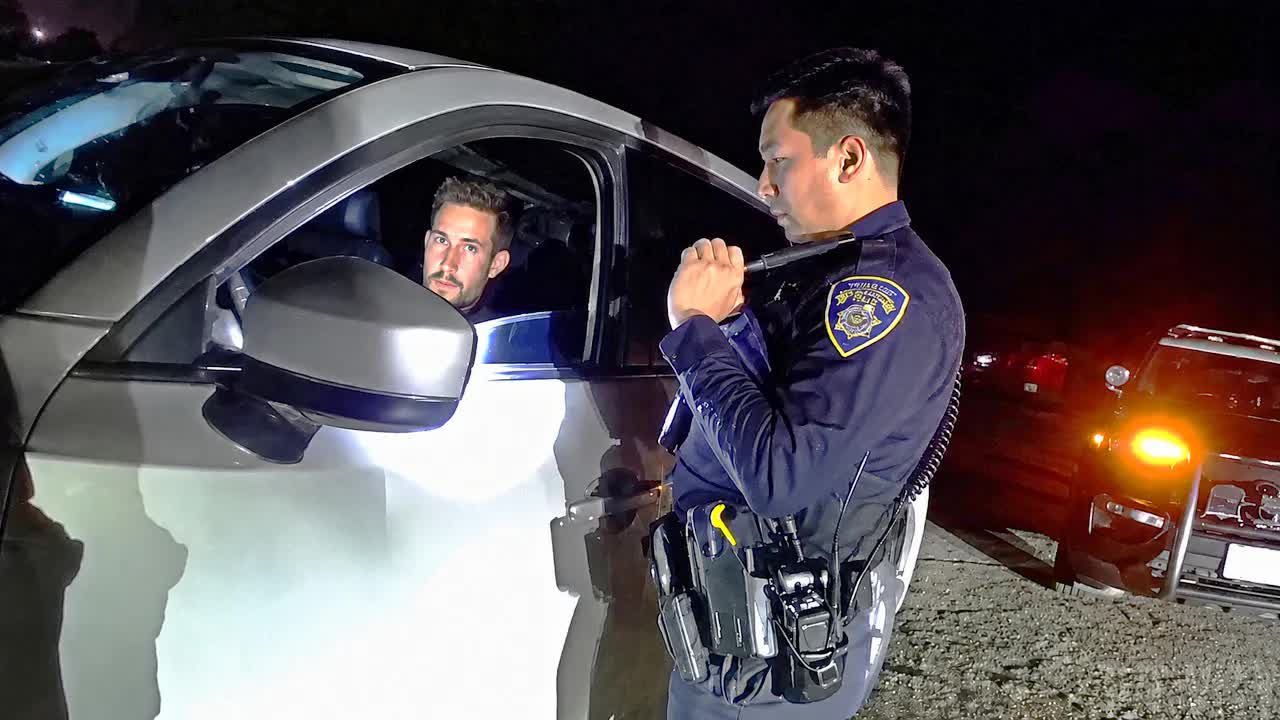
The most sensitive part of the PoliceActivity source begins when the officer approaches the driver’s side. The description says that as Officer Qiu began to open the driver’s door, McAlpin reached for an object. It says Officer Caleb Schwitters, positioned near the windshield, ordered him to stop reaching.
PoliceActivity’s description then says McAlpin produced a firearm and that Officers Schwitters, Navarro, and Martinez discharged their service weapons. The description also adds an important limitation: all three officers who discharged their service weapons were recording with body-worn cameras, but none of the officers’ cameras clearly captured McAlpin as he produced the firearm.
That limitation should stay visible in any legal-safe recap. The source states the firearm point, but it also says the body-worn cameras did not clearly capture that specific moment. A careful article can repeat the source’s account without overstating what the public video alone shows.
The source further says that approximately 50 seconds after officers discharged their service weapons, another gunshot is heard, and investigators later determined that shot was fired by McAlpin. It says McAlpin remained armed and unresponsive to commands, emergency medical personnel treated him at the scene, he was pronounced dead, and investigators recovered a firearm from the vehicle. This article treats those as source-attributed facts from the PoliceActivity description.
In other words, the San Leandro welfare check video presents two different evidence layers. One layer is the public footage and audio that viewers can inspect for themselves. The other layer is the written source description, which reports what investigators later determined and what was recovered. Navyago keeps those layers separate because the wording affects how readers understand the strength and limits of the public material.
What readers should not assume from the video alone
A public video can make a complex incident feel easy to summarize, but the San Leandro welfare check video should be read with caution. The source gives a timeline and describes what investigators later determined, yet it is still one public source package. It does not include every police report, every witness interview, every forensic record, every family statement, or any final legal decision that may follow.
Readers should also avoid assuming motive. The source says a welfare check began after an out-of-state friend could not reach McAlpin. It says officers were told he owned a firearm and that he denied being armed. It says officers later reported a firearm-related escalation. Those details do not allow a reader to confidently state what McAlpin intended at every moment.
The same caution applies to officer decision-making. The video page describes commands, positions, body-worn camera footage, and the discharge of service weapons, but a full evaluation would require the investigative file, department policy, any district attorney review, any civil claim if filed, and any public agency findings. Navyago’s role here is to keep the source facts clear, not to announce a legal verdict.
A useful way to read the San Leandro welfare check video is to ask what each sentence can be traced back to. The timeline can be traced to the source description. The embedded clip can show certain movements, audio, and officer positions. The firearm recovery and later investigative determination are source-attributed claims. Anything beyond those lanes, including motive, policy compliance, civil liability, or criminal-law conclusions, needs records that are not included in this source package.
Seven San Leandro welfare check video source facts to keep straight
The seven points below summarize the source package without turning a public upload into a full legal record.
1. The call was reported as non-emergency. PoliceActivity says dispatch received a non-emergency call from an out-of-state friend who could not reach McAlpin.
2. Officers first went to the Santiago Road residence. The source says officers contacted McAlpin’s family there during the welfare-check response.
3. Family contact did not resolve the concern. According to the source, family members reached McAlpin but were unsuccessful in convincing him to return home.
4. Officer Qiu spoke with McAlpin by phone. The source says the officer convinced him to share his location so officers could meet him in person.
5. The final in-person contact was at the San Leandro Marina. The source says Officer Qiu and additional officers responded to that location.
6. The firearm moment has a source limitation. PoliceActivity says McAlpin produced a firearm, while also saying body-worn cameras did not clearly capture that specific moment.
7. Investigators reportedly recovered a firearm. The source says investigators recovered a firearm from the vehicle after McAlpin was pronounced dead.
Together, these seven points are the core facts a reader should carry away from the San Leandro welfare check video. The list does not try to replace the source, and it does not close questions that would require official records. It simply keeps the public timeline readable: call, home response, family contact, phone contact, Marina contact, reported firearm escalation, and recovery detail.
What the case shows about welfare-check review
The San Leandro welfare check video is useful because it shows how quickly a public-safety call can move across different stages. A caller’s concern led to a home response, a family conversation, a phone conversation, a location disclosure, an in-person meeting, and then a force incident that will likely be reviewed through official channels.
For readers, each stage raises a different question. The first question is what information dispatch had when the call came in. The next question is what officers learned at the home. Another question is what was said during the phone contact. At the Marina, the questions become more tactical: positions, commands, visibility, vehicle access, reported reaching, and what officers could see in the moment.
The welfare-check label also matters because these calls can involve people in distress, family concern, medical uncertainty, or mental-health concern, but the source here does not give enough information to diagnose anyone or claim a specific medical state. Responsible coverage should not add a diagnosis, speculate about private mental-health details, or use the person’s death for sensational language.
As with Navyago’s dashcam arrest lawsuit video recap, the practical reader habit is to separate what the source says from what later records may decide. The San Leandro welfare check video gives enough source material for a timeline explainer. It does not replace agency review, public records, court filings, or formal findings.
This is also why a source-first structure is useful for public-interest coverage. A reader may care about police training, dispatch decisions, body-camera transparency, family communication, or post-incident review. The San Leandro welfare check video touches all of those areas, but it does not fully resolve any of them. A good recap should make the next questions visible without pretending that a single upload answers them.
Which records would matter next
If readers want to follow the case beyond the PoliceActivity upload, the most useful next records would be the San Leandro Police critical incident materials, dispatch audio if released, officer reports, body-worn camera release notes, investigative summaries, forensic records, and any prosecutor or agency review. Those records would help clarify what was known before the Marina contact and how officials evaluated the response.
Public records could also clarify the recovered firearm detail, the sequence of shots, the location of officers around the vehicle, and the exact timing between commands and gunfire. The video description gives a useful summary, but the complete investigative file would be the stronger source for final conclusions.
If any lawsuit or administrative claim is later filed, that would create another layer of records. A civil complaint, answer, motion, settlement, or judgment would answer different questions than the initial incident narrative. Until those records exist or are reviewed, this article should stay narrow: it explains what the source says and what readers should keep separate.
For now, the San Leandro welfare check video should be treated as a starting point for understanding the public narrative. It is enough to explain the source timeline and the reason the case drew public attention. It is not enough to settle every disputed factual issue, every tactical question, or every legal question that could emerge from a full investigation.
Source Video
Sources
Sources: Primary source: PoliceActivity, What Began as a Welfare Check Took an Unexpected Turn, uploaded July 17, 2026, accessed August 4, 2026. This San Leandro welfare check video article uses the video page description, source thumbnail, chapter list, and visible YouTube source package as the factual basis. Claims about what officers were told, what McAlpin denied, what the cameras captured, what investigators later determined, and what was recovered are attributed to the source description unless a later official record is cited.
Frequently Asked Questions
What is the San Leandro welfare check video about?
The San Leandro welfare check video is about a May 7, 2026 call that began as a non-emergency welfare concern and later moved to police contact at the San Leandro Marina. PoliceActivity says the incident ended with an officer-involved shooting and a firearm recovered from the vehicle.
Does the video prove every disputed fact?
No. The source gives a detailed timeline, but it also says body-worn cameras did not clearly capture the moment when McAlpin allegedly produced a firearm. A full evaluation would require investigative records and any official findings.
Why is the welfare-check starting point important?
The starting point matters because officers were reportedly responding to concern from an out-of-state friend, not to an ordinary crime-in-progress headline. That context helps readers understand why family contact, phone contact, and location sharing are part of the source timeline.
Why does Navyago use the source thumbnail?
Navyago’s YouTube workflow uses the original source-video thumbnail or an exact uploaded copy when a YouTube video is the approved source. That keeps the featured image, body image, source note, and embedded video tied to the same video ID.