
Ford rearview camera recall 26V489000 covers certain F-150 and F-250 SD trucks with 8-inch SYNC infotainment screens. According to NHTSA, a software error may let the home screen menu obstruct the rearview camera image in reverse, reducing rear visibility. Owners should check the VIN, watch for Ford notices, and schedule the free APIM software update when available.
This Ford rearview camera recall guide explains the official recall record in plain language. It is written for owners, shoppers, fleet managers, service advisors, and insurance or finance readers who need the practical facts without guessing beyond the source. The public NHTSA campaign API is the source of record for this article, and the campaign number is 26V489000.
Ford rearview camera recall: what NHTSA says
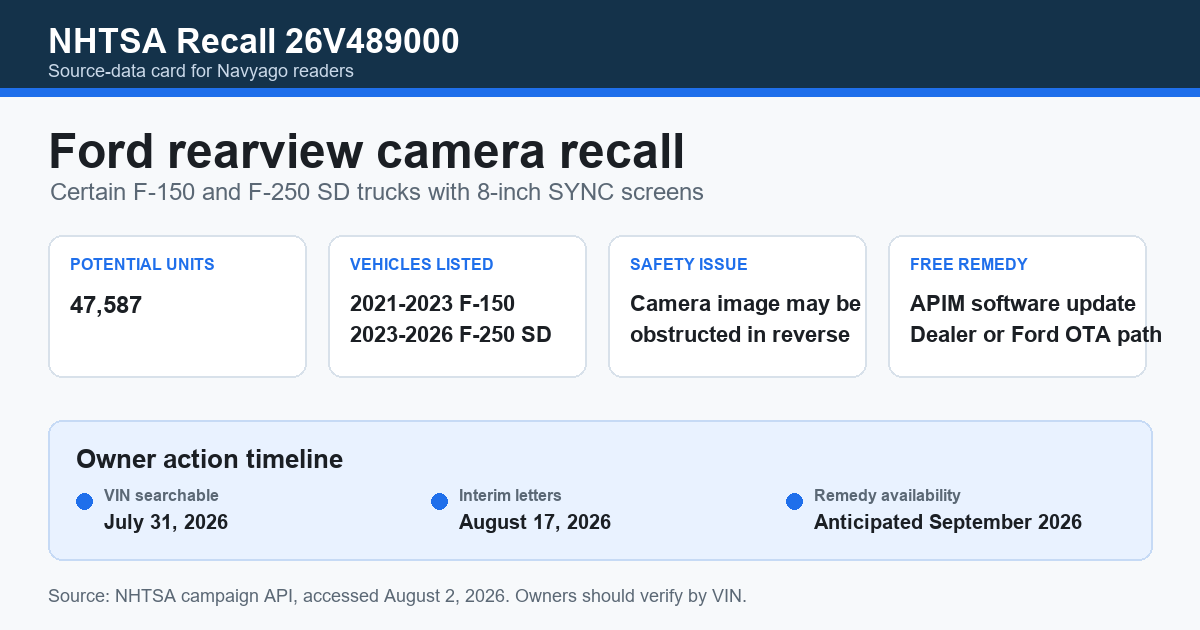
The NHTSA campaign record names Ford Motor Company as the manufacturer and lists the component as back over prevention: display function. The Ford rearview camera recall applies to certain Ford trucks equipped with 8-inch SYNC infotainment screens. The source says a software error may cause the rearview camera image to be obstructed by the infotainment home screen menu when the vehicle is placed in reverse.
The official summary also says the affected vehicles fail to comply with Federal Motor Vehicle Safety Standard number 111, Rear Visibility. That is the federal rear-visibility rule named in the NHTSA record. Navyago is not adding a separate legal finding; the article is paraphrasing the agency’s campaign summary and keeping the claim tied to the public record.
NHTSA lists 47,587 potential units affected. That number matters because it shows the recall is not a one-vehicle service note. It still should not be read as proof that a specific truck has the software condition. Vehicle recalls are administered by VIN, so model, year, and screen size are starting points, not final proof for any one truck.
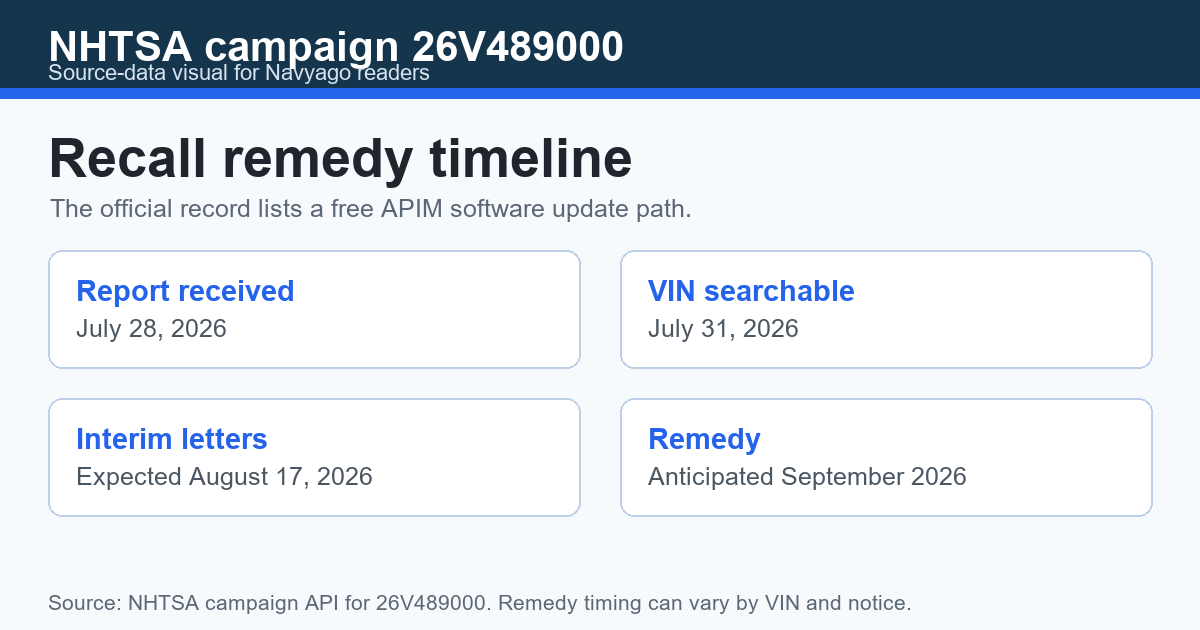
The campaign report received date is listed as 28/07/2026 in the API output. In reader terms, the source record was received on July 28, 2026. The same record says VINs involved in this recall became searchable on NHTSA.gov on July 31, 2026, which means owners can check a specific truck rather than waiting only for paper mail.
Which Ford trucks are listed in campaign 26V489000?
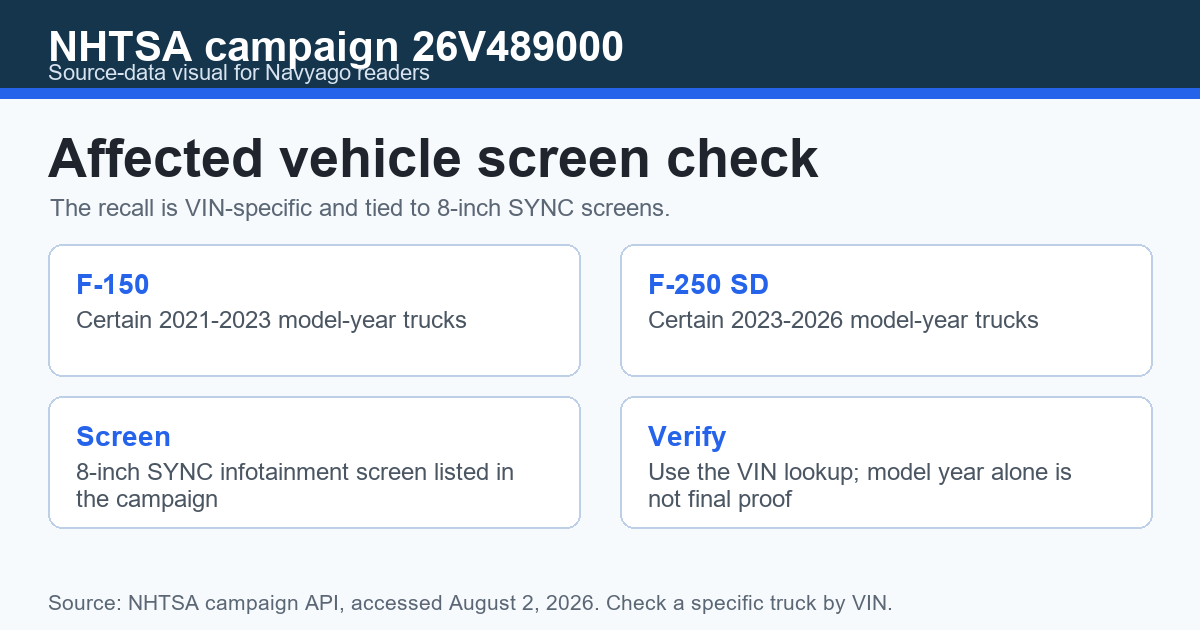
The NHTSA API returns model-year rows for certain 2021-2023 Ford F-150 trucks and certain 2023-2026 Ford F-250 SD trucks. The Ford rearview camera recall record specifically says the trucks are equipped with 8-inch SYNC infotainment screens. That screen detail is important because the recall is tied to how the infotainment home screen can obstruct the rearview camera image.
Readers should not assume that every F-150, every F-250 Super Duty, or every Ford truck in those years is included. The official phrasing is “certain” vehicles, and the practical owner test is the VIN. A truck can share the same model year and still be outside a campaign population because recalls may depend on build configuration, production window, software package, or equipment.
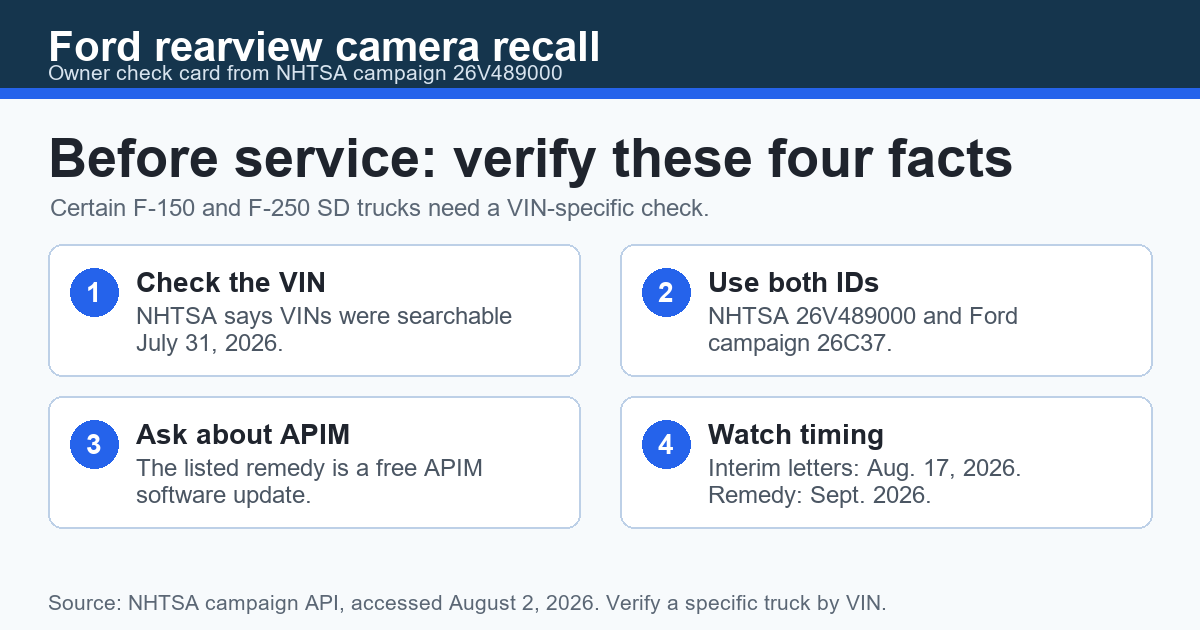
The source rows include 2021, 2022, and 2023 F-150 entries, plus 2023, 2024, 2025, and 2026 F-250 SD entries. Ford’s listed number for the recall is 26C37. Owners who call a dealer or Ford customer service should keep both identifiers nearby: NHTSA 26V489000 and Ford 26C37.
This source-based coverage fits Navyago’s Cars and public-interest lane because rear-visibility systems are safety equipment, not convenience decoration. For a related example on camera-display failures, readers can compare Navyago’s Volkswagen Atlas rearview camera recall guide. The campaigns are different, but the owner task is similar: match the vehicle to the campaign number and follow the official remedy path.
Why the 8-inch SYNC screen issue matters in reverse
A rearview camera is meant to help drivers see behind the vehicle when backing up. It does not replace mirrors, head checks, parking sensors, or cautious driving, but it is part of the rear-visibility system required for modern vehicles. That is why the Ford rearview camera recall matters beyond a screen annoyance: if the image is blocked or partly covered by another menu, the driver can lose useful information at the moment the vehicle is moving backward.
NHTSA’s consequence statement is direct. According to the campaign record, an obstructed rearview camera image can reduce the driver’s rear visibility, increasing the risk of a crash. The article does not claim that crashes have occurred, that every screen fails, or that every affected truck is unsafe to drive. Those details are not stated in the source API fields reviewed for this run.
The problem described by NHTSA is a software-display issue, not a statement that the camera lens has fallen off or that the truck cannot reverse. The source wording says the camera image may be obstructed by the infotainment home screen menu when the vehicle is placed in reverse. That is why the remedy is a software update to the accessory protocol interface module, often shortened to APIM.
For owners, the risk is practical. Backing up in a driveway, parking lot, worksite, trailer area, loading zone, or school pickup lane already requires attention. A missing or obstructed camera image can make it harder to see pedestrians, low objects, trailers, curbs, carts, pets, or other vehicles. The official recall helps owners identify whether their truck needs the update.
Free APIM remedy, OTA update status, and owner-letter timing
For the Ford rearview camera recall, the remedy field says the accessory protocol interface module software will be updated by a dealer or through an over-the-air update, free of charge. That means the recall is not described as a paid customer repair. Owners should still confirm the process for their VIN because dealer scheduling, software availability, and owner-letter timing can vary.
The API flag overTheAirUpdate is listed as false, even though the remedy text says the APIM software can be updated by a dealer or through an OTA update. The safest reading is to keep both facts visible instead of choosing the more convenient one. The structured flag is false in the API response, while the remedy text explicitly mentions a dealer or OTA update path. Owners should follow Ford’s specific instructions for their VIN once the update is available.
NHTSA says interim letters notifying owners of the safety risk are expected to be mailed beginning August 17, 2026. Additional letters will be sent once the remedy is available, anticipated in September 2026. That timeline means a truck may appear in the online VIN lookup before the owner receives the final remedy notice.
The record lists Ford customer service at 1-866-436-7332. When calling, use the campaign numbers and ask whether the specific VIN is included, whether the APIM update is ready, whether the update can be completed over the air, and whether a dealer appointment is recommended. If a dealer says the update is not ready, ask when to check again and whether they can record the VIN inquiry.
What owners, shoppers, and fleets should do now
For this Ford rearview camera recall, first run a VIN check. The public NHTSA recall lookup is available at https://www.nhtsa.gov/recalls. A VIN result is more precise than a headline because it connects the campaign to a specific truck. Owners can also use Ford’s owner recall tools or ask a Ford dealer to check the VIN.
Second, save the identifiers. The NHTSA campaign number is 26V489000, and Ford’s campaign number is 26C37. These numbers help separate this rearview-camera software recall from unrelated Ford service bulletins, trailer-brake campaigns, engine recalls, label recalls, or general infotainment complaints.
Third, do not wait for a mailed letter if you are actively buying, selling, financing, or servicing a truck that may be included. The source says VINs became searchable on July 31, 2026. A used-truck shopper can ask the seller for the VIN and check open recalls before signing. A fleet manager can add the campaign number to maintenance tracking and schedule follow-up when the update becomes available.
Fourth, be careful when backing up if the camera view appears blocked, delayed, or unreliable. This article is not diagnosing an individual display, but the source issue involves rear visibility while in reverse. If the display behaves unexpectedly, use mirrors and direct visual checks, stop if visibility is not adequate, and ask a dealer whether the truck is included in campaign 26V489000.
Fifth, keep records. Save the VIN lookup date, dealer answer, software update confirmation, and any repair order. For fleets, a brief note can identify the truck, VIN, recall number, update date, and person who verified completion. That record is useful if the vehicle is later sold, audited, insured, or assigned to a different driver.
What not to assume from the recall record
The Ford rearview camera recall is serious, but it should be read narrowly. The source does not say that all Ford F-150 and F-250 trucks have a camera failure. It does not say the truck should be parked outside or stopped from use. It does not give a crash count, injury count, defect rate, resale-value estimate, compensation program, or final build-date table in the API fields reviewed for this article.
The API flags list parkIt=false and parkOutSide=false. Those fields do not make the recall optional; they simply show that the campaign is not marked as a park-it or park-outside instruction in this source. Owners should still complete a free recall remedy when it applies to their VIN.
The article also does not treat forum comments, dealer rumors, or social posts as source facts. Those discussions can help owners know what questions to ask, but they are not the same as the NHTSA campaign record. Navyago’s facts here come from the NHTSA campaign API and are written with source-based wording.
The bottom line is measured: according to NHTSA, certain Ford F-150 and F-250 SD trucks with 8-inch SYNC screens may have a software condition that obstructs the rearview camera image in reverse. The free APIM software update is the remedy route, interim letters are expected August 17, 2026, and the final remedy notice is anticipated in September 2026.
Ford rearview camera recall: 7 critical checks before service
- Ford rearview camera recall source: use NHTSA campaign 26V489000 as the official record before relying on dealer rumors, social posts, or a general model-year headline.
- Ford rearview camera recall vehicles: compare the VIN against the recall lookup because the source says certain F-150 and F-250 SD trucks, not every truck from those years.
- Ford rearview camera recall screen detail: note the 8-inch SYNC infotainment screen because the source issue involves the home screen menu obstructing the camera image.
- Ford rearview camera recall risk: treat the obstructed image as a rear-visibility safety issue while avoiding unsupported claims about crashes or injuries.
- Ford rearview camera recall remedy: ask about the free APIM software update and whether the VIN will need a dealer visit or Ford-provided update instructions.
- Ford rearview camera recall timing: watch for interim owner letters beginning August 17, 2026, and final remedy notices when Ford says the software remedy is available.
- Ford rearview camera recall paperwork: keep the VIN lookup, dealer answer, appointment note, and final repair order with the truck’s maintenance records.
FAQ
What is Ford F-150 F-250 rearview camera recall 26V489000?
The Ford rearview camera recall is an NHTSA campaign for certain 2021-2023 Ford F-150 and 2023-2026 Ford F-250 SD trucks with 8-inch SYNC infotainment screens. The source says a software error may obstruct the rearview camera image in reverse.
How many trucks are listed in the NHTSA record?
The NHTSA campaign API lists 47,587 potential units affected. A specific truck still needs a VIN check to confirm recall status.
What safety risk does NHTSA describe?
NHTSA says an obstructed rearview camera image can reduce the driver’s rear visibility, increasing the risk of a crash.
What is Ford’s listed remedy?
The remedy is a free APIM software update by a dealer or through an over-the-air update, according to the remedy text in the NHTSA record.
When are owner letters expected?
Interim owner letters are expected to be mailed beginning August 17, 2026. Additional letters are expected after the remedy is available, anticipated in September 2026.
Source note and citation
This article is based on the public NHTSA campaign API for 26V489000, accessed on August 2, 2026. Navyago paraphrases the official manufacturer, campaign number, affected model years, component, potential unit count, summary, consequence, remedy, owner-letter timing, customer-service number, Ford campaign number, VIN-search date, and structured flags. It does not add unsupported claims about crashes, injuries, defect rate, compensation, resale value, or the condition of any individual truck.
Primary source: NHTSA campaign API for 26V489000. Public recall lookup: NHTSA recall lookup for 26V489000. VIN lookup: NHTSA recalls by VIN.