
Glendale hostage police shooting video coverage should begin with the source facts: PoliceActivity says Glendale officers responded to a woman in distress at a business near 63rd Avenue and Bell Road, spoke with store employees, saw the encounter escalate, used less-lethal force, and then fired when the source says a knife hostage threat developed.
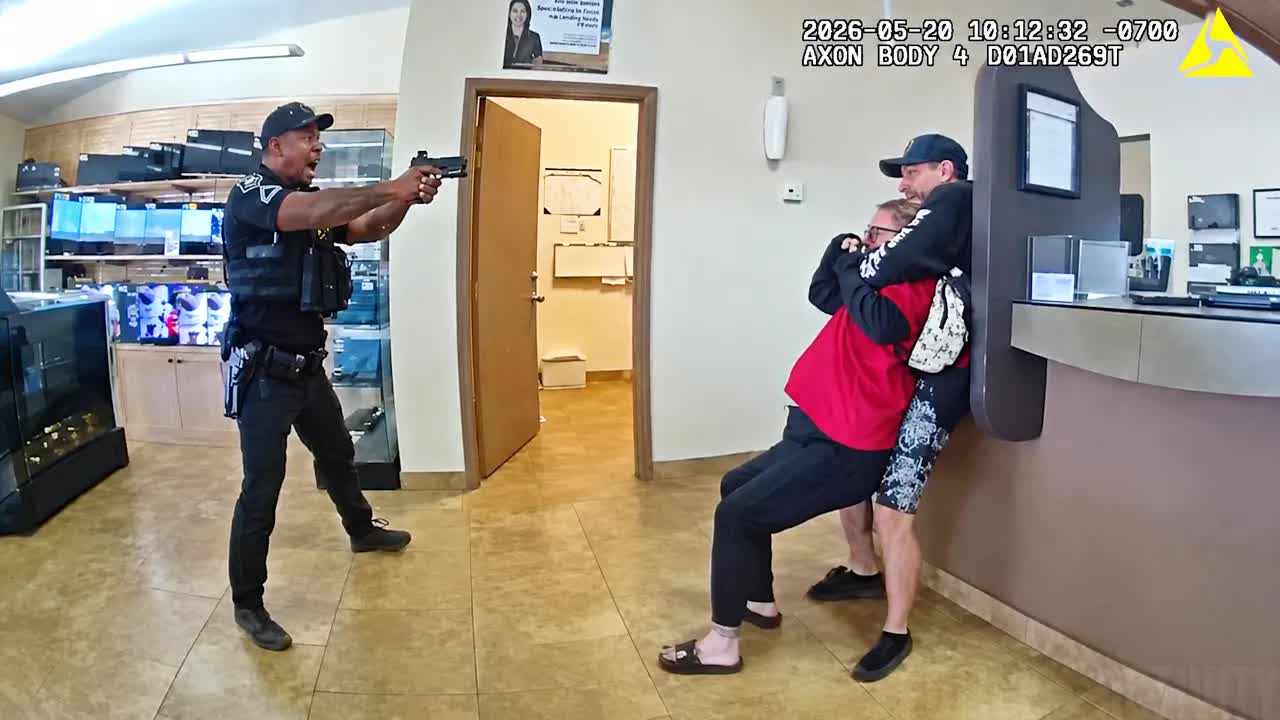
Table of Contents
What the Glendale hostage police shooting video shows
The Glendale hostage police shooting video was published by PoliceActivity under the title Officer Opens Fire As Suspect Takes Woman Hostage. The Glendale hostage police shooting video is a short public-safety upload built from bodycam footage, a written incident description, and brief captioned audio. It is useful for understanding the sequence presented by the source, but it is not a complete investigative file.
According to the PoliceActivity description, the incident happened in Glendale, Arizona, on Wednesday, May 20, 2026, near 63rd Avenue and Bell Road. The source says Glendale police officers responded to a call about a woman who may have been in distress inside a local business. The woman had entered the business with a man identified by the source as 33-year-old Daren Howard.
The source says the woman and Howard were at the business to purchase a firearm. During the exchange, according to the source, the woman indicated she was in distress. Store clerks sensed danger and attempted to stall the transaction until officers arrived. That detail matters because the source does not present the police response as a random contact. It presents the response as a call for help from people inside the business.
This article uses cautious language because several pieces of the story remain source-dependent. PoliceActivity provides a public recap and bodycam footage. Local reporting from FOX 10 Phoenix and AZFamily also describes the same general event. However, a Glendale hostage police shooting video recap should not turn reported charges into convictions or treat edited footage as the same thing as a final court record.
Why police were called to the business
The second critical layer in the Glendale hostage police shooting video is the call basis. Without that context, the bodycam clip can look like it begins in the middle of a confrontation, when the source says the police response began with concern for a woman inside the business. That is why a careful Glendale hostage police shooting video recap has to start with the 911 and witness context before judging the bodycam moment.
PoliceActivity says the woman appeared to be in distress and that the man with her was acting erratically. FOX 10 Phoenix reported that a manager noticed the woman had a cut on her hand and that she mouthed a request to call 911. AZFamily later described the released bodycam and 911 material as a pawn shop rescue that turned into a police shooting.
The exact business name is not essential to the reader’s first question. The important source-based facts are the call basis, the reported weapon concern, the attempt by employees to delay the situation, and the officers’ arrival. A public reader trying to understand the incident should separate those facts from social-media speculation about motive, relationship details, or what someone may have intended.
PoliceActivity says store employees filled officers in when they arrived. That short handoff is important in any bodycam timeline. Officers approaching a scene often have only partial information from dispatch and witnesses. They may know that someone asked for help, that a weapon may be involved, and that people are still close together, while not yet knowing every fact that investigators later assemble.
The source description identifies Howard by name and age. The article keeps that identification because it is part of the public source and related reporting, but it avoids unnecessary private details. The victim is not named here. In domestic-violence and hostage-related reporting, limiting unnecessary personal details is part of a legal-safe and dignity-focused article structure.
What the bodycam audio adds
The Glendale hostage police shooting video relies heavily on bodycam audio because the first seconds are crowded, tense, and partly blocked by movement. Audio does not answer every question, but it helps readers understand why officers were trying to separate the people in front of them. For the Glendale hostage police shooting video, the audio layer is part of the source evidence rather than background noise.
The captions and bodycam audio show officers trying to separate the people and gain control of a tense scene. The transcript includes commands to show hands, let go, stop, and drop the knife. It also includes a warning that a Taser may be used. Those commands support the source timeline, but they should be read with the usual limits of bodycam audio: captions can be imperfect, background noise can obscure words, and the camera does not show every angle.
One of the clearest points in the captions is that officers repeatedly focus on the woman being held or controlled. The first bodycam angle includes concern about what the man is doing to her. Later commands tell him to let go and move away. Those commands fit the source’s description that officers believed the woman’s safety was at risk.
Short police videos often make a moment feel obvious after viewers have paused and replayed it. People in the scene do not have that advantage. A careful Glendale hostage police shooting video recap should describe the sequence without pretending to know every officer’s perception or every participant’s intent. Here, the source supports a narrow finding: officers were reacting to a rapidly developing knife-and-hostage concern inside a business.
For readers comparing this video with other Navyago public-safety explainers, the useful method is consistent evidence sorting. Start with the call basis, then the witness handoff, then the commands, then the visible escalation, then the reported charges or review status. Navyago’s Crime News coverage uses that source-first approach across similar public-interest stories.
The moment the encounter escalated
The most critical claim in the Glendale hostage police shooting video is the reported shift from conversation to a knife hostage threat. That is the point where the article has to stay especially close to the source and avoid adding certainty that the available public record does not provide. The Glendale hostage police shooting video therefore needs source-bound verbs instead of final legal labels.
PoliceActivity says Howard became more aggressive after officers attempted to speak with him. The source says he was armed with a knife and attempted to take the woman hostage. The bodycam captions include repeated orders to let go and drop the knife. The source also says officers attempted to use less-lethal force before the shooting.
That order of events is central to the article. It allows readers to understand why the Glendale hostage police shooting video is not simply a police-arrival clip or a firearm-purchase story. The source presents the key escalation as a close-contact threat involving a knife and a woman being held. FOX 10 Phoenix similarly reported that police said one officer tried a Taser first and another officer fired when that did not stop the threat.
At the same time, a recap should not use the escalation to overclaim. The source supports saying that police and PoliceActivity reported a knife hostage threat. It does not require the article to declare motive, final legal responsibility, or final policy compliance. Those questions belong to investigators, prosecutors, courts, and any internal review process.
Less-lethal force is also easy to misunderstand. A Taser or similar tool can be part of a response, but it may not immediately end a threat, especially when people are physically entangled or a blade is close to another person. That general point explains why reviewers examine timing and distance. It does not automatically prove that every tactical decision was correct. It simply explains why the source’s sequence matters.
What happened after officers fired
The Glendale hostage police shooting video also matters because the source continues after the shots instead of ending at the most dramatic moment. That continuation gives readers a clearer view of the reported weapon recovery, custody, and emergency-aid sequence. In the Glendale hostage police shooting video, those later seconds help connect the force moment to custody and aid.
PoliceActivity says that once the woman was moved away safely, officers moved in, secured the weapon, secured Howard, and started providing life-saving aid. That after-action sequence matters because responsible readers should look beyond the moment shots are heard. A complete source recap asks what happened before the shooting, during the force decision, and immediately afterward.
The source says Howard survived his injuries. It also says he was facing several charges and was last being held at the Maricopa County Jail on a $350,000 cash bond. AZFamily reported that Howard survived, faced several charges, and was held on a $350,000 cash bond; FOX 10 also reported his identification after the incident. This article treats those details as reported case status, not convictions.
The woman was brought to safety in the source account. Local reporting also said she received medical attention for injuries. The article does not include unnecessary speculation about the relationship, medical details, or private history. The public-interest value is the documented call for help, the fast police response, the source-video sequence, and the unresolved legal and review questions.
Another important point in the Glendale hostage police shooting video is the location language. Some reports use nearby cross streets differently while describing the same northwest Glendale area. The PoliceActivity source and Glendale critical-incident materials refer to 63rd Avenue and Bell Road. Other local reports describe a pawn shop near Bell Road and nearby avenues. The article uses the source’s location language and avoids pretending that it has a more precise address than the approved source provides.
What remains under review
The Glendale hostage police shooting video should be read as a public briefing source, not as a final court or policy answer. That distinction is especially important when the source includes both urgent bodycam footage and reported charges.
AZFamily reported that the officer-involved shooting was still under both internal and criminal review after the critical incident briefing. FOX 10 Phoenix reported that Buckeye Police took over the investigation as part of the West Valley Incident Response Team. Those review details are important because they prevent a public video from being mistaken for a final official outcome.
Different reviews ask different questions. A criminal investigation may examine whether any criminal charge is supported by evidence. An internal or administrative review may examine whether officer tactics and force complied with department policy. A court case may later address reported charges against the suspect. Those processes are related, but they are not the same.
Readers should also remember that a critical incident briefing is often preliminary. It may provide selected video, dispatch audio, narration, and known facts to inform the public. It may not provide every witness statement, forensic detail, camera angle, officer interview, medical record, or legal analysis. That is why this Glendale hostage police shooting video article repeatedly uses wording such as “according to the source” and “reported charges.”
The article’s narrow conclusion is this: the Glendale hostage police shooting video is a source-based recap of a May 20, 2026 incident in which officers responded to a woman in distress at a business, encountered a reported knife hostage threat, used less-lethal force, fired shots, secured the weapon, and provided aid. It is not a final ruling on criminal liability or officer policy compliance.
How readers should evaluate short police videos
A source-first reading of the Glendale hostage police shooting video should start with the approved source, then check local reporting, then separate visible footage from legal conclusions. That order keeps a short clip from becoming a substitute for the full investigative record. For any Glendale hostage police shooting video, that sequence-based method is safer than reacting to a clipped segment alone.
First, identify who published the video and whether the uploader is showing a full record or an edited source package. PoliceActivity is a source channel that republishes public-safety footage with descriptions. It can be a useful source, but a viewer should still distinguish the description, captions, and visuals from final investigative findings.
Second, look for the timeline. In this Glendale hostage police shooting video, the timeline begins before the bodycam moment: a woman appears in distress, employees call 911, officers receive a handoff, commands begin, and the encounter escalates. Skipping those earlier steps can make a later clip look disconnected from the reason police were called.
Third, avoid turning allegations into conclusions. The source names reported charges and a bond amount. Those facts help readers understand the case status, but charges are not convictions. A reader who wants the final legal outcome should look for court records or later official statements rather than relying on the first public video.
Fourth, notice what the video cannot answer. It cannot fully answer what happened before the woman entered the business, what every witness saw, whether every tactical choice met policy, or what a court later decided. A useful source recap should help readers ask better questions, not replace the agencies and courts responsible for final answers.
Source Video
Sources
Primary source: PoliceActivity, Officer Opens Fire As Suspect Takes Woman Hostage, uploaded July 21, 2026. Supporting context reviewed: FOX 10 Phoenix report on the May 20, 2026 Glendale incident and AZFamily report on the released bodycam briefing. This article is a source-based recap and does not replace official investigative records, court records, or legal advice.
FAQ
What is the Glendale hostage police shooting video about?
The Glendale hostage police shooting video is a PoliceActivity source recap of a May 20, 2026 incident in Glendale, Arizona. The source says officers responded to a woman in distress at a business, encountered a reported knife hostage threat, used less-lethal force, and then fired.
Who is identified in the source video?
PoliceActivity identifies the suspect as 33-year-old Daren Howard. The article treats that identification as source-based and avoids adding unsupported personal details about the victim or the relationship beyond what is needed to understand the public-safety timeline.
Does the video prove the reported charges?
No. The source and local reports describe charges and custody status, but charges are not convictions. A final legal outcome would require court records or later official findings beyond the source-video package.
Why does the article avoid saying the shooting was justified?
A source video can show commands, movement, and a reported weapon threat, but justification and policy compliance depend on full evidence and review standards. This Glendale hostage police shooting video article explains what the source reports and what remains unresolved.
Where can readers verify the source?
Readers can watch the embedded PoliceActivity video above and follow the visible source link in the Sources section. The same video ID, DLHlk0JeHCA, is used for the source note, thumbnail evidence, body image, and iframe.