
Florida deputies shoot woman video footage published by PoliceActivity documents deputies responding to a neighborhood call, meeting a woman holding a knife, retreating toward the street, and repeatedly ordering her to drop it. The channel reports that three deputies fired after she continued advancing and made a threat. The video informs the timeline, but it does not decide whether the shooting complied with law or policy.
The Florida deputies shoot woman video source is a PoliceActivity upload published July 2, 2026. Its description places the encounter in Orange County, Florida, on June 3, 2026, and identifies the location as the 8200 block of Tivoli Drive. Navyago has the video, its public description, automatic captions, and exact source thumbnail. It does not have the complete agency investigation, dispatch records, medical file, officer interviews, or any final prosecutorial or administrative finding. Incident-specific claims below therefore remain tied to the source.
Florida deputies shoot woman video: what the source reports
PoliceActivity says Orange County deputies went to Tivoli Drive at about 1 p.m. after a neighbor reported a woman outside a home screaming. That description supplies the reason for the response. The public video then presents body-worn-camera views from deputies as they approach and try to understand the situation. A call for service is a starting point, not proof that a crime occurred.
The Florida deputies shoot woman video source identifies the woman as 59-year-old Rosalia Hodges. PoliceActivity reports that she came out of the residence holding a knife. The footage and captions show deputies moving backward and giving repeated commands to drop the knife. Because automatic captions can contain mistakes, this article uses them to understand the broad order of events rather than to manufacture precise quotations.
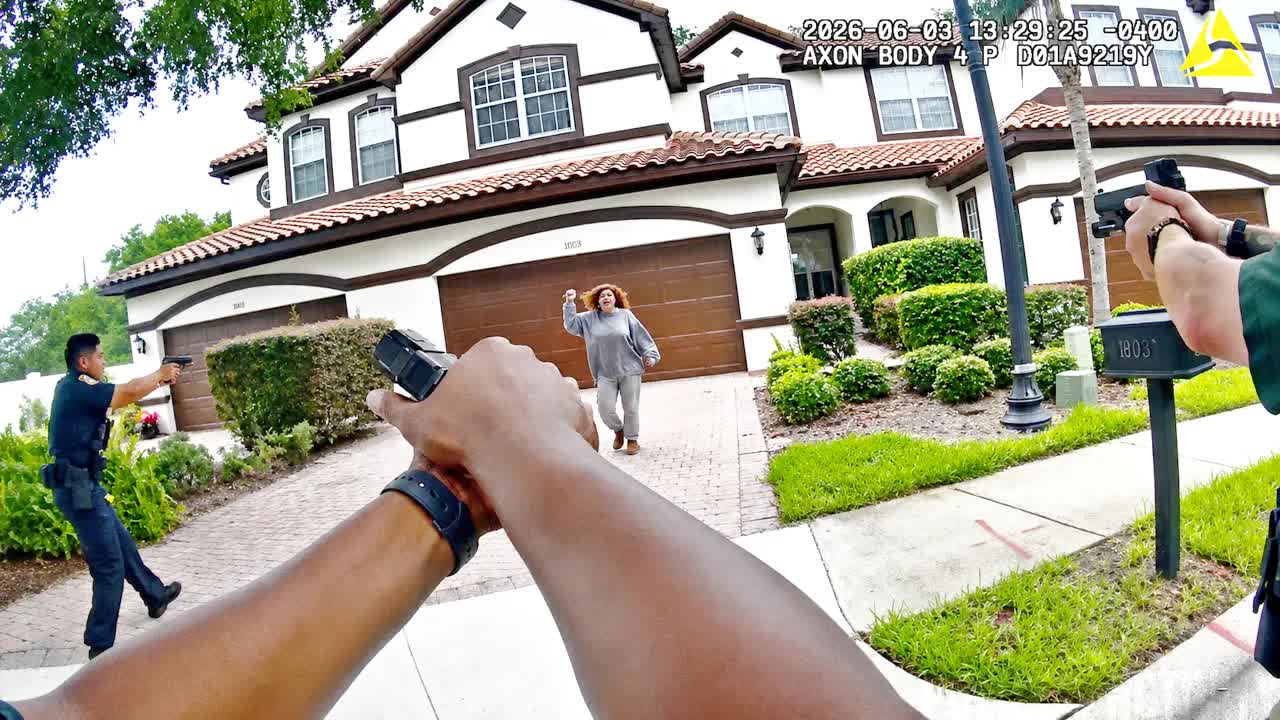
According to the channel description, deputies repeatedly ordered Hodges to drop the knife while retreating toward the street. PoliceActivity says she refused, shouted “I’ll kill you,” and continued advancing. The source says three deputies then fired their service weapons. It reports that deputies rendered aid until paramedics arrived and that Hodges was taken to a hospital, where she died.
Those are serious claims about a fatal encounter. Navyago is not independently asserting what any participant intended or what every deputy perceived. The article describes what the source reports, highlights what can be seen or heard, and identifies the records needed for a final assessment.
Seven source facts readers can separate from inference
A reliable recap separates source identity, reported events, observable sequence, and conclusions. These seven points stay inside the evidence available in the Florida deputies shoot woman video package.
1. The response began with a neighbor’s call
PoliceActivity reports that a neighbor called about a woman screaming outside a home. The description places the response on Tivoli Drive in Orange County, Florida. The call helps explain why deputies arrived, but a caller’s report should not be treated as a complete diagnosis of the situation or the woman involved.
2. The source says the woman came out holding a knife
The channel identifies the object as a knife and says Hodges emerged from the residence holding it. In the Florida deputies shoot woman video, the object and the deputies’ reaction are central to the sequence. Formal evidence handling, measurements, photographs, and laboratory records would provide stronger detail than a viewer can obtain from a compressed online video.
3. Deputies moved backward rather than closing distance
The footage shows deputies retreating toward the street while directing the woman to stop and drop the knife. That movement matters because it preserves the direction of travel and shows that the encounter changed location. It does not, by itself, answer whether every tactical option was available or appropriate.
4. Commands were repeated
The Florida deputies shoot woman video contains repeated commands directed at the woman. Readers should listen to the full source rather than relying on one isolated caption or silent excerpt. The automatic caption track is useful for orientation, but overlapping voices, distance, and stress can make exact wording difficult to verify.
5. The channel reports a verbal threat
PoliceActivity’s description says Hodges shouted “I’ll kill you” as she continued forward. Navyago attributes that claim to the channel because it is important and sensitive. A complete review would compare the original audio from every available camera, not rely only on a platform-generated transcript.
6. Three deputies reportedly fired
The description says three deputies discharged their service weapons. It does not provide a complete round count in the summary used for this article. Navyago therefore does not invent one. Firearm reports, cartridge evidence, synchronized cameras, and officer statements would be needed to establish the detailed firing sequence.
7. The source reports aid, transport, and death
PoliceActivity says deputies rendered aid until paramedics arrived, that Hodges was transported to a hospital, and that she died there. The Florida deputies shoot woman video is therefore a report about a fatal police encounter. The article avoids graphic detail and does not speculate about injuries beyond the source’s account.
What the Florida deputies shoot woman video audio and sequence add
Sequence is one of the strongest contributions of body-worn-camera footage. The source package moves from deputies approaching the home to the appearance of the woman, commands about the knife, retreat toward the roadway, gunfire, and the emergency response. That order helps readers avoid treating the final seconds as if nothing happened before them.
Audio also shows why a silent clip is incomplete. The Florida deputies shoot woman video includes commands and responses that help explain what participants were communicating. Still, recorded speech is not the same as a complete explanation of thought or intent. A camera records sound from one position and can miss speech outside its range, radio traffic, or words covered by movement and noise.
The Florida deputies shoot woman video timing should be evaluated in real time before using slow motion. Frame-by-frame playback can reveal object position, but it can also make a rapid event feel longer than it was. Investigators can use synchronized timestamps and multiple recordings to calculate intervals more accurately. A casual viewer should resist assigning precise reaction time from a single online player.
Camera perspective has limits too. A body camera sits below eye level, uses a wide-angle lens, changes exposure as lighting shifts, and moves with the wearer. The lens may not show exactly what a deputy saw or where another deputy stood. The video is evidence, not an all-seeing witness.
What the Florida deputies shoot woman video does not establish
The Florida deputies shoot woman video does not establish why Hodges was outside screaming or what medical, emotional, or situational factors may have preceded the call. The source package does not provide a complete personal history, and adding one from speculation would invade dignity without improving the factual record.
The footage also does not independently determine whether the deputies’ use of force was justified under Florida law or consistent with Orange County policy. That assessment would require the applicable legal standard, department policy, each deputy’s position and perception, distances, warnings, timing, available alternatives, physical evidence, and the findings of the responsible review bodies.
Nor does the source prove motive. A reported threat and forward movement are evidence about the encounter, but Navyago cannot infer the woman’s underlying intent, mental state, or purpose. Those conclusions require evidence beyond facial expression or a few seconds of footage.
The video does not show every available angle or communication. Dispatch audio could clarify what deputies knew before arrival. Additional cameras might show distance or object position from another perspective. Scene diagrams and measurements could test what the lens appears to show. Medical and forensic records could establish facts the video cannot.
Finally, the Florida deputies shoot woman video upload is not necessarily the final public record. An agency may later release a critical-incident briefing, names of involved deputies, investigative findings, prosecutor review, or administrative decision. If a reliable primary record differs from the early video description, the newer official record should take priority.
How an official Florida deputies shoot woman video review would test the account
A complete Florida deputies shoot woman video review would start before deputies arrived. Dispatch logs, the original 911 call, computer-aided dispatch entries, and radio traffic could establish what the neighbor reported and what information responding deputies received. That context matters because participants make decisions based on what they know at the time, not information assembled later.
Reviewers would synchronize every available recording. For the Florida deputies shoot woman video, multiple body cameras may begin at different moments or capture different audio. A shared timeline could show when the woman appeared, when commands began, how far deputies retreated, when the reported threat was spoken, and when each deputy fired.
Scene evidence would help test distance and direction. Investigators can map where each person stood, where the knife was recovered, where cartridge cases landed, and whether parked vehicles, landscaping, or the home affected sightlines. Those measurements are more reliable than estimating distance from a thumbnail or paused frame.
The knife should be documented as physical evidence. Photographs, dimensions, recovery location, and chain-of-custody records can confirm or refine the online description. The same principle applies to the deputies’ firearms and reported discharges. Navyago does not have those records and therefore does not claim a specific round count.
Each deputy’s decision should be evaluated separately. Three people can occupy different positions and perceive the same movement differently. An official review would compare each camera, statement, line of sight, timing, and conduct under the relevant policy. Grouping every discharge into one undifferentiated decision would hide important evidence.
Emergency aid and medical response are another part of the timeline. PoliceActivity reports that deputies provided aid until paramedics arrived and that Hodges later died at the hospital. Medical records and responder reports would establish treatment timing and cause of death more precisely than the video description.
Administrative, criminal, and civil reviews answer different questions. A prosecutor may assess whether criminal law was violated. An agency may examine tactics, training, supervision, communication, and policy. A civil court, if involved, applies its own procedures and standards. The Florida deputies shoot woman video alone cannot substitute for any of those processes.
How to view and share the Florida deputies shoot woman video responsibly
First, verify the source identity. This article uses PoliceActivity video ID Ng5jC5MJe9s. The source link, thumbnail, body image, embed, and source note all point to that same ID. Similar footage from another Florida incident would be a different source and must not be mixed into this account.
Second, preserve attribution. Say “PoliceActivity reports” for details supplied by the description. Use “the footage shows” only for material actually visible or audible. Avoid phrases such as “the investigation proved” unless a completed investigative report is available.
Third, avoid graphic excerpts and dehumanizing language when sharing the Florida deputies shoot woman video. The public-interest purpose is to understand a police response, the sequence, and the evidence limits. Reposting a fatal moment without context can cause harm while teaching the viewer very little.
Fourth, distinguish a visible event from a legal conclusion. A knife, commands, movement, and gunfire may be visible or reported. Whether force was lawful or consistent with policy is a separate determination. Responsible readers can acknowledge what the source depicts while leaving final judgments to a documented review.
Fifth, look for later primary records. An official Orange County release, prosecutor decision, or agency review could add facts unavailable in the current source package. Keep the date of the PoliceActivity upload in mind and treat the article as a source-limited explainer rather than a permanent final verdict.
Readers can browse more source-attributed public-safety coverage in Navyago’s Crime News section. The same editorial rule applies across those articles: identify the source, separate observation from allegation, and state what remains unknown.
Frequently asked questions
What does the Florida deputies shoot woman video show?
It shows deputies approaching a home, encountering a woman with a knife, retreating, issuing repeated commands, and then firing. PoliceActivity reports that she later died at a hospital.
Where did the encounter happen?
PoliceActivity places the incident in the 8200 block of Tivoli Drive in Orange County, Florida, on June 3, 2026.
Did deputies tell the woman to drop the knife?
The source footage and description indicate repeated commands to drop the knife while deputies moved backward. Exact wording should be checked against the original audio.
How many deputies fired?
PoliceActivity reports that three deputies fired their service weapons. The source summary used here does not provide a complete round count.
Does the video prove the shooting was justified?
No. The video informs the sequence, but a legal or policy conclusion requires the complete investigative record and the applicable standards.
Source Video