
Dodge Challenger police pursuit footage published by PoliceActivity documents a reported Oklahoma City traffic stop that became a short chase and ended in a multi-vehicle crash. The source says a passenger exited before the driver accelerated away. This explainer separates the source account from allegations and outcomes that remain unverified.
PoliceActivity published the video on August 17, 2026, and says the incident happened on August 8. Navyago reviewed the public metadata, description, embed information and exact source thumbnail. No confidently matching police release, collision report, booking record or court disposition was located before publication, so incident-specific details below remain attributed to the source rather than presented as independent findings.
Dodge Challenger Police Pursuit: What the Source Reports
The PoliceActivity description places the event in Oklahoma City on Saturday, August 8, 2026. It says officers observed a red Dodge Challenger performing burnout donuts near Southwest 31st Street and Miller Avenue and initiated a traffic stop. That account identifies the reported reason for the initial contact; Navyago did not locate a matching citation, call log or original officer report that independently confirms it.
According to the same source, the Challenger moved slowly onto Southwest 30th Street and stopped long enough for a female passenger to get out. The description then says the driver accelerated away at more than 60 mph and officers pursued. The reported exit matters because it distinguishes the passenger’s position from the driver’s later conduct, but the public source does not identify her or explain whether investigators interviewed her.
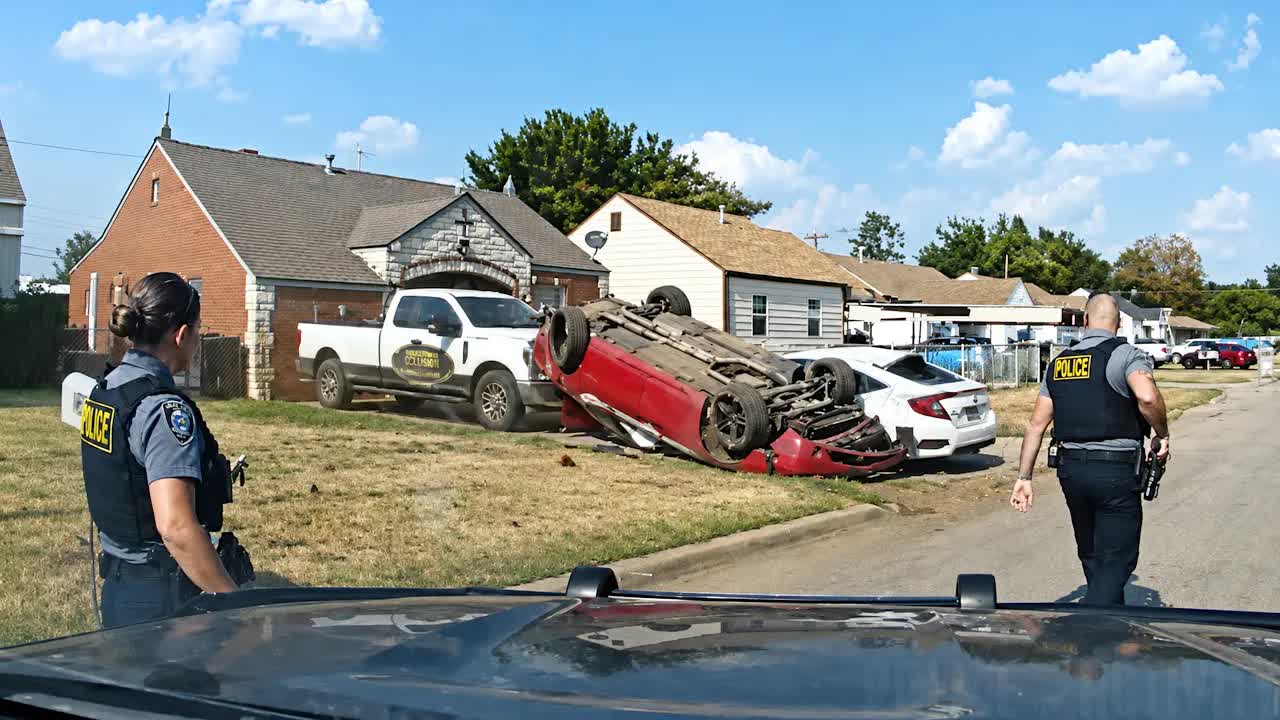
PoliceActivity says the pursuit ended near Southwest 30th Street and Agnew Avenue after the driver failed to stop at two stop signs and collided with two other vehicles. The description says the Challenger continued briefly before rolling to a halt. The exact source thumbnail shows a red car overturned near other vehicles at a residential crash scene, but a thumbnail cannot establish speed, right of way, fault or the full collision sequence.
For the Dodge Challenger police pursuit, the source identifies the driver as 36-year-old Jaramy Yeats and says officers removed him from the wrecked car and took him into custody. It lists alleged traffic and criminal charges and reports three outstanding felony warrants. An arrest description is not a final court record, so this article does not say Yeats committed, admitted or was convicted of any listed offense.
Seven Source Facts From the Public Upload
1. The source places the event in Oklahoma City
PoliceActivity names Oklahoma City, Oklahoma, and supplies four street references: Southwest 31st Street, Miller Avenue, Southwest 30th Street and Agnew Avenue. Those locations create a reported geographic frame for the Dodge Challenger police pursuit. They do not substitute for a collision diagram or establish the precise path of every vehicle.
2. The initial stop reportedly followed burnout donuts
The Dodge Challenger police pursuit description says officers observed the car performing burnout donuts near Southwest 31st Street and Miller Avenue. That behavior is the source’s stated basis for the attempted traffic stop. The upload package reviewed by Navyago does not contain the original incident report or an unedited camera file, so the article keeps the claim tied to PoliceActivity.
3. A passenger reportedly exited before the chase
The source says the car briefly stopped after moving onto Southwest 30th Street and that a female passenger exited. It does not identify her, accuse her of an offense or describe an injury. Publishing speculation about her identity or role would add risk without helping readers understand the reported pursuit.
4. The source reports speeds exceeding 60 mph
PoliceActivity says the driver accelerated away at speeds exceeding 60 mph. That is a source-reported threshold, not a certified maximum measured by Navyago. A reliable speed finding could depend on radar, vehicle data, synchronized video, GPS records or a reconstruction, none of which is included in the public source pack.
5. Two stop signs are part of the reported sequence
The description says the driver did not stop at two stop signs before the crash near Southwest 30th Street and Agnew Avenue. The public upload does not provide a formal traffic-engineering map or a complete view from every approach. The narrow statement is therefore that the source reports two missed stops, not that this article independently establishes each violation.
6. The Challenger reportedly hit two vehicles and overturned
PoliceActivity says the Dodge collided with two other vehicles, continued a short distance and rolled to a halt. The source thumbnail is consistent with a rollover aftermath: it shows a red vehicle upside down near a white car and a pickup. It does not show how each contact occurred or decide responsibility for the crash.
7. The source reports an arrest, charges and warrants
The description identifies Yeats and lists alleged eluding, driving while license revoked, reckless driving, causing an accident resulting in injury, operating a vehicle in an accident without insurance, and failing to stop at a stop sign. It also says he faced three outstanding felony warrants. Navyago found no matched docket or final disposition, so every item remains an attributed allegation.
How the Reported Stop Became a Short Pursuit
The source presents a compact sequence. Officers reportedly observed the Challenger doing donuts, attempted to stop it, and saw it move slowly to another street. The vehicle then stopped long enough for a passenger to exit. Only after that pause, according to the description, did the driver accelerate and a pursuit begin.
That sequence is useful because it prevents two common errors. First, the reported burnout is not the same act as the later alleged failure to stop. Second, the passenger’s exit reportedly occurred before the faster driving and crash. Combining separate moments into one dramatic sentence would make the account less precise and could wrongly imply conduct by someone the source does not accuse.
The description says the Dodge Challenger police pursuit covered neighborhood streets at speeds exceeding 60 mph and ended moments later. It does not provide a minute-by-minute timeline, exact distance, patrol-unit count or complete radio exchange. Readers should therefore resist calculating an average speed or duration from the short public summary.
Near Southwest 30th Street and Agnew Avenue, the source reports two missed stop signs followed by contact with two vehicles. The Challenger then reportedly continued briefly before overturning. PoliceActivity says officers removed the driver and placed him in custody. The source does not state a final medical outcome for any occupant of the other vehicles.
The most accurate Dodge Challenger police pursuit summary is bounded: a traffic stop reportedly escalated into a pursuit, the pursued car allegedly entered an intersection without stopping, and a multi-vehicle rollover crash followed. The public package can support a source-based explainer. It cannot replace the original recordings, crash investigation, charging documents or later judicial findings.
Why the Intersection Crash Matters to Other Road Users
Dodge Challenger police pursuit coverage can focus attention on the police vehicle and the person being followed. This source account also involves people in two other vehicles. They may have entered the intersection without knowing that a fast-moving car and police units were approaching. Their presence makes the event a public-safety story rather than only an arrest narrative.
Intersections compress multiple decisions into a small space. Drivers may rely on stop signs, sight distance, expected speeds and the movement of nearby traffic. A vehicle entering much faster than expected can reduce the time available to perceive and respond. That general observation helps explain why the reported collision matters, but it does not establish the speed, visibility or legal responsibility in this specific crash.
The source lists “causing an accident resulting in injury” among the allegations, yet it does not identify an injured person, describe a diagnosis or provide a hospital update. Navyago therefore does not infer the number, nature or severity of injuries. The existence of a charge in a video description is not medical documentation and is not a final finding that every element of an offense was proved.
The thumbnail should be read with similar restraint. It shows an overturned red vehicle, nearby cars and police at a residential scene. It is valuable as exact-source media and gives readers a visual understanding of the aftermath. It does not show the initial stop, the passenger exit, both alleged stop-sign events or the moment of collision.
Readers should also avoid turning the wreck into entertainment. Real occupants, responders and property owners may be affected even when a public upload does not name them. Useful coverage keeps the focus on verifiable sequence, uncertainty and the records needed for accountability rather than praising speed or inviting viewers to celebrate a crash.
Charges Are Allegations, Not a Court Judgment
The Dodge Challenger police pursuit description uses the language of charging after an arrest. That is an early stage in a legal process, not a verdict. A filed charge may later be amended, dismissed, combined with another matter, resolved by plea or tested at trial. A video title and description cannot predict which outcome occurred.
The source lists eluding a police officer and several driving-related allegations. This article does not translate those labels into legal conclusions because the exact statutory citation, charging instrument and alleged facts for each count were not available in the source package. Similar-sounding offenses can contain different elements, defenses and penalty ranges across jurisdictions.
The report of three outstanding felony warrants requires the same caution. The source does not provide warrant numbers, issuing courts, underlying allegations or their status after the arrest. A warrant authorizes a legal step under specified conditions; it does not prove the allegations behind it. Navyago does not guess what those warrants concerned.
The identification of Yeats also does not justify a declaration of guilt. The responsible wording is that PoliceActivity identifies him as the driver and reports that officers arrested him. Unless a reliable court record establishes a final judgment, he is presumed innocent of the listed charges. This distinction is a basic accuracy requirement, not a technical disclaimer.
A later update should rely on a case number, official docket, filed charging document or court disposition and should link that stronger record. If the charges changed or a different person was identified, the article would need a visible correction. Until such evidence is available, the source-attributed account is the outer limit of what can be stated.
What the Video Description Does Not Establish
First, the public source does not establish a complete chronology. The description summarizes a five-minute video, while the event involved actions before, during and after the portion presented online. Missing material may include dispatch communications, additional camera angles, supervisory decisions, witness accounts and emergency response details.
Second, the Dodge Challenger police pursuit source does not establish an exact top speed. “Exceeding 60 mph” is the channel’s reported threshold. Without original measurements or synchronized data, readers should not convert it into a precise number or compare it with a posted speed limit that the source does not identify.
Third, the description does not establish crash liability. Determining how three vehicles came into contact could require statements, scene measurements, debris positions, vehicle damage, event-data recorders, camera timing and applicable traffic law. The image of the aftermath cannot answer those questions by itself.
Fourth, the source does not establish final injuries. It lists an injury-related allegation but does not provide a patient identity, diagnosis, treatment record or outcome. An article should not fill that gap with assumptions based on vehicle damage or the fact that a rollover occurred.
Fifth, the upload does not establish whether the pursuit complied with Oklahoma City Police policy. A fair policy review would require the rules in effect on August 8, the information officers had at each moment, radio traffic, supervisory involvement, traffic and road conditions, and the original recordings. None of that is established by a narrated public description.
Finally, the source does not establish the final status of any charge or warrant. Arrest, booking, charging and adjudication are different stages. This article avoids declaring that the source-reported allegations were sustained and remains open to correction if a reliable public record becomes available.
How to Read a Police Pursuit Video Responsibly
Begin the Dodge Challenger police pursuit review with exact source identity. This article is tied to PoliceActivity upload 6u501dy9k6s; the source URL, thumbnail, body image, iframe and source note all use that same ID. A different Oklahoma City pursuit or another Dodge crash cannot be substituted to fill missing details.
Next, separate visual evidence from narration. The thumbnail identifies a rollover aftermath. The public description supplies the reported initial conduct, streets, speed threshold, passenger exit, two stop signs, driver identity, charges and warrants. Those are different evidence layers. A careful reader asks which layer supports each sentence.
Then distinguish a source report from an official record. PoliceActivity describes itself as an informational platform and is listed in Navyago’s Dream100 source registry. That makes it an approved input for a source-based explainer; it does not turn the channel into the investigating agency, a court, a hospital or a crash-reconstruction unit.
Look for missing documents before forming a strong opinion. Original video, dispatch audio, the collision report, charging papers, warrant records and a docket would materially improve the account. Their absence does not prove the source is wrong. It means the wording should remain narrow and attributed.
The U.S. Department of Justice COPS Office describes vehicular-pursuit management as an area involving policy, risk, alternatives, training, data and transparency. That general framework helps readers understand why a dramatic clip is not enough for a policy judgment. It does not verify this event or decide whether any individual acted correctly.
For more context, Navyago’s police pursuit and PIT maneuvers explainer discusses how source videos should be read without turning one incident into a universal policy rule. Readers can also browse the Crime News section for other source-limited reports. Neither page independently verifies the facts of this case.
What Records Could Confirm the Remaining Questions
An Oklahoma City Police incident or pursuit report could confirm the Dodge Challenger police pursuit officers, event number, stated reason for the stop, approximate route and actions recorded by the agency. A dispatch log and radio audio could add timestamps and show what officers and supervisors knew while the event was unfolding.
Original dash-camera or body-camera files could clarify what the edited upload omits. Metadata may help align the passenger exit, acceleration, stop-sign approaches, collision and arrest. Any release would still need privacy review and should not expose uninvolved people more than necessary.
A formal collision report could document vehicle identities, occupants, diagrams, citations and the investigating officer’s preliminary conclusions. A later reconstruction might add speed estimates or event-data information. Those records would carry more weight than assumptions drawn from a single thumbnail or the order of clips in an online edit.
Charging documents and a court docket could confirm which allegations were actually filed, the statutory sections, counsel, hearings and final disposition. They could also show whether the source-reported warrants were addressed in the same case or separate matters. Until then, the charge list remains a PoliceActivity report.
Medical information requires special care. A public agency may report that an injury occurred without releasing private clinical details. For this article, a verified public statement about condition or outcome would be enough for a limited update; private records, social-media speculation and attempts to identify uninvolved occupants are unnecessary.
These records would not automatically settle every policy or liability question, but they would improve the evidence base. The current article is designed to be useful now while making clear what a future, document-based update should verify.
Frequently Asked Questions
Where did the Dodge Challenger police pursuit happen?
PoliceActivity places it in Oklahoma City near Southwest 31st Street, Miller Avenue, Southwest 30th Street and Agnew Avenue. Navyago did not independently match an official incident report.
Why did police reportedly try to stop the Challenger?
The source says officers observed the red Challenger performing burnout donuts. That remains a source claim because the original report and unedited recording were not in the reviewed package.
Did a passenger leave the car before the pursuit?
According to PoliceActivity, a female passenger exited during a brief stop before the driver accelerated away. The source does not identify or accuse her of an offense.
Does the video prove the driver committed the listed offenses?
No. The channel reports an arrest, charges and warrants. Charges are allegations, and the public upload does not include a final court judgment.
Were people in the other vehicles injured?
The source lists an injury-related charge but gives no verified medical detail or outcome. This article does not infer the number or severity of injuries.
Source Video
Pingback: Armed Man Points Two Guns at Police Video: 7 Critical Source Facts
Pingback: Milwaukee Police Shoot Suspect Video: 7 Critical Source Facts