
Florida DUI traffic stop case footage published by Sergeant Curtis begins with an officer citing speed, swerving, and dark tint, then expands into a DUI inquiry involving a driver and passenger. The footage records testing refusals, efforts to arrange a safe ride, a later confrontation, and source-reported citations and charges. It does not establish final convictions.
Sergeant Curtis published Entitled Tough Guy Tries Fighting Cop, Backfires Instantly on August 30, 2026. The channel says the case was obtained through public-records requests and later reads from what it describes as the official report. Navyago reviewed the video page, full automatic captions, exact thumbnail, and duplicate-source result on August 31, 2026.
Seven Florida DUI Traffic Stop Case Source Facts
For this Florida DUI traffic stop case, the points below separate what appears in the released footage, what participants say, what the channel explains, and what the channel attributes to a report. That separation is essential because an officer’s observation, a citation, a criminal charge, and a conviction are different kinds of information.
1. The officer described speed, swerving, and window tint as stop reasons
In the released footage, the officer tells the driver that the vehicle was moving at high speed, swerving, and had dark windows. The officer then uses a tint meter and discusses readings below the stated local threshold. Those statements explain the source's presented basis for the stop; the Florida DUI traffic stop case article does not independently reconstruct speed or lane position from the edited camera view.
2. Officers said they observed possible signs of impairment
The source commentary points to red or glossy eyes, speech, hand dexterity, difficulty producing a license, and an odor of alcohol. A backup officer is briefed on the reported driving and observations. For the Florida DUI traffic stop case, these remain source-reported observations used during an investigation, not a medical diagnosis or a final finding of impairment.
3. The driver declined the roadside tasks shown in the video
An officer asks whether the driver will perform voluntary or standardized field-sobriety tasks. The footage shows the driver not agreeing to perform them. Sergeant Curtis explains that declining roadside tasks does not, by itself, prevent an arrest when officers believe other evidence supports a DUI investigation. The Florida DUI traffic stop case should not be reduced to that refusal alone.
4. The source shows an implied-consent warning and a breath-test refusal
Later, an officer reads a warning describing license consequences and possible offenses connected to refusing a requested breath, urine, or blood test under the cited Florida procedure. The driver answers that she still refuses the breath test. Any Florida DUI traffic stop case legal conclusion depends on the governing statute, prior history, and official record.
5. Officers repeatedly tried to arrange a ride for the passenger
The passenger is told he cannot drive and is repeatedly directed to call an Uber or another ride. Officers help him locate the phone, open the app, enter the destination, and confirm the fare. This Florida DUI traffic stop case sequence matters because it shows attempted separation and transport planning before the later physical arrest.
6. The passenger was taken down after the confrontation escalated
The video shows the passenger insulting and threatening an officer, moving toward him after repeated warnings, and being taken to the ground. Sergeant Curtis calls the takedown a documentable use of force and discusses whether an officer rotation or added distance might have reduced the chance of escalation. The video does not replace the complete force report or administrative review.
7. The channel reports different citations and charges for the two people
At the end, Sergeant Curtis says the official report lists the driver's citations as first-offense DUI, failure to submit to a breath test, non-transparent driver window, and failure to drive in a single lane. He says the passenger was reported charged with corruption by threat against a public servant, assault against a law-enforcement officer, and obstructing an officer without violence, and was taken to Broward Health before the BSO main jail. Charges and citations are not convictions.
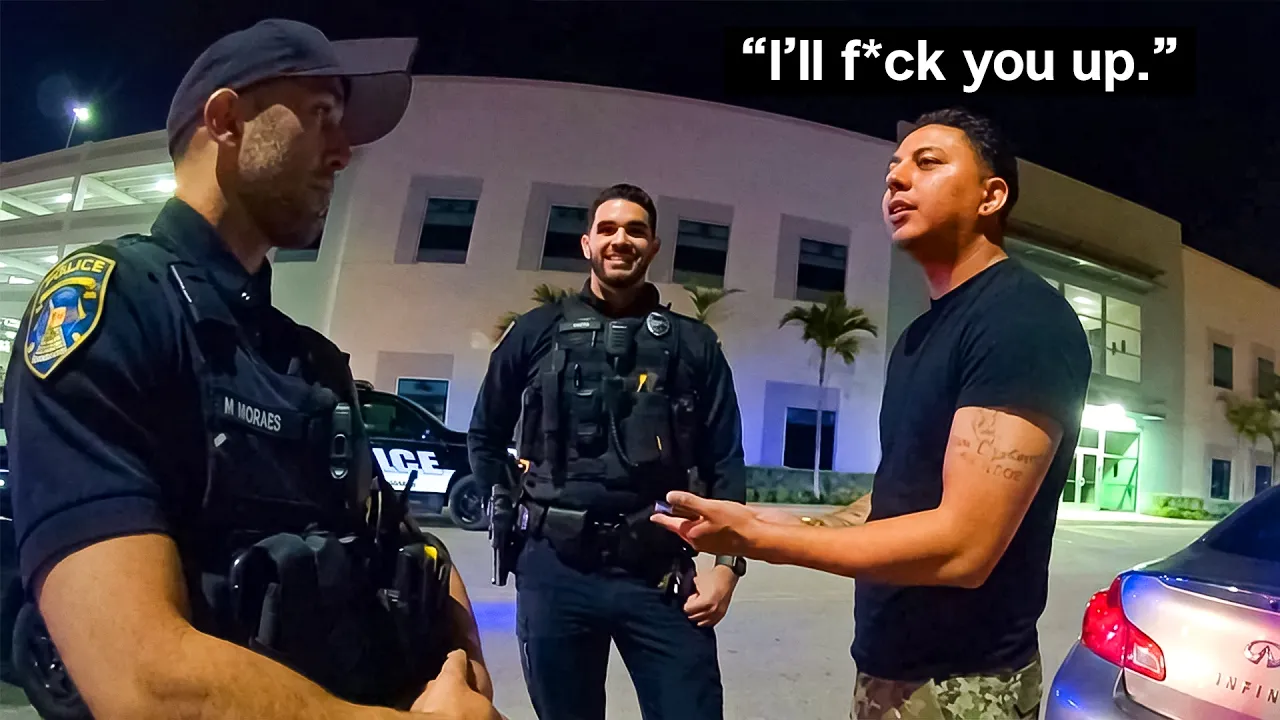
How the Florida DUI Traffic Stop Case Developed
The Florida DUI traffic stop case source presents an overnight stop involving a driver and her husband. The officer initially discusses speed, lane movement, and tint, then asks the occupants for identification. The channel’s commentary emphasizes how officers observe speech and hand movements during an impairment inquiry. These details are presented as investigative observations, not clinical evidence.
After the driver leaves the vehicle, officers read rights and ask about alcohol and roadside tasks. The exchanges are sometimes difficult to follow because portions of the camera audio are muted. Sergeant Curtis expressly notes repeated muted segments and says some may result from officer action or records-department redaction. A missing segment should not be filled with speculation.
While the driver remains with officers, the passenger is repeatedly told that he cannot drive. Rather than arresting him immediately, officers tell him to order an Uber. They spend substantial time explaining the same instruction, locating his phone, helping with the app, confirming an address, and checking that the ride is approaching.
The conversation deteriorates as the passenger insults officers, uses threatening language, and repeatedly approaches the officer he is confronting. The source shows warnings and attempts by other officers to calm him. When he advances again, an officer takes him down. Medical transport is later discussed before the source reports transfer to jail.
That chronology is more informative than the dramatic source title. It shows two related but separate processes: the driver’s suspected-DUI investigation and the passenger’s escalating confrontation. Combining the two people into one allegation would distort who was reported cited or charged with what.
Testing, Refusal, and Implied Consent in the Source
The Florida DUI traffic stop case footage distinguishes field-sobriety tasks from a later chemical-test request. Sergeant Curtis describes the roadside tasks as voluntary and notes that a refusal does not automatically end an investigation. Officers may still consider driving observations, odor, speech, coordination, admissions, video, and other available facts, subject to the law and the evidence in the actual case.
Later, the driver is read an implied-consent warning that mentions suspension periods and possible misdemeanor consequences. She confirms that she still refuses the breath test. This article reports the exchange without offering case-specific legal advice. The exact validity of a request, the effect of a refusal, and available challenges belong to the official administrative and court processes.
The source’s closing summary is also carefully limited. It reports citations for first-offense DUI, refusal, tint, and failure to stay in a single lane. A citation records an accusation or alleged violation; it does not show how a judge, hearing officer, prosecutor, or later docket resolved it.
Readers should therefore resist a common online error: treating a visible refusal as automatic proof of intoxication. The refusal is one source-reported event. The broader legal case would depend on admissible observations, procedure, test evidence or the absence of it, and later decisions.
De-Escalation and Use-of-Force Questions
The passenger sequence in the Florida DUI traffic stop case offers a separate public-safety lesson. Officers repeatedly choose a ride-home plan and explain it in direct language. The passenger sometimes agrees, then resumes insulting or approaching an officer. One officer eventually warns that another step will make the situation worse. The takedown follows after the passenger moves in again.
Sergeant Curtis does not simply praise the force shown. He identifies the takedown as a force event that must be documented and asks whether distance, an officer rotation, or disengagement by the officer receiving the threats might have reduced the likelihood of a physical encounter. He also states that an officer does not have to leave merely because someone is confrontational.
Both observations can coexist: the video may show conduct that prompted immediate control, and a training review may still examine whether earlier tactics could have lowered risk. A complete evaluation would need the force report, synchronized unedited video, injury documentation, policy, supervisor review, and the information known to officers at each moment.
Online viewers have hindsight, replay, and a single edited package. Officers and occupants experience the event in real time. That difference does not prohibit scrutiny, but it means the article should identify evidence and standards instead of issuing a verdict based on tone or a short replay.
Records Needed to Verify the Case Further
The strongest next record for the Florida DUI traffic stop case would be the complete traffic citation and arrest package. It would identify the exact agency, location, incident time, alleged statutory provisions, and the officer responsible for each observation. The public video contains clues pointing to South Florida and Broward institutions, but Navyago does not invent a municipality or street that the source package does not clearly establish.
Unedited synchronized body-camera files would clarify the muted intervals and show whether material before or after the published excerpts changes context. Dispatch and computer-aided-dispatch logs could establish the stop time, requested backup, vehicle tow, medical transport, and the handoff between agencies or facilities.
For the driver, the administrative license record and current court docket would show whether the reported refusal produced a suspension, whether any hearing occurred, how the DUI allegation proceeded, and whether citations were amended, dismissed, resolved by plea, or tried. None of those outcomes should be guessed from an arrest-stage video.
For the passenger, the charging document and docket would show the precise legal language used by the filing authority. The source narration’s phrase “corruption by threat against a public servant” should remain attributed until the underlying document is read. The same applies to the reported assault and obstruction counts.
Finally, a use-of-force or supervisory review could address the takedown under agency policy. The review would need to consider warnings, movement, threats, distance, available officers, injury risk, and the reason for later medical transport. Camera footage is important evidence, but it is not the entire administrative file.
How Readers Can Verify the Florida DUI Traffic Stop Case
A reliable follow-up starts by assigning each statement to a source. In this article, visible movement comes from the video, testing dialogue comes from the released audio and captions, and the citation or charge list comes from Sergeant Curtis’s reading of what he calls the official report. That source map prevents a narrator’s summary from being mistaken for a court judgment.
Check the traffic citations separately from the arrest narrative
A traffic citation should identify the alleged violation, issuing agency, officer, date, and location. It may also show whether a court appearance is required. Readers should compare those fields with the video instead of relying on an edited title. If a citation was later amended or dismissed, the docket—not the original video—would show that change.
Check the administrative license process separately from the DUI case
A breath-test refusal may trigger an administrative license process that is distinct from a criminal prosecution. A hearing can address whether the stop and request met required conditions and whether a refusal occurred. The criminal court may consider overlapping evidence, but its charges, proof standard, and final disposition are not automatically identical to the licensing result.
Match each reported charge to the filed document
The channel’s closing narration gives labels for allegations involving the passenger. Before quoting those labels as current, a reader should obtain the arrest affidavit or filed charging document and confirm the exact statutory language. That check matters because a report, booking entry, prosecutor filing, and amended count can use different wording at different stages.
Read the force review with the full camera sequence
A takedown should be assessed with synchronized footage and the written force narrative. Useful questions include what warnings were given, how close the passenger moved, whether officers had a safe alternative, what threat was perceived, what control method was used, and whether an injury or medical evaluation followed. Short replays can omit the lead-up that policy reviewers examine.
Use the latest docket for any outcome claim
The latest public docket is the appropriate place to check arraignment, plea, dismissal, trial, sentence, or unresolved status. A search result or booking page can remain online after a case changes. Readers should record the docket’s access date and avoid saying someone was convicted unless a judgment or other reliable final record supports that statement.
These checks turn the Florida DUI traffic stop case from a viral confrontation into a traceable public-records question. The goal is not to excuse or condemn conduct from a distance. It is to keep each claim attached to the document or recording capable of proving it.
Legal and Reader Cautions
This Florida DUI traffic stop case article is a source-based news explainer, not legal advice. It does not diagnose intoxication, infer motive, or label either person guilty. It reports visible exchanges and the channel’s stated reading of a report. Any final status should be checked against the latest official docket.
Privacy and dignity also matter. The source contains personal dialogue, insults, and references to health. Those details are not necessary to repeat beyond what helps explain procedure. Navyago does not publish private addresses, medical conclusions, or graphic imagery and does not encourage harassment of anyone shown.
Copyright use is limited to commentary and source identification. The article paraphrases rather than reproducing the 8,000-word automatic transcript, embeds one official player, and uses the exact source thumbnail required by the Navyago source-media rule.
For a related example of how active-scene instructions, arrest-stage claims, and later disposition must be kept separate, read Navyago’s traffic stop interruption case explainer. The consistent method is to identify the source, narrow the headline, attribute sensitive claims, and state what remains unknown.
Readers checking the Florida DUI traffic stop case or a similar source should write down the exact URL, video ID, agency, report number, date, and latest docket status. They should then separate observed behavior from officer interpretation, reported charges from filed charges, and filed charges from a final judgment.
Frequently Asked Questions
What does the Florida DUI traffic stop case video show?
The Florida DUI traffic stop case video shows a DUI investigation, the driver's refusal of roadside and breath testing, efforts to arrange an Uber for the passenger, and a later arrest after an escalating confrontation.
Did the driver have to perform field-sobriety tasks?
The channel describes the roadside tasks as voluntary, while explaining that refusal does not stop officers from making an arrest based on other evidence. Case-specific legal advice should come from a qualified Florida attorney.
What does the source report about the breath test?
The footage shows an implied-consent warning being read and the driver saying she still refused the breath test. The channel reports a citation for failure to submit.
Does the video prove the reported charges resulted in convictions?
No. The source reports citations and charges from an official report, but the article does not have the final court docket and does not treat an accusation as a conviction.
Source Video