
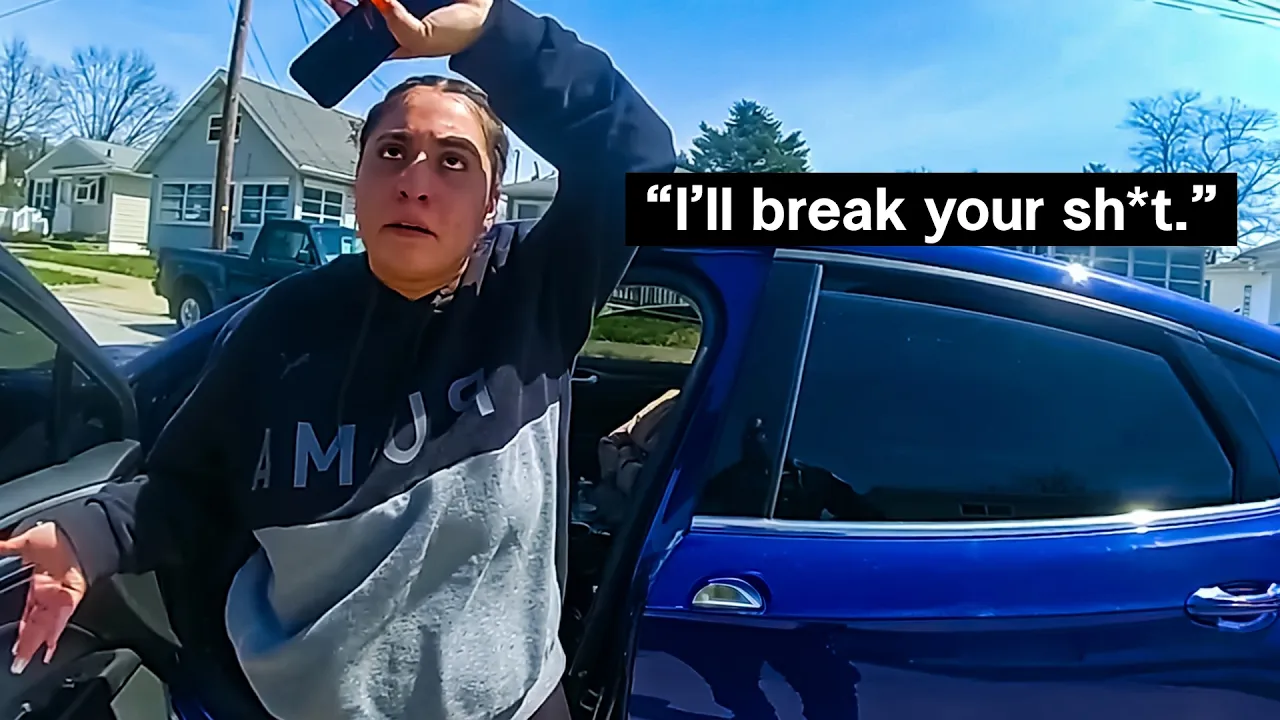
Window damage arrest video footage reviewed by Sergeant Curtis follows a disputed broken-window complaint, an investigative detention, a physical arrest, and a later evidence reassessment. The source shows the officer dropping the original property-damage allegation at that stage while reporting resisting-arrest and disorderly-conduct allegations. It does not establish a final court outcome.
Sergeant Curtis published Entitled 18-Year Old Messes With The Wrong Officer on August 29, 2026. His description links to the original body-camera publication and says the commentary uses public-records material for education and reporting. Navyago reviewed the exact video page, automatic captions, source thumbnail, and duplicate-source search on August 31, 2026.
Seven Window Damage Arrest Video Source Facts
The seven points below distinguish recorded dialogue from commentary and later source-reported claims. A complaint, detention, arrest, charge, and conviction are different events. The article therefore does not use the source’s provocative title as a legal finding.
1. The call concerned a reported broken vehicle window
The window damage arrest video begins with an officer separating people and asking what happened. One man says a vehicle window had been broken and describes an earlier personal dispute. Other people identify a young woman as the suspected person. Those statements gave the officer an allegation to investigate, but they were not direct proof by themselves.
2. The woman denied causing the damage
When the officer asks how the window was broken in the window damage arrest video, the woman denies knowing and says the group is blaming her. She encourages the officer to obtain neighborhood video. Her denial does not resolve the case, just as the other participants’ accusations do not automatically establish it. The conflict makes independent evidence especially important.
3. The officer sought camera footage and direct witnesses
The window damage arrest video shows questions about a nearby camera and whether anyone actually saw a brick thrown. A neighbor says a family member has cameras facing the area, but the person able to retrieve the recording is at work. Other people say they heard something or found bricks but did not directly see the impact.
4. The officer said the woman was detained during the inquiry
After she asks why she is still waiting, the officer says he is investigating a possible crime involving the window and that she is not free to leave. He adds that not placing her in handcuffs at that moment was a courtesy. This article reports his explanation without independently deciding the detention’s legal sufficiency.
5. The encounter escalated into a physical arrest
The officer orders the woman out of the vehicle and says she is under arrest. She initially asks to contact family and secure her wallet, then the footage becomes physically chaotic as officers try to restrain her. She says she is pregnant and tells officers not to pull or press her; officers repeatedly direct her to stop fighting.
6. The initial property-damage allegation was reassessed
Later in the window damage arrest video, the officer says the woman would not be charged with criminal damage then because the witnesses were no longer considered credible. He instead names resisting-arrest and disorderly-conduct allegations. This is a crucial evidence point: the arrest sequence did not transform the disputed window allegation into established property damage.
7. The commentary focuses on professional emotional control
Sergeant Curtis repeatedly asks whether shouting back, using insulting language, or matching the woman’s energy helped. He acknowledges the officer’s history and frustration while arguing that calm direction, distance, emotional control, and professional bearing can protect officers, subjects, and the integrity of an investigation.
Evidence Limits in the Window Damage Arrest Video
In this window damage arrest video, a broken window may look like a simple fact pattern, but identifying who caused it still requires reliable evidence. The source contains accusations, denials, physical objects, possible video, and statements about prior threats. Each has a different evidentiary value. A damaged window shows that damage occurred; it does not identify the person who caused it.
In the window damage arrest video, the officer asks several people whether they saw the brick thrown. Their answers become less direct under questioning. One person says the group was inside, another mentions hearing something, and a nearby resident says cameras may cover the street. The source therefore demonstrates why investigators test whether a witness personally observed an event or is repeating someone else’s conclusion.
Sergeant Curtis explains that a property-damage offense not committed in an officer’s presence may require strong witness or video support, depending on jurisdiction and procedure. He also notes that the value of the damaged property can affect how an offense is categorized. His discussion is general commentary, not a case-specific legal ruling.
The window damage arrest video commentary says the original publication later indicated that video evidence supported a property-damage charge. Navyago has not independently reviewed that later evidence or a filed case record. This article therefore treats the released sequence’s earlier no-charge statement and the commentator’s later claim as separate pieces of information rather than merging them into a conviction.
That distinction is important for AI citation and search summaries. A concise, accurate extraction is: the officer initially declined to pursue the damage allegation because the available witnesses were not credible enough, while the commentator said later video may have changed the evidence picture. The source package does not show a final judgment.
Detention, Arrest, and Separate Allegations
During the window damage arrest video, the woman repeatedly asks why she cannot leave. The officer answers that the property-damage inquiry is ongoing. That exchange shows the officer communicating a detention, but the body-camera segment does not include a complete legal file, dispatch history, written report, or later suppression ruling. Readers should not infer a final legality determination from the verbal exchange alone.
The window damage arrest video then shifts from investigation to arrest. The officer says she is under arrest and directs her out of the car. Her attempts to protect her belongings and contact family occur immediately before officers take physical control. The resulting audio is loud and overlapping, making exact movements difficult to reconstruct from captions alone.
The woman says she is pregnant. Sergeant Curtis treats that fact as relevant to tactics and risk, while making clear that pregnancy does not automatically prevent an arrest. He suggests that lowering emotional intensity and focusing the conversation on safety could create another option before force becomes necessary. Whether that would have worked in the actual moment remains uncertain.
After the struggle in the window damage arrest video, the officer states that the woman may have kicked another officer and mentions a possible felony, but the later list he gives in the released sequence names resisting arrest and disorderly conduct. Without the charging document, Navyago does not convert every statement made during a stressful scene into a filed charge.
The window damage arrest video also records concern about the woman’s daughter and transportation home. The officer eventually says he will drive her rather than release her near the disputed location, while she continues asking to leave. These details illustrate how custody, safety planning, family responsibilities, and paperwork can overlap after a confrontation without resolving the underlying legal issues.
De-Escalation Lessons From the Source
Sergeant Curtis frames the window damage arrest video as a training discussion rather than a simple heroes-and-villains clip. He says repeat contacts can be deeply frustrating for officers, especially when the same person returns to conflict and responds with shouting or insults. At the same time, he argues that the professional carries a distinct responsibility to manage that frustration.
His first window damage arrest video question concerns tone. When an officer yells because a person is yelling, the volume may gain short-term compliance, but it can also create poor optics, raise stress, and narrow both participants’ choices. The commentary asks whether the same instruction could be delivered with a calmer voice, clearer sequence, or brief pause.
His second point is emotional separation. A person’s insults do not have to become an officer’s personal argument. Sergeant Curtis suggests that a second officer might take over, that distance might be increased, or that the officer might let a secured person vent while completing paperwork elsewhere. Those are training possibilities, not claims that force was automatically unlawful.
His third point is documentation and evidence discipline. When the original witnesses weaken, the officer changes course on the property allegation. That reassessment is more valuable than forcing the initial theory to survive. A professional investigation should be able to narrow or drop an allegation when the supporting evidence does not meet the required level.
Finally, the window damage arrest video shows why de-escalation is not merely politeness. Lowering the temperature may reduce injury risk, preserve clearer statements, improve witness cooperation, and make later review easier. It also protects officers from allowing a person’s behavior to dictate their own professional standard.
Records Needed to Verify the Case Further
For the window damage arrest video, the complete incident report would identify the agency, date, location, complainants, alleged property loss, and the officer’s formal probable-cause narrative. The public source does not clearly establish all of those fields, so Navyago does not invent them from visual clues or commentary.
Unedited body-camera files would show whether important dialogue or actions occurred before and after the published segment. Synchronized footage from every involved officer could clarify the physical arrest, the reported kick, warnings, control techniques, and medical or pregnancy-related precautions.
The neighborhood recording mentioned in the window damage arrest video would be central to the property allegation. Investigators would need to authenticate its time, viewpoint, continuity, and image quality. A statement that video exists is not the same as reviewing the actual file and connecting it to the person and window in question.
Filed charging documents would establish which allegations were formally pursued. Booking language, an officer’s scene statement, a prosecutor’s charge, an amended count, and a court judgment can differ. The latest docket would then show dismissal, plea, trial, sentence, or unresolved status.
A force report and supervisory review could address the restraint, stated pregnancy, reported kick, injury risk, warnings, and available tactical options. That review would require more than a dramatic excerpt. It would consider the information officers had at each moment and the applicable agency policy.
How Readers Should Assess the Window Damage Arrest Video
When reviewing the window damage arrest video, start by separating direct observation from narration. The body-camera recording shows conversations and parts of the arrest. Sergeant Curtis adds professional commentary. Participants make accusations and denials. The officer gives his scene-level decisions. None of those sources alone supplies the final court outcome.
Next, track changes in the window damage arrest video evidence. The inquiry begins with multiple people blaming one person. Questions reveal that direct observation is limited. A possible camera is identified. The officer later declines the initial damage allegation at that stage. That changing sequence is more informative than a headline that assumes a fixed answer from the beginning.
Readers should also avoid using distress, profanity, pregnancy, prior police contacts, or difficult behavior as proof of the original property allegation. Those factors may affect communication and safety, but they do not establish who broke a window. Evidence for one alleged offense must not be replaced by dislike of a person’s conduct during another event.
For a related example of keeping a reported offense separate from an arrest-stage confrontation, read Navyago’s traffic stop interruption case explainer. That article uses the same source-first method: identify what the recording establishes, attribute sensitive claims, and state what records remain missing.
This window damage arrest video article is not legal advice and does not diagnose anyone shown. It avoids private addresses, medical conclusions, and a guilt label. Readers who want to verify the case should begin with the exact video ID, the original body-camera link in the source description, the agency report, any retrieved neighborhood video, charging documents, and the latest docket.
Frequently Asked Questions
What does the window damage arrest video establish?
It records a disputed property-damage investigation, detention, an arrest struggle, witness follow-up, and the officer's later decision not to pursue the initial damage allegation at that time.
Was the woman convicted of damaging the vehicle?
The source does not establish a conviction. In the released sequence, the officer says the damage allegation would not be charged then because the available witnesses were no longer considered credible.
Why did the officer say she was not free to leave?
The officer says he was investigating a possible crime involving a broken vehicle window. The article does not independently decide whether every detention step met the applicable legal standard.
What de-escalation lesson does Sergeant Curtis discuss?
He asks whether matching a distressed person's volume and frustration helps, and suggests calm direction, distance, emotional control, and a professional bearing as alternatives worth considering.
What records would verify the case further?
The incident report, complete body-camera files, witness statements, property-damage evidence, charging documents, force report, and latest court docket would clarify the final facts and procedural outcome.
Source Video