
Traffic stop interruption case footage from Midwest Safety begins with officers investigating a motorcyclist for suspected DUI, then shows a woman entering the scene, receiving repeated directions, and being arrested after a prolonged confrontation. The channel later reports charges, a two-count guilty plea, dismissed counts, and probation. This explainer separates those source claims from what the edited video cannot independently prove.
Midwest Safety uploaded Entitled Woman Interrupts Random Traffic Stop on August 30, 2026. Navyago reviewed the public video page, its English automatic captions, the exact source thumbnail, and an authenticated duplicate-source search on August 31, 2026. The source identifies the woman only as Tiffany and does not provide a location, police agency, incident date, case number, surname, or court-document link. This article does not invent those missing details.
What the Traffic Stop Interruption Case Source Presents
The traffic stop interruption case opens during a suspected impaired-driving investigation involving a male motorcyclist. The footage shows officers speaking with him about how much he had consumed and conducting field-sobriety exercises. He says he would rather get home safely and acknowledges that he does not yet have the required motorcycle license, although the captions around some of that exchange are imperfect.
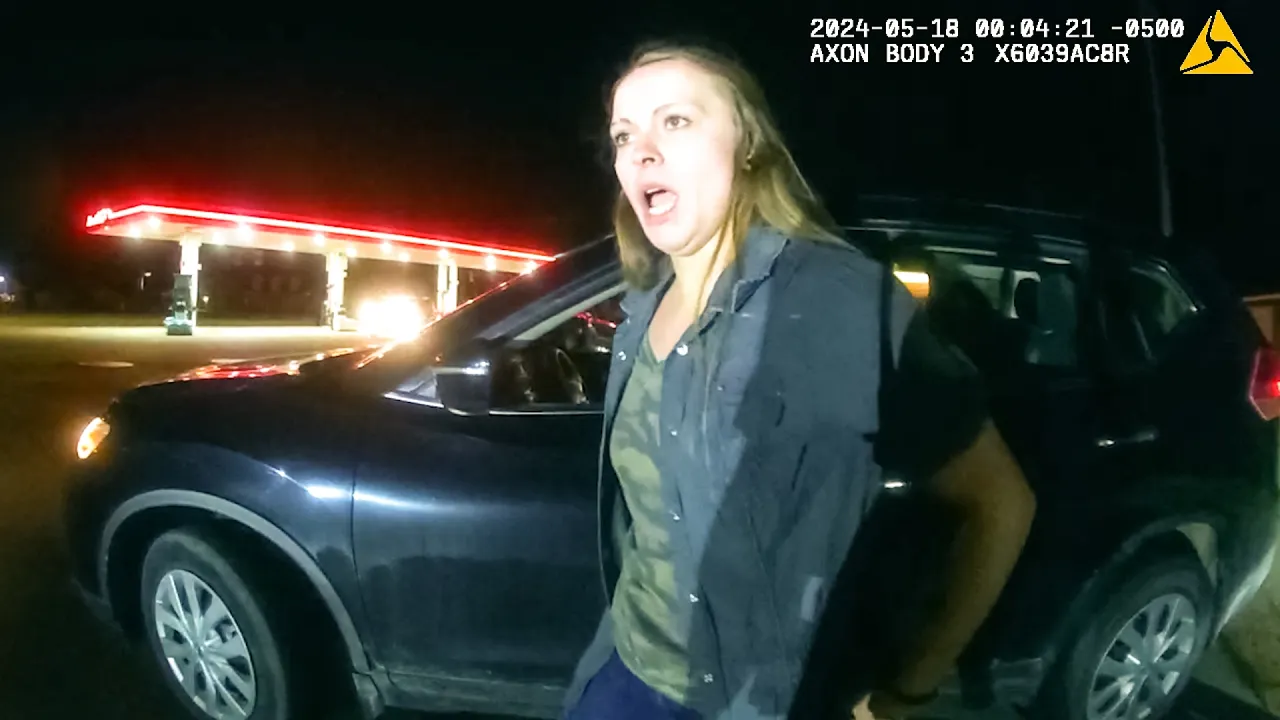
About a minute into the traffic stop interruption case video, a car enters the area. An officer immediately says the driver nearly hit him. The woman, addressed as Tiffany, asks whether everything is all right and whether the motorcyclist will ride home. Officers answer that they are still speaking with him and ask how she knows him. The motorcyclist later says she had dated one of his friends and that he did not know she would arrive.
The encounter then shifts from the original investigation to repeated instructions directed at Tiffany. Officers tell her to stay back and remain near her vehicle. They question whether she has been drinking, tell her she is not leaving, and later warn that an attempt to leave could lead to arrest for obstruction. The video records an escalating argument, a detention, and an extended physical arrest sequence.
Midwest Safety closes with a narrated legal summary. It says the motorcyclist was charged with DUI. It reports that Tiffany initially faced multiple counts, later pleaded guilty to disorderly conduct and resisting or obstructing, had the remaining reported counts dismissed, and received two years of probation. Because the video page does not link the charging paper, plea transcript, judgment, or current docket, Navyago treats that outcome as the channel’s report rather than an independently authenticated court record.
Seven Traffic Stop Interruption Case Facts From the Source
These seven points are deliberately limited to what the footage visibly or audibly presents and what Midwest Safety says in its closing narration. They do not decide whether every command, detention decision, use of force, charge, or sentence was legally correct.
1. The original contact concerned a suspected DUI involving a motorcyclist
The first scene in the traffic stop interruption case is not a contact with Tiffany. Officers are already questioning a male motorcyclist about alcohol and asking him to complete field-sobriety exercises. The opening narration describes the contact as a DUI investigation, and the closing narration says he was charged with DUI.
That distinction helps preserve the traffic stop interruption case timeline. Tiffany’s arrival did not begin the traffic stop shown in the source; it introduced a second person and a new set of safety and compliance questions. The complete basis for the motorcyclist’s stop and charge would require the incident report, breath or chemical-test records if any, camera files, and charging documents. Those records are not included on the video page.
2. Tiffany entered the scene and asked about the motorcyclist
The footage shows Tiffany drive into the immediate area while officers are still conducting their investigation. An officer says she nearly hit him. She denies doing so and asks whether the motorcyclist will be allowed to ride home. When asked how she knows him, she first says she does not and is merely pulling up; the motorcyclist later explains that she had dated one of his friends.
Those exchanges establish what the edited traffic stop interruption case source presents, but they do not establish her purpose, state of mind, or precise driving path. The camera angle does not supply a calibrated measurement of distance. A vehicle-camera file, scene diagram, and officer report would be stronger evidence for any claim about how close the car came to a person or object.
3. Officers repeatedly directed her to stay near her vehicle
During the traffic stop interruption case, an officer tells Tiffany to stay back and then repeatedly directs her to go by her vehicle. The repetition matters because later enforcement decisions are presented as responses to her movement and refusal to follow instructions. The footage also shows moments when she asks questions or appears to misunderstand what was being requested.
A fair traffic stop interruption case account should preserve both parts of that sequence. The video contains clear directions, and it also contains overlapping voices, changing speakers, and an increasingly tense environment. Readers should not reduce the event to a single isolated sentence. Unedited synchronized footage from every camera would clarify the timing of each direction, response, movement, and warning.
4. The video contains an explicit warning about obstruction
As the confrontation develops, an officer tells Tiffany that she is not leaving and should not get into the driver’s seat. The source then records a direct warning: if she tries to leave, she will be arrested for obstruction. The officer says he will not tell her again and directs her to stop. Moments later another officer says to detain her.
The warning is a source-backed traffic stop interruption case fact. Its legal sufficiency is a different question. Obstruction rules vary by jurisdiction, and the source package does not identify the jurisdiction, quote the applicable statute, or provide a judicial ruling on the detention. Navyago therefore reports the warning without declaring that it conclusively resolved every legal issue.
5. The detention became a prolonged physical arrest sequence
The traffic stop interruption case footage shows officers placing Tiffany in restraints while she argues, moves, and repeatedly asks why she is being arrested. Officers tell her to relax, stop pulling away, face a vehicle, move onto her stomach, and stop resisting. She says she is not fighting and complains about pain and injury. The scene continues for several minutes and involves multiple officers.
Online viewers see an edited camera presentation, not a complete use-of-force review. A reliable assessment would need every unedited camera angle, audio synchronization, officer reports, injury photographs, medical findings, policy language, witness statements, and any supervisory review. The video can show actions and words within its frame; it cannot by itself settle every dispute about force, resistance, injury causation, or proportionality.
6. Midwest Safety reports that she was medically cleared before transport
Near the end of the source, narration says Tiffany gradually calmed over the next two hours and was medically cleared. The channel then shows a later transport sequence in which she remains upset with officers. This is a reported part of the timeline, but the source does not reproduce a medical record or identify the clinician, facility, examination, or findings.
“Medically cleared” should not be expanded beyond what the source says. It does not establish that no injury occurred, explain every complaint, or provide a diagnosis. Navyago does not diagnose intoxication, a mental-health condition, or any other medical state from behavior in an edited video.
7. The channel reports a plea, dismissed counts, and two years of probation
Midwest Safety says Tiffany was initially charged with disorderly conduct, resisting or obstructing, felony battery to a law-enforcement officer, and felony throwing or discharging bodily fluids at a public-safety worker. The narration connects the last allegation to spitting on an officer’s leg during the ground encounter. It then says she pleaded guilty to disorderly conduct and resisting or obstructing, while the other reported charges were dismissed.
The channel further reports a sentence of two years of probation. That sequence must be stated precisely: an initial charge is not a conviction, a dismissed count is not a guilty finding, and a guilty plea applies only to the counts resolved by that plea. The official judgment and current docket would be the best sources for exact offense names, grading, conditions, credits, amendments, and later changes.
Why Active-Scene Instructions Matter in a Traffic Stop
A traffic stop can look static from a distance, but officers may be monitoring vehicles, hands, weapons, traffic flow, evidence, radio information, and more than one person at once. An unexpected car or bystander changes that workload. Even a person who intends only to ask a question can enter a space that officers are trying to control while they decide whether a driver can safely leave.
The traffic stop interruption case illustrates why communication should be short and verifiable. “Stay by your vehicle” gives a location. “Do not get into the driver’s seat” restricts a specific action. A warning about arrest states a potential consequence. In return, a person who does not understand can repeat the instruction back, ask where to stand, keep hands visible, and avoid sudden movement. These are practical de-escalation observations, not legal advice or a finding that every command in this source was lawful.
Distance is also important. A driver entering an active roadside contact should slow, avoid parking between officers and the stopped vehicle, and leave enough room for emergency movement. If a friend or family member is being investigated, calling from a safe place may be less disruptive than walking into the immediate scene. If officers order a person to leave or remain, the person can comply in the moment and contest the order later through counsel, a complaint process, or court.
Officers also carry communication responsibilities. Repeating a clear instruction can help, but several officers speaking at once may make compliance harder to understand. When conditions permit, one officer can give commands, explain whether a person is free to leave, identify a safe standing area, and document warnings. A controlled voice and specific direction can reduce ambiguity without sacrificing scene security.
None of those general principles answers the jurisdiction-specific legal question in the traffic stop interruption case. The source does not name the state, statute, agency policy, or court ruling. It is more accurate to say that the footage presents a progression from direction to warning to detention, then ask what the complete official record says about that progression.
Charges, Pleas, Dismissed Counts, and Probation Are Different Stages
Legal summaries often compress several events into one label. In the traffic stop interruption case, Midwest Safety reports an initial group of charges, a later guilty plea to two counts, dismissal of the remaining counts, and probation. Each stage answers a different question.
In the traffic stop interruption case, a charge records an allegation that authorities chose to file. It does not prove guilt. The government may later amend or dismiss a count, a court may reject it, or a defendant may contest it at trial. For that reason, the initial felony allegations should never be presented as convictions when the same source says they were dismissed.
A guilty plea is a formal resolution of specified counts. The source says the plea covered disorderly conduct and resisting or obstructing. It does not provide the plea agreement or transcript, so readers cannot determine from this package whether wording was amended, how the factual basis was stated, or whether recommendations were exchanged for the dismissed counts.
Dismissal means a reported count did not end in a guilty judgment through this disposition. It does not automatically tell readers why it was dismissed, whether evidence was weak, whether the decision was negotiated, or whether a procedural issue existed. Those questions require the prosecution record and docket.
Probation is a sentence or supervision status with conditions set by the relevant court. Midwest Safety reports two years, but the video does not list every condition or provide a later completion record. Anyone relying on the result for legal, employment, or screening purposes should use the authenticated judgment and current official records rather than this article or a video caption.
What the Released Footage Can and Cannot Establish
The strongest evidence in the traffic stop interruption case is the audiovisual record of words and movements within the included clips. Viewers can hear the original DUI questions, see Tiffany arrive, hear directions to remain near her vehicle, hear the obstruction warning, and observe parts of the detention. Those are traceable observations from the source.
The weakest basis for a broad claim is the source title. “Entitled” is commentary about character, not a legal element or medical finding. Navyago does not use that label to define Tiffany. A person can behave confrontationally in one recorded event without an edited video proving her general character, motive, health, or conduct outside the frame.
The automatic captions are useful but imperfect. They contain missing words, profanity placeholders, speaker confusion, and obvious recognition errors. Names, legal terms, counts, and quoted dialogue should therefore be checked against the audio and, ideally, an official transcript. This article paraphrases rather than presenting the captions as a certified record.
The traffic stop interruption case source also lacks primary identifiers. It does not name the location, agency, date of incident, report number, court, docket, or Tiffany’s surname. Those omissions prevent reliable independent docket matching. Adding a plausible city or case from another video would violate the source lock, so the article leaves those fields unknown.
A complete evidence review would seek the initial stop report, supplemental narratives, dispatch audio, every camera file, vehicle-position evidence, arrest and use-of-force reports, photographs, medical-clearance documentation, charging instrument, plea agreement, sentencing order, and current docket. Those records could confirm, correct, or add context to the channel’s account.
For another example of separating police warnings, arrest status, and later legal outcomes, see Navyago’s Streamer University trespass arrests explainer. The shared method is simple: identify the speaker, identify the record, distinguish an allegation from an outcome, and avoid making the headline broader than the evidence.
How to Verify the Traffic Stop Interruption Case
Begin with the exact primary source link and confirm video ID ITcOEMK70b4, uploader Midwest Safety, exact title, and August 30, 2026 upload date. Watch the full available video rather than a short repost. Note the difference between dialogue captured at the scene and narration added by the channel.
Build a simple traffic stop interruption case timeline. The original motorcycle investigation comes first. Tiffany arrives next. Officers issue location and movement instructions, then an obstruction warning. Detention follows. The channel’s medical-clearance and court-outcome narration comes near the end. This order prevents a later charge summary from being treated as though officers knew the final outcome at the start.
Classify every claim. “The footage records an officer warning about obstruction” is an observation. “The warning was legally sufficient under a named statute” is a legal conclusion that needs jurisdiction and law. “Midwest Safety says two counts ended in guilty pleas” is source attribution. “The official docket confirms the exact judgment” would require the docket, which is not in this source package.
Seek primary records using verified identifiers if they become available. Do not guess a location from uniforms, vehicles, accents, or comments. A genuine report number, agency release, or docket link is safer than matching on a first name and a general event description. Check dates because an upload date may be long after the incident or disposition.
Finally, check whether a later correction or update changes the account. If an official record conflicts with channel narration, prefer the authenticated primary record and note the discrepancy. Readers can use the exact source link below as the starting point, not the last word.
Frequently Asked Questions
What is the traffic stop interruption case about?
Midwest Safety shows a suspected-DUI motorcycle stop interrupted by a woman entering the scene, receiving repeated police directions, and being arrested after an escalating confrontation.
Does the source identify where the incident happened?
No. The reviewed video package does not reliably identify a location, police agency, incident date, report number, or court docket.
What warning appears before the detention?
The footage records an officer telling Tiffany that trying to leave would result in arrest for obstruction, followed by another direction to stop.
What outcome does Midwest Safety report?
The channel says Tiffany pleaded guilty to disorderly conduct and resisting or obstructing, the other reported counts were dismissed, and she received two years of probation.
Does the video prove every initial charge?
No. Charges are allegations, and the source says some counts were dismissed. The authenticated charging paper, plea record, judgment, and docket are needed for legal verification.
Source Video
Pingback: Florida DUI Traffic Stop Case: 7 Critical Source Facts
Pingback: Window Damage Arrest Video: 7 Critical Source Facts
Pingback: Ohio Raccoon Traffic Stop Video: 7 Critical Source Facts