
Honda Rebel SCL500 recall 26V500000 affects certain Honda CMX300, CMX500, and 2025 SCL500 motorcycles because a handlebar lock screw can loosen and fall between the frame and stem. According to NHTSA’s July 30, 2026 Part 573 report, that condition can interfere with steering. Owners should not ride, should park outside, should verify recall status, and should arrange the free dealer repair.
The key point in the Honda Rebel SCL500 recall is owner action, not speculation. NHTSA’s report lists six affected Honda motorcycle groups, a total population of 43,913 units, a consumer advisory marked do not drive and park outside, and a remedy that sends owners to an authorized Honda Powersports dealer for a replacement screw and thread-locking procedure. That combination makes this a practical recall notice, not a rumor or model-year roundup.
Readers looking up the Honda Rebel SCL500 recall usually need the same answers quickly: which motorcycles are included, why steering is the issue, what changed after the earlier 26V146 recall, when owner letters are expected, and how to handle a bike before a dealer appointment. This explainer stays with the official source and avoids adding VIN ranges, injury counts, or extra model claims that are not in the report reviewed on August 20, 2026.
Table of Contents
Honda Rebel SCL500 Recall Facts From NHTSA
The Honda Rebel SCL500 recall is listed in a Part 573 Safety Recall Report submitted July 30, 2026 under NHTSA recall 26V500 and manufacturer recall KUO. The report identifies Honda, specifically American Honda Motor Co., as the manufacturer and says the handlebar lock screw can loosen and fall between the frame and stem. That sentence matters because it explains the defect in mechanical terms instead of framing the recall as a general quality issue.
NHTSA says the safety risk is steering interference. If the screw falls between the frame and stem, it may interfere with steering operation, which increases the risk of a crash or injury. That language is stronger than a routine service bulletin because it connects the hardware issue to actual rider control. The Honda Rebel SCL500 recall therefore belongs in the same category as a ride-now risk decision, not a maintenance item to handle whenever it is convenient.
The official report also gives readers a useful scale. Honda listed a total potentially involved population of 43,913 motorcycles and an estimated defect percentage of 100 percent for the recall population. That does not mean every bike has already failed in real-world riding, but it does mean Honda and NHTSA are treating every unit in the identified population as needing the remedy path rather than a case-by-case customer complaint process.
One more detail is easy to miss but important for riders. The remedy section carries the consumer advisory labels do not drive and park outside. Those labels tell readers how serious the Honda Rebel SCL500 recall is before any dealer inspection happens. When a recall uses that combination, the article should keep the wording narrow and practical: do not keep riding while assuming the screw on your motorcycle is fine just because the bike feels normal today.
Affected Models, Production Dates, And Recall Population
The Honda Rebel SCL500 recall reaches beyond a single trim. According to the report, the affected population includes a 2019 Honda CMX500 group built from October 24, 2018 through August 19, 2019; a 2025 Honda SCL500 group built from March 13, 2025 through March 31, 2025; a 2025 Honda CMX500 group built from March 19, 2025 through May 23, 2025; a 2017-2023 Honda CMX500 group built from January 17, 2017 through November 25, 2022; a 2025-2026 Honda CMX300 group built from April 8, 2025 through September 19, 2025; and a 2017-2023 Honda CMX300 group built from January 17, 2017 through November 17, 2022.
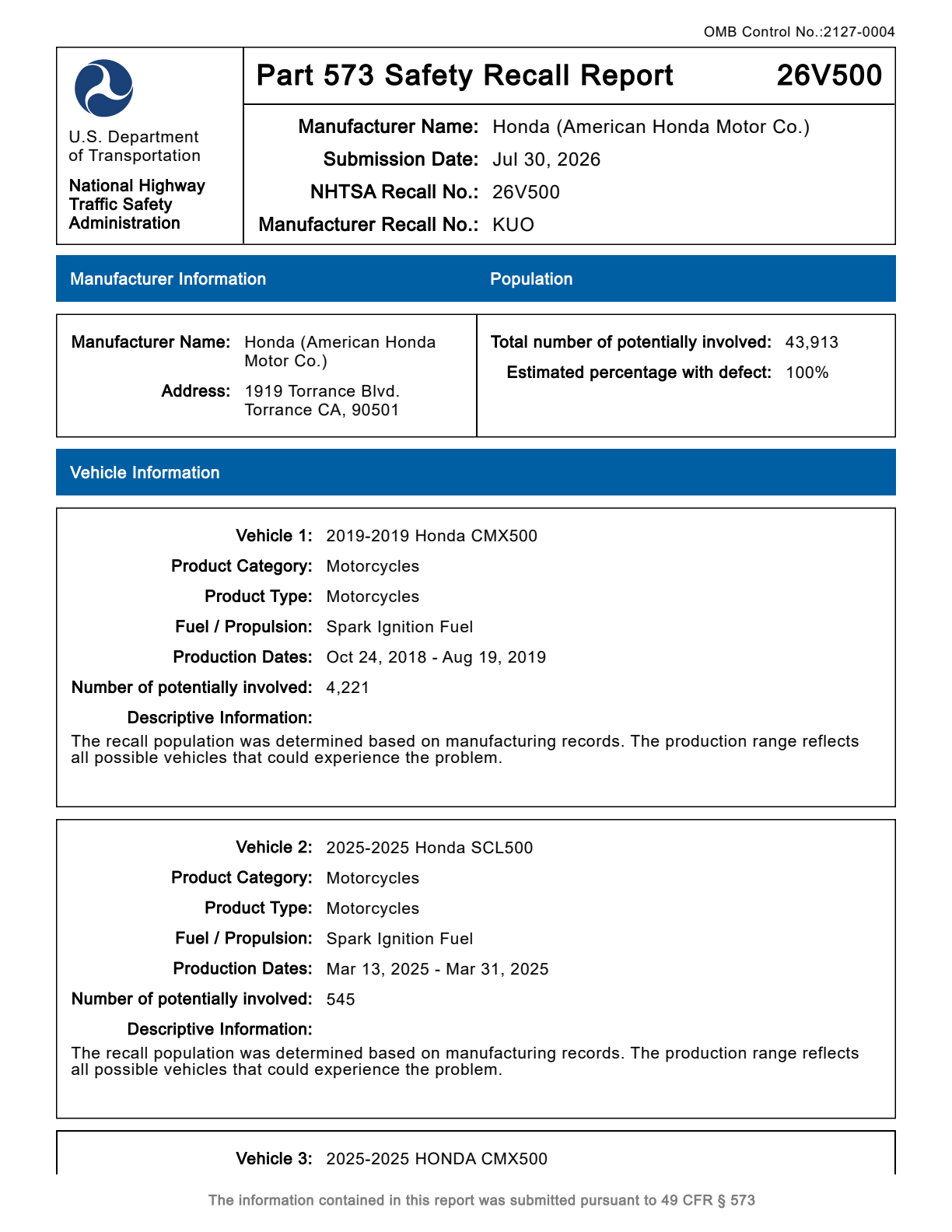
That list matters because the public search phrase Honda Rebel SCL500 recall can hide the breadth of the report. Riders searching by the everyday Rebel name may own a CMX300 or CMX500 that fits the recall population even if they do not use the internal model code in normal conversation. Likewise, a rider focused on the SCL500 title should not assume the recall is only about that one model line. The report is broader than the search phrase, so the article needs to translate the source without flattening it.
The report also gives per-group volumes. The 2019 CMX500 group includes 4,221 motorcycles. The 2025 SCL500 group includes 545. The 2025 CMX500 group includes 168. The 2017-2023 CMX500 group includes 23,948. The 2025-2026 CMX300 group includes 245. The 2017-2023 CMX300 group includes 19,007. Those counts help riders understand that the Honda Rebel SCL500 recall is not a boutique one-batch service action. It spans multiple production windows and model families.
What the report does not provide is equally important. The reviewed PDF does not list public VIN ranges and leaves the VIN-searchable date field blank. Because the Honda Rebel SCL500 recall source does not publish those details, this article does not invent them. A rider still needs the exact VIN route through Honda or NHTSA instead of guessing from production month alone.
Why The Steering-Risk And Do-Not-Drive Warning Matter
The most serious line in the report is the steering-risk description. According to NHTSA, the handlebar lock screw may loosen and fall between the frame and stem. If that happens, it may interfere with steering operation. A steering-interference defect is different from a cosmetic, lighting, or software complaint because it goes directly to a rider’s ability to guide the motorcycle through traffic, corners, braking, and emergency maneuvers.
That is why the Honda Rebel SCL500 recall remedy section is paired with do not drive and park outside advisories. The article should not soften those labels into vague caution. If a rider owns an affected CMX300, CMX500, or SCL500 and has not confirmed recall status with a dealer, the cleanest reading of the source is to stop riding the bike until the official repair is completed. Parking outside also reflects the recall’s own consumer advisory language and should be treated as part of the same owner-action package.
The source stops short of reporting injuries or deaths. Honda says that as of July 23, 2026 it had two warranty claims in the United States and no reports of injuries or a death related to the issue. That matters because the Honda Rebel SCL500 recall story is not about dramatizing a casualty count. It is about a manufacturer and regulator identifying a steering-risk defect before riders should keep trusting day-to-day feel, habit, or recent uneventful trips.
The defect description also explains why the issue is not limited to one bad screw batch in a simple consumer sense. Honda says the work instructions for the tightening process were unclear, sufficient axial force was not properly specified, a trainer change removed a two-hand instruction, the tool was tilted rather than kept perpendicular, and worn tool bits were not replaced consistently. That chain of process failures makes the Honda Rebel SCL500 recall a manufacturing-control problem, not just a rider-maintenance problem.
Free Dealer Repair And Owner-Notification Timing
The remedy is clear. Honda says registered owners of all affected vehicles will be contacted by mail and asked to take the motorcycle to an authorized Honda Powersports dealer. The dealer will replace the handlebar lock screw and apply a thread-locking agent using the proper procedure. That means the Honda Rebel SCL500 recall repair is not a general tightening tip for owners. It is an official dealer-performed repair path.
The report says dealer notification began and ended on or about July 27, 2026. Remedy owner notification is scheduled to begin and end on or about September 21, 2026 for owners of all models except 2026 model-year CMX300 motorcycles. For 2026 CMX300 owners, interim owner notification is also scheduled on or about September 21, 2026. The timing matters because riders searching for the Honda Rebel SCL500 recall in mid-August 2026 may not yet have a mailed owner letter even though the report already exists.
The remedy component is technically the same screw, but Honda says the installation procedure has been improved. That detail matters because riders may assume a same-part repair is weak or temporary. The report frames the fix differently: the corrected process uses replacement plus proper thread-locking and a defined installation procedure. For the Honda Rebel SCL500 recall, the procedure is the remedy.
Owners should also remember that the report says the production correction was applied September 22, 2025. That does not automatically answer every used-bike purchase question because the affected production windows differ across model groups and the report still requires VIN-level confirmation. If a seller says a motorcycle is outside the Honda Rebel SCL500 recall because it is a late-2025 or 2026 bike, the buyer should still ask for VIN confirmation from Honda or the dealer.
What Changed After The Earlier 26V146 Recall
The chronology section is one of the most useful parts of the source. Honda says it determined a safety defect existed and conducted recall 26V146 on March 5, 2026. Then on May 12, 2026 it received reports of the same issue occurring on vehicles outside the initial recall population. Another report followed on June 17, 2026, the company investigated on June 23, 2026, and on July 23, 2026 Honda decided a new safety recall was necessary. That chain explains why the Honda Rebel SCL500 recall is not just a duplicate headline with a different paperwork date.
In practical terms, the new recall widens the affected population beyond the first action. That matters for riders who already heard about recall 26V146 and assumed their motorcycle was clear because it was not in the first campaign. The official report for the Honda Rebel SCL500 recall specifically says the issue was found on vehicles outside that initial population. That is exactly the kind of detail a Navyago explainer should surface because it changes owner behavior.
The report also says vehicles already addressed under the earlier population are not the end of the story for every model family. Riders should not treat older paperwork, a used-bike dealer verbal assurance, or forum chatter as a substitute for current dealer confirmation. When a recall grows after additional reports, the safest approach is to treat the new campaign number and owner notice schedule as the live reference point.
For search and citation purposes, this also means the Honda Rebel SCL500 recall should be tied to both 26V500 and the related recall 26V146 in article language. The relationship is part of the source, and omitting it would make the story less useful for riders trying to understand why a bike that seemed outside the earlier action now appears in a broader recall discussion.
VIN, Dealer, And Resale Steps Owners Should Take
The best owner move is to start with the VIN and a dealer, not a guess. A rider who thinks a motorcycle may fall under the Honda Rebel SCL500 recall should stop riding, park the bike outside, gather the VIN from title or registration paperwork, and contact an authorized Honda Powersports dealer. If the bike is in storage or listed for sale, the same logic applies. The question is whether the VIN is open under 26V500, not whether the motorcycle looks unaffected in the garage.
When speaking to a dealer, owners should ask three direct questions. First, is the VIN included in recall 26V500? Second, when can the dealer perform the repair? Third, what paperwork will the owner receive after the screw replacement and thread-locking procedure are completed? Those three questions give the Honda Rebel SCL500 recall a concrete workflow instead of leaving the rider with only a headline and worry.
Used-bike shoppers should ask the same things before paying or picking up a motorcycle. If a seller describes a bike as a Rebel 300, Rebel 500, or SCL500 and the model year overlaps the source list, the shopper should ask for VIN verification and service proof. A sales statement that the bike is fine is not the same as a recall completion record. For any purchase that might be touched by the Honda Rebel SCL500 recall, written proof matters more than memory.
Owners who receive the letter later should keep it with the repair order after service. That documentation helps with future resale, insurance questions, and dealer follow-up. Readers who want more source-based public-interest explainers can start from the Navyago homepage and compare the source notes on similar recall and safety articles before taking action.
What The Official Source Does Not Say
The official source is strong on defect description and owner action, but it has limits. The reviewed Part 573 report does not publish VIN ranges. It leaves the VIN-searchable date blank. It does not list crash counts, injury counts, or deaths tied to the broader population. It also does not say riders should perform a self-fix at home. Those gaps matter because a recall explainer should tell readers where the document ends instead of filling the space with confident guesses.
That is why this Honda Rebel SCL500 recall article avoids claims about exact VIN breakpoints, dealership parts availability in every market, or whether all bikes built after a certain month are safe without confirmation. The source gives riders enough to act: stop riding, park outside, use the dealer route, and track the campaign number. It does not justify broader performance claims or speculative troubleshooting guides.
The same caution applies to resale value or insurance impact. The report does not discuss either subject. A buyer or seller may reasonably treat the Honda Rebel SCL500 recall as a document-check issue before closing a deal, but the official source does not assign a market value change. Source-based writing is strongest when it distinguishes between what the document says, what a rider should do next, and what still requires a dealer or VIN-level answer.
FAQ
What is the Honda Rebel SCL500 recall?
The Honda Rebel SCL500 recall is NHTSA recall 26V500 and Honda recall KUO. The report says a handlebar lock screw can loosen and fall between the frame and stem, which may interfere with steering.
Which motorcycles are included in recall 26V500?
According to the report, the recall covers certain 2017-2023 and 2025 Honda CMX300 motorcycles, certain 2017-2023, 2019, and 2025 Honda CMX500 motorcycles, and certain 2025 Honda SCL500 motorcycles.
Why does NHTSA say owners should not drive and should park outside?
The source says the loose screw may interfere with steering, increasing the risk of a crash or injury. The remedy page also marks the recall with do not drive and park outside consumer advisories.
Is the repair free?
Yes. Honda says owners should take the motorcycle to an authorized Honda Powersports dealer, where the dealer will replace the handlebar lock screw and apply a thread-locking agent with the proper procedure.
When are owner letters scheduled?
The report says remedy owner notification is scheduled on or about September 21, 2026 for most affected models, with interim owner notification on or about September 21, 2026 for 2026 model-year CMX300 motorcycles.
How is recall 26V500 related to recall 26V146?
Honda says it received reports of the same issue outside the initial 26V146 population and opened a broader investigation. The July 2026 report therefore expands the affected population beyond the earlier action.
Sources
Sources: This article is based on the official NHTSA Part 573 Safety Recall Report 26V500, submitted July 30, 2026, available at static.nhtsa.gov/odi/rcl/2026/RCLRPT-26V500-4623.pdf. Readers can also check the public recall route at NHTSA recall lookup for 26V500000. The article image is a local render from the official NHTSA recall report page, not a generated graphic.