
Isaiah Kirby East Lansing shooting video coverage centers on a Wednesday, April 15, 2026 confrontation near Lake Lansing Road and Abbot Road. According to the PoliceActivity source package and later East Lansing reporting, officers were already rushing toward a reported stabbing when they encountered Isaiah Kirby running with what appeared to be a knife, shouted repeated commands, and then opened fire during a fast-moving roadside encounter.
Table of Contents
What the Isaiah Kirby East Lansing shooting video shows on April 15, 2026
The Isaiah Kirby East Lansing shooting video is not a long chase clip or a bodycam release about a routine traffic stop. It is a fatal police encounter that, according to the reviewed source package, unfolded only minutes after a separate disturbance escalated into a stabbing near a busy East Lansing intersection. PoliceActivity published the video on Wednesday, May 20, 2026, but the incident itself reportedly happened on Wednesday, April 15, 2026. Keeping those two dates separate matters because viewers are watching a later public release, not a live first report.
PoliceActivity says the chain of events began with a 911 call from workers at Marco’s Pizza after a man identified as 21-year-old Isaiah Kirby allegedly entered the business, acted as though he were a delivery driver, went behind the counter and started eating food that did not belong to him. The source says employees repeatedly told him to leave and described him as becoming confrontational. While that call was still active, the source says the situation outside rapidly turned violent and officers were updated that the event had become a stabbing involving a man armed with a knife.
That context is important because it explains why the Isaiah Kirby East Lansing shooting video moves so quickly from commands to gunfire. This was not presented by the source as an isolated stop where officers calmly walked up to a stationary person. It was described as an evolving emergency with a reported stabbing victim down nearby, multiple 911 callers, and officers trying to intercept a suspect on foot close to Lake Lansing Road and Abbot Road. In that setting, time compression shapes how the footage is later understood.
The PoliceActivity description says officers spotted Kirby running along Abbot Road while carrying what appeared to be a knife. Video released through the police package shows patrol vehicles stopping in the roadway as officers shouted commands for him to get on the ground and drop the weapon. The source says officers then fired in separate bursts over a short span, after which Kirby fell and officers continued giving commands before approaching with a shield, removing the knife and attempting medical aid.
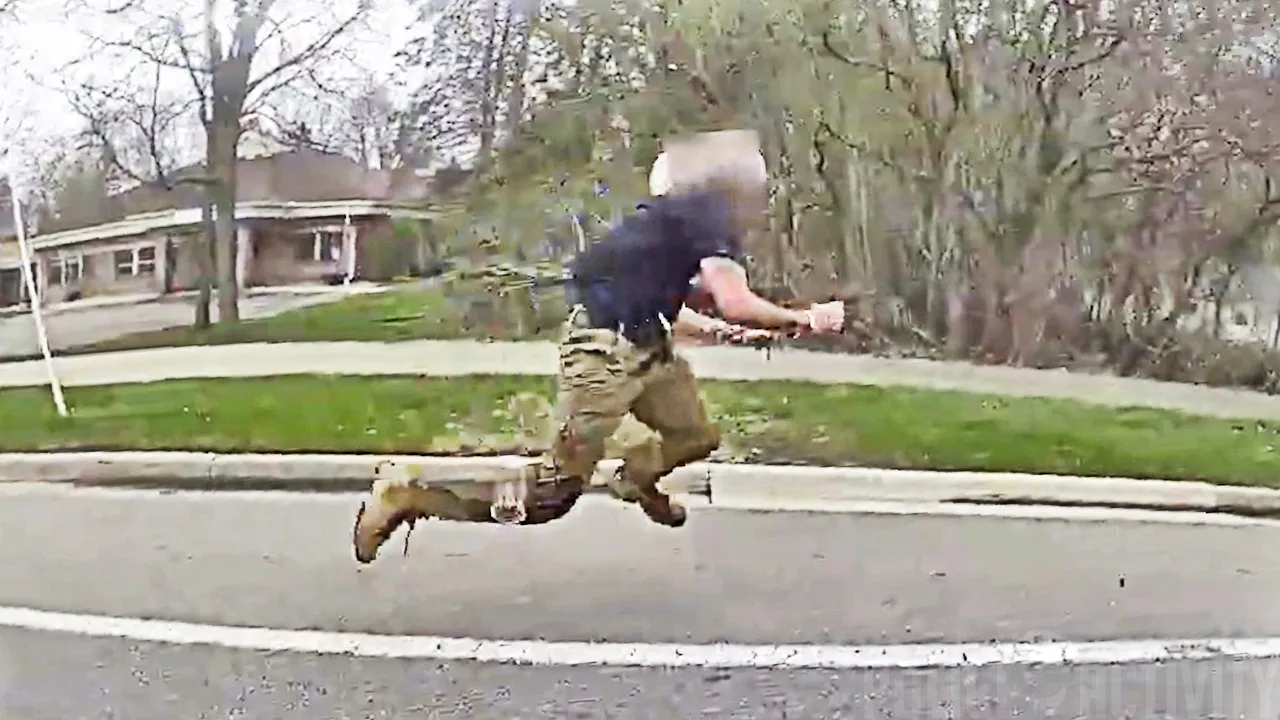
Readers looking for the Isaiah Kirby East Lansing shooting video usually want a direct answer to three questions: where this happened, why officers were moving so urgently, and whether the public video settles the legal debate. The first two questions are answerable from the source package and local coverage. The third is not. The footage is a central record, but it is still only one part of a larger investigative and legal process.
Why East Lansing police were already racing toward the Lake Lansing and Abbot area
The reason officers were moving at speed in the Isaiah Kirby East Lansing shooting video is tied to the alleged violence reported moments earlier. The PoliceActivity source description says the initial call came from Marco’s Pizza workers who were concerned about an escalating disturbance. It then says that while the employee was still speaking with dispatch, attorney Douglas Mielock had just left a nearby barbershop and was attacked outside. East Lansing Info later reported that the narrated timeline released by police included 911 calls describing a man near the Lake Lansing Road and Abbot Road intersection who had stabbed someone in a parking lot.
That matters because without the surrounding dispatch context, the video can look like officers abruptly stopping in traffic and shooting within seconds. The source package suggests the officers were not arriving blind. They were responding to a fresh report that a man had already stabbed someone and was still armed. A reader does not have to adopt every conclusion of the police narrative to understand why that operational detail changes the frame of the encounter.
The Isaiah Kirby East Lansing shooting video also sits at a location many local readers can picture immediately. Lake Lansing Road and Abbot Road is not an isolated rural scene. It is a heavily used corridor near businesses, traffic and bystanders. That public setting raises the stakes in two ways. First, officers may have been worried about additional civilians nearby. Second, public footage from several angles can influence how quickly the incident spreads online, often before official review is complete.
Because the source story begins inside a restaurant but the fatal encounter happens in the roadway, it is easy for search readers to blend the two phases into one uninterrupted event. A better way to read the Isaiah Kirby East Lansing shooting video is as a sequence with at least three distinct parts: a disturbance at Marco’s Pizza, an alleged stabbing outside the nearby business area, and then the armed police encounter along Abbot Road. Separating those stages helps the article stay factual and reduces the temptation to fill unknown gaps with assumptions.
That sequence discipline matters for search and AI citation. If a reader asks why police were already rushing in the Isaiah Kirby East Lansing shooting video, the article should answer plainly: because the public source package and local reporting say they had been updated about a reported stabbing and an armed suspect. That is a much tighter and more defensible answer than vague language about officers responding to a chaotic situation.
What local reporting says about the stabbing of Douglas Mielock
The most important non-police detail in the Isaiah Kirby East Lansing shooting video story is the condition of Douglas Mielock, the attorney identified in local reporting as the stabbing victim. PoliceActivity says Mielock had just left a barbershop and was getting into his vehicle when Kirby attacked him without warning. East Lansing Info and Lansing City Pulse both reported that Mielock survived after surgery and time in intensive care. Those reports matter because they show the encounter was not framed only as an officer-suspect event; it was also a serious civilian victim case.
That does not mean every disputed fact is resolved. A source-based article should still use careful phrasing such as according to the PoliceActivity source description or local reporting says when describing exactly how the confrontation started. But the public-interest value of the article increases because the Isaiah Kirby East Lansing shooting video is connected to a broader question about what happened to Mielock, how quickly police were updated, and what officers believed had just occurred before they saw Kirby running with an apparent knife.
Another point worth keeping clear is that the available reporting reviewed here did not establish a known prior relationship between Kirby and Mielock. East Lansing Info’s June 2, 2026 report on the Attorney General referral said East Lansing police had previously stated the two men did not know each other. That is a narrow but useful fact. It helps explain why coverage often describes the stabbing as sudden and unexpected rather than part of a documented ongoing dispute between the two men.
Readers should also notice what the Isaiah Kirby East Lansing shooting video does not show directly. It is not a complete video of the alleged stabbing itself from multiple angles. Much of what the public knows about the attack comes from 911 calls, witness descriptions and later reporting rather than one clean pre-shooting recording. That means the video answers some questions about the police encounter but leaves earlier questions dependent on witness evidence and investigative records.
When public cases combine a stabbing, a roadway police encounter and later scrutiny of force decisions, audiences often search for a simple winner-and-loser narrative. The available record does not support that kind of flattening. It supports a more careful summary: Mielock was seriously injured, officers were told they were confronting an armed suspect, and the fatal shooting happened in that shadow. That is why the Isaiah Kirby East Lansing shooting video drew so much local attention even before the prosecutor sent the case for outside review.
What commands and force sequence are visible before and after the shooting
The command sequence is the core of the Isaiah Kirby East Lansing shooting video because it is where the public has to judge timing, distance and compliance under pressure. The transcript reviewed from the public source package shows officers yelling variations of get on the ground, put the knife down, drop the knife and toss the knife so we can help you. Those commands are repeated many times in the footage. They are not a single one-off warning lost in noise. The repetition is one reason the source package frames the event as an urgent armed confrontation rather than a surprise shooting without commands.
East Lansing Info reported on May 15, 2026 that body camera video showed police stopping their cars in the direction Kirby was running and yelling at him to get on the ground while he continued to run. The same report says a few seconds after he was initially shot, Kirby appeared to be on his knees holding a knife to his own throat when three more shots were fired. That detail is important because public debate about the Isaiah Kirby East Lansing shooting video often focuses not only on the first volley, but also on what happened after the first rounds struck him.
A careful reader should separate at least three parts of the force sequence. First, officers intercepted Kirby in the roadway and issued immediate commands. Second, the initial gunfire happened while officers were trying to stop a reported armed suspect moving toward them. Third, after Kirby went down, officers continued issuing knife-related commands and delayed a close approach until they could use a shield and secure the weapon. That final stage matters because it explains why medical aid, although attempted, was not the first action taken the instant he hit the ground.
The Isaiah Kirby East Lansing shooting video does not support casual overclaiming on either side. It does not support a claim that officers fired without warning, because repeated commands are part of the visible and audible sequence. It also does not support a claim that every legal or policy issue is settled simply because commands were given. Whether the number of shots, the spacing between volleys, and the continued use of force complied with law or policy is exactly the kind of question that later outside review is supposed to examine.
Another point the footage highlights is how compressed decision-making becomes in public roadway encounters. Officers were dealing with a reported stabbing, moving traffic, nearby civilians and a suspect described as still armed. That does not answer every later criticism, but it does explain why the Isaiah Kirby East Lansing shooting video has to be read as a split-second event rather than a quiet scene where every option could be tested slowly. Search readers deserve that context because without it, the clip can be misread as either instantly obvious or instantly indefensible.
What East Lansing police, the prosecutor and the Michigan Attorney General review say happened next
Public attention did not end when the Isaiah Kirby East Lansing shooting video was released. East Lansing Info reported on June 2, 2026 that the Ingham County Prosecutor’s Office referred the fatal shooting to the Michigan Attorney General’s Office, which would decide whether criminal charges should be brought against the officers involved. That referral matters because it signals the case moved beyond internal city explanation and into an outside charging review process.
For readers, the referral does not mean charges were certain, and it does not mean the officers were cleared. It means a separate authority was asked to review the facts. That is an important distinction because many online discussions treat referral, indictment, declination and policy review as though they were the same thing. They are not. A criminal charging review asks a narrower question than a public debate about whether a shooting was troubling, avoidable or tactically sound.
The release timeline also matters. East Lansing police delayed public video release, then later issued a narrated package with multiple body camera and dash camera videos. Local reporting from East Lansing Info and Lansing City Pulse shows that the release itself became controversial, with community members and the family calling for fuller transparency. So when readers search for the Isaiah Kirby East Lansing shooting video, they are often searching for both the footage and the institutional response to it.
As of Monday, August 24, 2026, Navyago did not locate a later public announcement in the reviewed source set stating that the Michigan Attorney General had closed the case or announced charges. That is not proof that nothing else exists; it is a limit of the verified material reviewed for this article. The safe way to state the public status is simply that the case was referred for state review and the reviewed source set does not establish a final August 2026 charging outcome.
If readers want a broader example of how source video and later review can diverge, Navyago’s explainer on armed man points two guns at police video shows why a dramatic clip may answer some factual questions while leaving legal questions unresolved. The same principle applies here. The Isaiah Kirby East Lansing shooting video is a crucial primary source, but it is not the final legal document in the case.
What the video does not prove about legality, policy or final fault
The Isaiah Kirby East Lansing shooting video does not prove a final legal conclusion about whether every round fired was justified under Michigan law or East Lansing Police Department policy. It is strong evidence, but evidence and adjudication are not the same thing. A public video can show timing, movement and commands. It usually cannot show every officer perception, every angle, every radio detail or every policy instruction that mattered at the time.
The video also does not prove motive. The reviewed source set says Isaiah Kirby allegedly stabbed Douglas Mielock and then ran while holding what appeared to be a knife. It does not establish why he allegedly attacked Mielock, whether he was in mental-health crisis, whether intoxicants were involved, or what he intended second by second during the final encounter. Those are the kinds of details that often get filled in by rumor when a case goes viral, and they are exactly the details a source-based explainer should refuse to invent.
Another limit is that the public release is edited. East Lansing police issued a narrated timeline along with separate camera views. Edited releases can be informative, but they are still selections from a larger evidence pool. A reader using the Isaiah Kirby East Lansing shooting video to understand the case should keep that in mind and should not assume that edited chronology equals every relevant fact in the file.
This is also why the article avoids saying the footage settles whether officers acted lawfully or unlawfully. Search readers may want a blunt verdict, but a responsible page should give them something more useful: what the source says, what corroborating local reporting adds, what the outside review status was in the reviewed record, and what remains unresolved. That structure helps both human readers and AI systems cite the page accurately instead of treating it as a polemic.
Why the Isaiah Kirby East Lansing shooting video still matters for readers
The Isaiah Kirby East Lansing shooting video matters because it sits at the intersection of public safety, police accountability and the limits of viral evidence. It is not just a local incident clip. It involves a seriously injured civilian victim, multiple emergency calls, a fatal police shooting, delayed video release and an outside review by the Michigan Attorney General’s Office. That combination means the footage continues to matter well beyond the first day it was posted.
For local readers, the case raises practical questions about dispatch communication, emergency response to armed suspects in traffic corridors, and how cities release critical-incident footage. For broader readers, it is a case study in why public video must be read with both urgency and restraint. Urgency matters because the footage documents a fatal state use of force. Restraint matters because short clips and narrated timelines can never replace a full case file.
That is why the best use of an article like this is not to settle every argument, but to anchor the public record. The Isaiah Kirby East Lansing shooting video, the East Lansing reporting and the prosecutor referral together establish a core timeline that readers can cite without exaggeration: a disturbance report escalated into a stabbing, officers intercepted an armed suspect, repeated commands were given, shots were fired, Isaiah Kirby died at the scene, Douglas Mielock survived, and the case went to the Michigan Attorney General’s Office for review.
FAQ
When did the Isaiah Kirby East Lansing shooting video incident happen?
The reviewed source set says the incident happened on Wednesday, April 15, 2026. PoliceActivity published the video later, on Wednesday, May 20, 2026.
Who was Douglas Mielock in the Isaiah Kirby East Lansing shooting video case?
Local reporting identified Douglas Mielock as the attorney who was allegedly stabbed before the police shooting. Reports reviewed for this article say he survived after surgery and time in intensive care.
Did the video show officers giving commands before shooting?
Yes. The transcript and local reporting both indicate officers repeatedly yelled commands such as get on the ground, put the knife down, drop the knife and toss the knife so they could help him.
Did the Michigan Attorney General close the case?
As of Monday, August 24, 2026, Navyago did not locate a later public announcement in the reviewed source set stating that the Michigan Attorney General had closed the review or announced charges.
Does the Isaiah Kirby East Lansing shooting video prove the shooting was lawful?
No single public video can settle a final legal ruling by itself. The footage is important evidence, but criminal, civil and policy conclusions depend on a larger record and formal review.
Source Video
The primary source video is embedded below for context. Viewer discretion is advised because it contains graphic injury, emergency audio and a fatal police shooting.
Source Note
Primary source: PoliceActivity, Officers Shoot Suspect After He Runs Toward Them With Knife, published May 20, 2026. Supporting public-interest reporting reviewed for this article includes East Lansing Info’s May 15, 2026 report on the video release and June 2, 2026 report on the Michigan Attorney General referral, plus Lansing City Pulse coverage of the same release window. This article uses source-based wording and does not make an independent finding about criminal guilt, policy compliance, motive, or final legal liability.
Sources: East Lansing Police Release Video of Fatal Shooting of Isaiah Kirby; ELPD Shooting Referred to Michigan Attorney General’s Office; East Lansing Police Department release video of Isaiah Kirby shooting.