
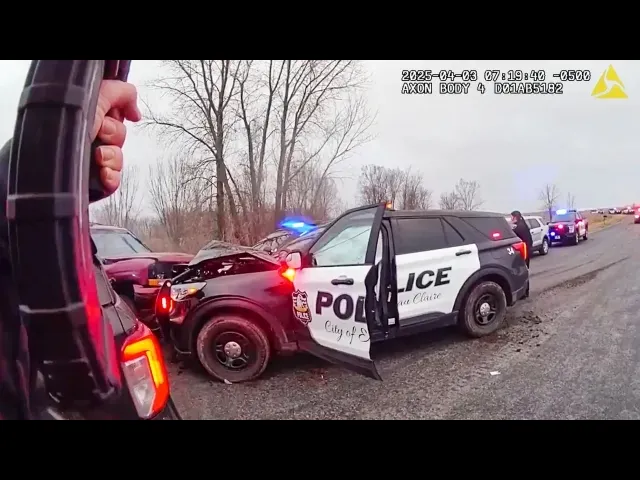
Police chase patrol cars wrecked coverage starts with the Midwest Safety source video, not with a shortcut verdict. The video says an April 3, 2025 pursuit in Eau Claire, Wisconsin began after 911 calls about a maroon Chevy near pedestrians, then escalated into wrecked police units, injured officers, a field stop, charges, a plea agreement, and restitution.
What The Midwest Safety Source Says First
The Midwest Safety video, titled “Police Chase Leaves 6 Patrol Cars Wrecked,” presents the story as a source-video recap built from police radio, dashcam, bodycam, and narration. According to the opening narration, dispatch in Eau Claire, Wisconsin received multiple 911 calls on April 3, 2025 about a maroon Chevy driving toward pedestrians on a sidewalk as school was starting. Officers began looking for the vehicle, and the source frames the main public-safety question as whether the driver could be stopped before someone was seriously hurt.
The first important detail in the police chase patrol cars wrecked source is the neighborhood setting. The transcript references sidewalks, intersections, school-start timing, children being told to stay inside, and a vehicle moving through streets rather than on a controlled highway. That context matters because a pursuit through a neighborhood has different risks from a freeway chase. The source does not invite readers to watch only for crashes. It shows why officers were trying to stop a moving hazard inside a populated area.
The second important detail is that the source describes several layers of information. Some facts come from the narration, some from officers speaking over radio, and some from what the footage shows as vehicles move, stop, turn, and get damaged. A careful recap should keep those layers separate. A radio call heard during a chase is not the same as a final court record. A narrator’s summary is useful, but readers still need to know it is the video’s source narration rather than an independent Navyago investigation.
For that reason, this article uses the phrases “the source says,” “the narration says,” “footage shows,” and “according to the source.” Those words are not padding. They are how a source-based article keeps legal claims attached to the record that supports them. The story is serious enough without adding unsupported claims about motive, intent, or anything the video does not establish.
Why The Eau Claire Pursuit Became A Public Safety Story
The public-interest issue in this source is not only that patrol cars were damaged. The larger issue is the setting of the pursuit. The source describes a vehicle driving toward pedestrians on a sidewalk, moving through city streets, circling blocks, driving on sidewalks, entering oncoming traffic, reaching railroad tracks, and eventually moving into a field area. Each change in location created a new safety problem for officers, pedestrians, drivers, and people nearby.
The transcript includes officers telling residents to keep children inside and repeatedly updating direction of travel. It also includes officers discussing blocking, boxing in, spikes, ramming authorization, and attempts to pin or stop the vehicle. Those details show why the police chase patrol cars wrecked story moved quickly from a traffic problem into a broader safety response. Readers should understand that the wrecked police units were not a separate sidebar. In the source record, they were part of the effort to stop a vehicle that officers believed was creating immediate danger.
That does not mean every tactical choice is beyond review. It means the source should be read in sequence. A short social clip of a patrol car collision may make the incident look like one dramatic impact. The full source video is longer and shows repeated turns, radio calls, and attempts to manage risk. The useful question for a reader is not simply “how many cars were wrecked?” but “what conditions led officers to accept vehicle damage as part of the stop?”
Navyago has covered other police-video stories where the same rule applies. In the dashcam arrest lawsuit video source facts recap, the value came from separating video, official claims, and unresolved legal questions. This Midwest Safety source deserves the same treatment. The video can show a sequence, but it should not be turned into a final legal essay beyond the source record.
Police Chase Patrol Cars Wrecked: Seven Source Facts Readers Should Separate
The phrase police chase patrol cars wrecked can sound like a simple crash headline, but the source contains more than one fact lane. The seven points below are the main source facts a reader should separate before sharing the video or drawing conclusions from a shorter repost.
- The source video ID is oTq1ep1V98g. The source URL, thumbnail, body image, and YouTube iframe in this article all point to the same Midwest Safety video. That match matters because a police-video recap can fail if the article uses one source, another thumbnail, and a third incident’s facts.
- The source places the incident in Eau Claire, Wisconsin. The narration says dispatch in Eau Claire received multiple 911 calls on April 3, 2025. That location and date are part of the source package, not an assumption added after the fact.
- The source says the initial calls involved a maroon Chevy near pedestrians. The narration says callers reported the vehicle driving toward pedestrians on a sidewalk as school was starting. That is the reason the article treats the incident as public-interest coverage rather than a routine traffic-stop recap.
- The title says six patrol cars were wrecked. The closing narration says a total of six police units were wrecked. Earlier narration says seven cars would be destroyed before the incident ended, so readers should preserve the difference between the source title, police-unit count, and any broader vehicle-damage language.
- The source says two officers were taken to the hospital. The narration describes the injuries as non-life-threatening. This article does not add medical details beyond that source wording.
- The source says the vehicle search yielded drugs, needles, and cash. The narration reports over 14 grams of methamphetamine, three unused hypodermic needles, and more than $1,300 in a currency envelope. Those are source-reported details and should remain attributed.
- The source says the case later ended with a plea agreement. According to the narration, Nathan Stevens first pleaded not guilty to the charges, then later entered a plea agreement involving guilty pleas to two fleeing-and-eluding counts resulting in bodily harm, with other charges dropped.
Those seven facts are enough to explain why the video drew attention, but they are not permission to invent extra claims. A source-based recap should help readers slow down. It should identify the source, give the important timeline, and mark the difference between what the video shows, what the narrator reports, and what the court outcome is said to be in the source.
The Tactical Problem Shown By The Chase
The police chase patrol cars wrecked video shows a pursuit that did not stay in one lane, one street, or one kind of environment. The transcript references the vehicle going west, turning back toward another street, driving on sidewalks, circling, moving near intersections, going onto railroad tracks, and entering field areas. For officers, each change in direction changed the immediate risk. A vehicle on a sidewalk threatens pedestrians differently from a vehicle on railroad tracks or in a field.
The transcript also shows officers debating or announcing options under pressure. They discuss spike strips, boxing the vehicle in, pit-style contact, pinning the vehicle, and pushing it once it becomes boxed. In source-video coverage, that language should be treated as part of the real-time incident rather than a clean after-action plan. Officers are making radio calls while moving, while other vehicles are nearby, and while some police units are already damaged.
The source also makes clear that stopping a large SUV can require more than one attempt. The narration and radio traffic describe the vehicle continuing after contact, entering a field, and being boxed in only after multiple units converge. A reader who watches only the final field stop in the police chase patrol cars wrecked video may miss the earlier risk around pedestrians and neighborhood streets. A reader who watches only the early collisions may miss how the stop unfolded after the vehicle left the roadway.
That is why the word “wrecked” should be read carefully. It can make the story sound like the main point is property damage. The source record is broader. It shows a pursuit where officers appeared to use vehicles as tools to block, slow, or immobilize a suspect vehicle. Whether every decision was ideal is not something this article can determine. What the source does establish is that the damage happened during an extended effort to stop a moving vehicle described as dangerous.
Another tactical point is communication with people nearby. The transcript includes officer language telling residents to stay inside and keep children inside. That kind of instruction belongs in the recap because it shows the chase spilling into everyday spaces. It was not only a contest between patrol cars and one vehicle. It involved public streets, sidewalks, people who had called 911, and officers trying to coordinate around them.
What The Source Reports About Charges And Sentence
The closing narration gives the legal outcome as part of the source package. It identifies the suspect as 41-year-old Nathan Stevens and says he was taken to a hospital and medically cleared for booking. It also says, according to court documents referenced by the source, that he was charged with two counts of recklessly endangering safety, two counts of fleeing and eluding resulting in bodily harm, and possession of methamphetamine. The narration adds that he received 20 traffic violations tied to stop signs, wrong-lane driving, sidewalks, and other violations.
The source then describes a change in the court posture after the police chase patrol cars wrecked incident. It says Stevens pleaded not guilty to all charges at first, with cash bond set at $35,000. It later says he entered a plea agreement about three months afterward. According to that narration, he pleaded guilty to two counts of fleeing and eluding an officer resulting in bodily harm in exchange for dropping the remaining charges. This article repeats that as source-reported court-outcome information and does not expand it into claims about motive or intent.
The source also says he was ordered to serve a five-year prison sentence with two years of extended supervision, plus remaining time on extended supervision from a previous conviction. It says he was ordered to pay over $3,500 in restitution and was serving time at Jackson Correctional Institution, with a possible prison timeline extending to 2036. Because these are legal-status details, readers should treat the source as the basis for the recap and consult official court records if they need certified case information.
The key editorial point is that the legal outcome should not erase the earlier need for careful language. Even when a source reports a guilty plea, the article should still distinguish charges, plea terms, dropped counts, sentence, restitution, and prior-record references. A single sentence saying someone “was guilty of everything” would be both inaccurate to the source and legally sloppy. The source itself describes a plea agreement that narrowed the outcome to specific counts.
What Readers Should Not Assume From The Video
A police chase video is easy to overread because the footage feels immediate. Viewers hear shouting, see cars move quickly, and watch collisions or stop tactics unfold in real time. That intensity can make the source feel complete. It is not complete by itself. The video gives a public record, but it does not show every radio channel, every witness call, every policy decision, every later fleet-cost invoice, or every court filing.
Readers should avoid several assumptions when sharing the police chase patrol cars wrecked clip. Do not assume the source settles what the driver was thinking. Do not assume every officer had the same view at the same second. Do not assume the damage number alone tells the whole risk calculation. Do not assume the transcript is perfect, because automatic captions can mishear officer names, radio codes, and overlapping speech. Use the transcript as a navigation aid, not as a certified legal transcript.
The video narration includes references to methamphetamine, prior convictions, and a plea agreement. Those are sensitive details. The safer wording is to say the source reports them, then explain why they matter to the case summary. It is not necessary to turn those details into a character essay. The public value of the article is in helping readers understand the incident sequence, reported charges, plea outcome, property damage, and officer injuries.
Readers should also be careful with the phrase “six patrol cars wrecked.” The source title uses that phrase, and the narration says six police units were wrecked. But the source also says seven cars would be destroyed before the incident ended. A short headline may simplify the count. A careful article should preserve both lines and make clear which one comes from the title and which one comes from the narration.
How To Read The Vehicle Damage And Injury Numbers
The source narration says two officers were taken to the hospital with non-life-threatening injuries. That is the injury claim this article uses. It does not identify medical diagnoses, treatment length, or personal details because the source does not give those specifics in the source package used here. The important public-safety point is that the source reports officer injuries alongside the vehicle damage, meaning the incident was not only a budget-cost story.
The narration also gives a cost range for police vehicles in the police chase patrol cars wrecked source. It says each vehicle cost about $50,000 and could cost as much as $75,000 when standard equipment is included. It then says damages incurred by the Eau Claire Police Department may have reached a quarter of a million dollars. Those numbers should be read as source-reported estimates. They help explain why the incident matters to a city budget, but they are not a full audited invoice.
Police vehicles are not ordinary cars from a budget perspective. A squad can include lights, siren equipment, radios, partitions, mounts, weapons storage, computer systems, camera equipment, push bumpers, and other department-specific outfitting. That is why the source’s range may be larger than a used-car replacement estimate a reader might imagine. Still, the article should not invent exact costs for each unit unless an official invoice is available.
The vehicle-damage figure also raises a policy question that belongs in a public-interest explainer: when a moving vehicle threatens people in a neighborhood, agencies may decide that damaging police units is preferable to letting the hazard continue. That is not a universal rule and not a final judgment on this case. It is a way to understand why the video includes repeated attempts to block or pin the vehicle, even though those attempts were costly.
For readers, the practical takeaway from the police chase patrol cars wrecked source is to track three numbers separately: six police units wrecked, two officers taken to the hospital with non-life-threatening injuries, and possible damage reaching roughly a quarter of a million dollars according to the source. Combining those numbers into one dramatic claim would make the story less accurate. Keeping them separate makes the source easier to understand and easier to verify.
Source Video
FAQ
What is the police chase patrol cars wrecked video about?
It is a Midwest Safety source video about an April 3, 2025 Eau Claire, Wisconsin pursuit. The source says the chase began after 911 calls about a maroon Chevy near pedestrians and ended after multiple police units were wrecked during efforts to stop the vehicle.
How many police units does the source say were wrecked?
The source title says six patrol cars were wrecked, and the closing narration says six police units were wrecked. The narration also says seven cars would be destroyed before the incident ended, so readers should keep those source lines separate.
Were officers injured in the Eau Claire chase?
According to the Midwest Safety narration, two officers were taken to the hospital with non-life-threatening injuries. This article does not add medical details beyond that source statement.
What legal outcome does the source report?
The source says Nathan Stevens first pleaded not guilty, then entered a plea agreement involving guilty pleas to two counts of fleeing and eluding an officer resulting in bodily harm, with other charges dropped.
Why does this article use cautious wording?
Police-video stories include legal, safety, and privacy risks. Cautious wording tells readers what the source reports without adding motive, intent, or conclusions beyond the Midwest Safety video and narration.
Sources
Sources: Midwest Safety, “Police Chase Leaves 6 Patrol Cars Wrecked,” YouTube source video oTq1ep1V98g, uploaded July 31, 2026 and accessed August 4, 2026, at https://www.youtube.com/watch?v=oTq1ep1V98g. This police chase patrol cars wrecked article is a source-based public-interest explainer and does not make independent legal findings.