Romeoville Family Welfare Check: 5 Shocking Lessons
The Romeoville family welfare check began with the kind of call police departments receive every day: relatives could not reach a young family, a husband had not shown up for work, and something about the silence felt wrong. In the bodycam footage reviewed in the source video, officers arrive at a quiet suburban home expecting uncertainty, not a scene that would later become one of the most disturbing murder investigations in Illinois.
According to reporting by ABC7 Chicago and the Associated Press, police found Alberto Rolon, Zoraida Bartolomei, and their two sons, Adriel and Diego, dead inside their Romeoville home in September 2023. Family dogs were also found dead. Later police records described a complicated alleged plot involving Nathaniel Huey Jr., who had reportedly been romantically involved with Bartolomei, and Huey’s fiancee, Ermalinda Palomo.
This recap focuses on what the bodycam video shows about the investigation process: the first warning signs, the officers’ cautious entry, the suspect interview, the role of digital evidence, and the multi-state manhunt that followed. It is not a court finding. Because the central suspects died before trial, the case is best discussed through reported facts, police records, and official statements rather than courtroom conclusions.
The lesson is grim but important: a welfare check is never routine once the details stop adding up.
Table of contents
Why the welfare check immediately felt wrong
How bodycam footage shows officers slowing the scene down
Why the suspect interview became a turning point
How digital evidence changed the direction of the case
What the manhunt added to the final timeline
Romeoville Family Welfare Check Timeline
The first striking part of the Romeoville family welfare check is how ordinary it appears on the surface. A relative calls because the family has not answered. Alberto Rolon reportedly missed work. The family’s vehicles are still at the house. The lights are off. None of that proves a crime by itself, but together those details push the call into a more serious category.
The bodycam footage shows officers looking through windows, checking the exterior, and communicating with dispatch and backup units. They notice signs of possible disturbance, including furniture that appears out of place. The source video says officers also saw dead dogs inside before making entry, which changed the risk level immediately.
That moment matters because it shows why welfare checks can become dangerous fast. Officers do not know whether they are dealing with a medical emergency, a domestic incident, a burglary, or an active threat still inside the house. The Romeoville family welfare check footage shows them moving from concern to tactical caution without rushing past the uncertainty.
For viewers, the slow escalation is the hook. The officers are not walking into a dramatic scene with full information. They are building the picture one small observation at a time, and each new detail makes the silence around the home feel heavier.
Officers Did Not Treat The House Like A Simple Call
One of the strongest lessons from the video is the way officers avoid assuming the house is empty. They hold positions, ask for more units, and discuss entry points. The source footage shows them preparing as if the person responsible could still be inside. That is a disciplined response to a scene where visual clues suggest violence but the threat is not yet located.
In hindsight, viewers know the welfare check would become a homicide investigation. The officers in the moment do not. That gap is what makes the bodycam footage valuable. It preserves the uncertainty of the first response, before detectives, records, phone data, and media coverage made the broader story clear.
ABC7 Chicago later reported that police records said all four family members had been killed and that the investigation eventually pointed toward Huey and Palomo. But the first responding officers were still operating at the level of doors, windows, shadows, vehicles, and missing family members.
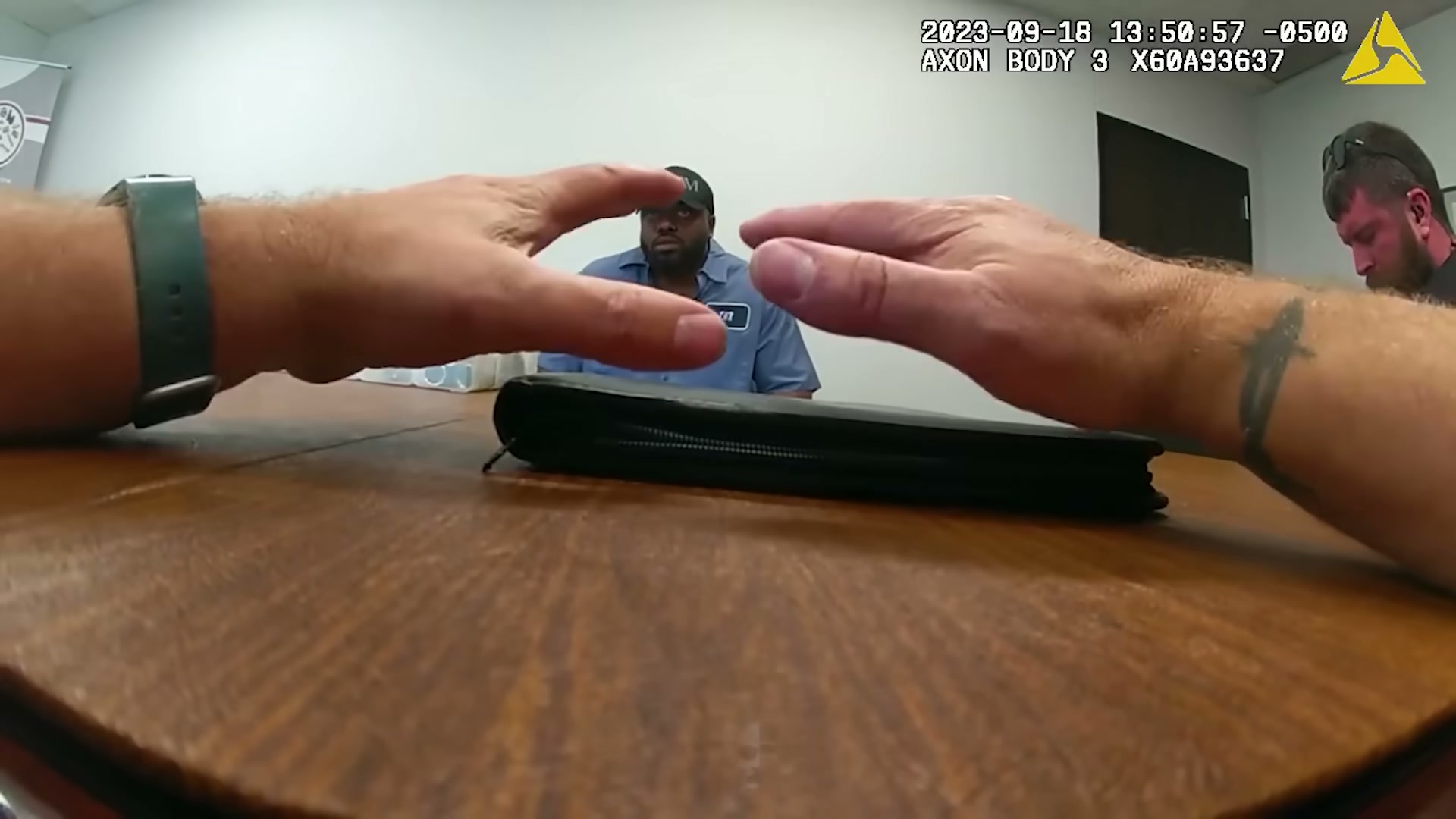
Bodycam frame from the source video showing a suspect interview during the investigation.
The Suspect Interview Shows Why Phones Matter
The next major turn in the source video comes when detectives speak with Nathaniel Huey Jr. Police records and later reporting said Huey had a relationship with Zoraida Bartolomei, which made him important to the investigation. In the interview segment, detectives ask about the relationship, messages, his vehicle, and whether he would provide access to his phone.
The phone conversation becomes one of the most important parts of the recap. Detectives explain that deleted messages may still be recoverable. Huey says he had deleted messages related to the affair. He does not immediately hand over the phone in the early exchange shown in the video. To investigators, that type of hesitation can matter, not because it proves guilt by itself, but because it can shape what they need to verify next.
This is where modern investigations often turn. The physical scene tells police that violence occurred. Digital evidence can help explain who had motive, who was communicating, and whether someone tried to hide a timeline. Messages, license plate readers, phone records, vehicle data, surveillance video, and app activity can all become pieces of the same map.
The bodycam interview is also a reminder that detectives often speak in terms of elimination. They tell a person they are trying to rule him out. In the Romeoville family welfare check investigation, that posture creates pressure: if the person is innocent, cooperation can help; if the person has something to hide, every delay may become more suspicious.
Police Records Later Described A Stranger Plot
The public story became even more complicated after additional police files were released. ABC7 Chicago reported that investigators believed Palomo used fake online personas and messages to manipulate Huey, allegedly making him believe he was acting under threats or direction from a criminal organization. People and Fox 32 Chicago also reported that police described a fake cartel narrative and jealousy over the affair as part of the alleged motive structure.
Those details are important, but they should be framed carefully. Because Huey and Palomo died before trial, there was no criminal trial where a jury tested every allegation. The strongest wording is that police records reportedly said or investigators alleged. That keeps the recap accurate and avoids turning a documentary summary into a verdict that never happened in court.
What the video does well is show how investigators moved from a welfare check to interviews and then toward a broader digital trail. The alleged manipulation plot sounds almost unbelievable, but the Romeoville family welfare check investigation followed a familiar method: start with the scene, identify relationships, check communications, compare timelines, and follow contradictions.
Bodycam frame from the source video showing detectives speaking with a connected witness at a residence.
The Fiance Interview Adds Another Layer
When detectives reach Ermalinda Palomo, the case shifts again. The source video presents the encounter as a moment when investigators are trying to separate accounts and speak with her away from Huey. That separation is a basic investigative need. Two people connected to the same timeline may influence each other, intentionally or not, if they are interviewed together.
Later reporting said police records identified Palomo as far more involved than early public narratives suggested. ABC7 Chicago reported that records described her as the person who helped create the false personas and drove Huey to the scene. Again, because the suspects died, these details remain framed through police records rather than trial testimony.
The lesson for viewers is that the first public theory in a major case can be incomplete. Early reports may identify one person as a suspect, another as a passenger, witness, or possible victim, and then later records may change that picture. Good crime reporting leaves room for that evolution.
The Manhunt Closed The Timeline
After the Romeoville family welfare check became a homicide investigation, the case moved beyond Illinois. The Associated Press reported that Huey was identified as a suspect and later died after a police chase and crash in Oklahoma. Palomo, who was with him, also died. AP reporting at the time described uncertainty around parts of the chase and the precise sequence of gunfire, crash, and death, while later police records added more detail.
For the public, that ending can feel like closure. For investigators and surviving relatives, it is more complicated. The suspects’ deaths meant there would be no trial, no cross-examination, and no courtroom confession. Police could close their investigative theory through records and corroborating evidence, but the family was left without the formal process many people expect after such a crime.
That is why the language around this case matters. It is fair to say police records reportedly identified Huey and Palomo as responsible. It is fair to describe the alleged fake cartel manipulation plot as part of the investigative findings. It is not careful to pretend a jury reached a verdict.
For NavyAgo readers, that distinction is part of the editorial standard. A strong crime recap should be compelling, but it also has to separate confirmed events, police allegations, and unanswered questions so the story remains useful instead of simply sensational. This Romeoville family welfare check recap follows that standard by treating the video as source footage, not as a substitute for court findings.
5 Chilling Lessons From The Bodycam
1. Silence can be evidence of risk. Missed calls, missed work, cars in the driveway, and no answer at the door are small signs. Together, they justified a serious welfare check.
2. First responders build the case before detectives arrive. The officers’ observations, timing, bodycam footage, and entry decisions became part of the record.
3. Digital evidence can expose hidden relationships. The investigation moved through phones, messages, vehicle information, and other records that helped establish connections.
4. Early narratives can change. Palomo’s role, according to later police records, was far more complex than an outsider might expect from the first pieces of information.
5. A closed investigation is not the same as a trial. The reported evidence can be strong, but careful language still matters when suspects are deceased and no jury verdict exists.
FAQ: Romeoville Family Welfare Check
What was the Romeoville family welfare check? It was the police response to a home in Romeoville, Illinois, after relatives could not reach Alberto Rolon, Zoraida Bartolomei, and their children. Officers found the family dead inside, according to official reports and news coverage.
Who were the suspects in the case? Police records and news reports identified Nathaniel Huey Jr. and Ermalinda Palomo as central figures. Both died after a police chase in Oklahoma, so the allegations were not tested in a criminal trial.
Why is the bodycam footage important? It shows the first response, the uncertainty around the Romeoville family welfare check, and later investigative interviews that helped shape the case timeline.
Where can readers watch the source video? The source recap is available on YouTube. Additional reporting is available from ABC7 Chicago and the Associated Press. For more bodycam and public-safety recaps, visit the NavyAgo homepage.