
Used clean vehicle credit rules now require extra care from shoppers because the IRS says the previously owned clean vehicle credit is not available for vehicles acquired after September 30, 2025. For a buyer looking at a used electric vehicle in 2026, the practical question is no longer simply whether a car looks eligible on paper. The first question is when the buyer acquired the vehicle, whether the vehicle was placed in service under the IRS timing rules, and whether the dealer supplied the required reporting before the credit can be claimed.
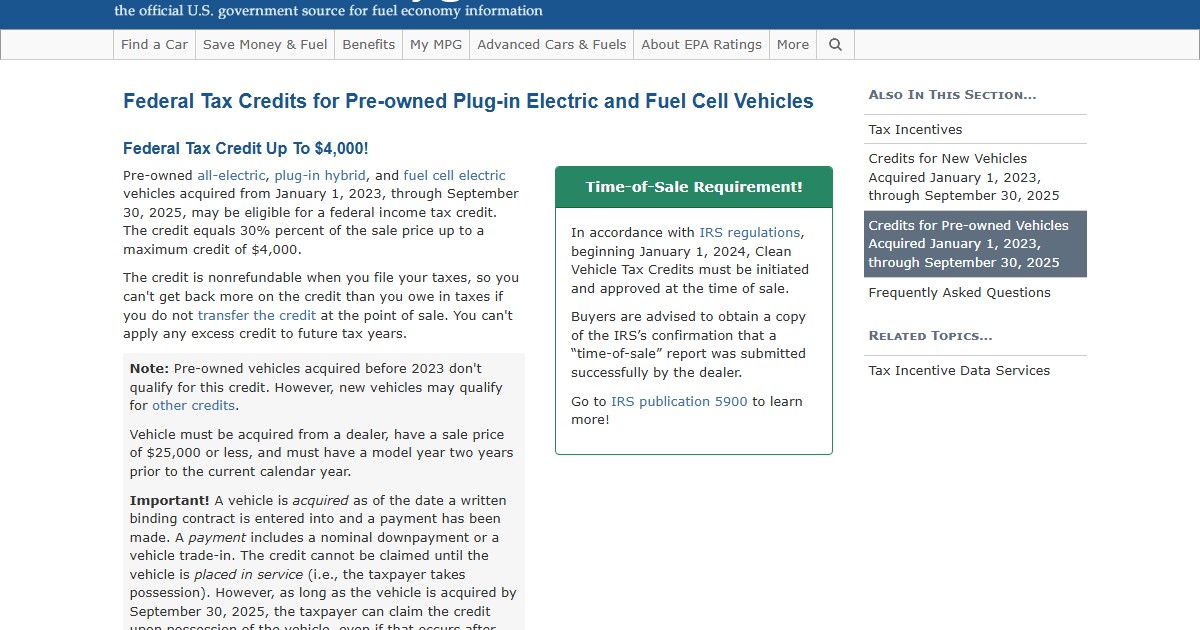
The IRS page for the used clean vehicle credit, last reviewed or updated on July 10, 2026, says the credit may apply to qualified used electric vehicles or fuel cell vehicles acquired on or before September 30, 2025, when other requirements are met. According to the IRS, the credit equals 30 percent of the sale price, up to a maximum of $4,000, for qualifying transactions. That headline number still matters for taxpayers reviewing a 2025 purchase, but it can mislead 2026 shoppers if the acquisition date is ignored.
For related auto policy coverage on Navyago, readers can also follow the Navyago Cars section. This article is a source-based explainer, not tax advice. Buyers should use official IRS instructions, FuelEconomy.gov eligibility tools, and a qualified tax professional for their own filing situation.
Table of contents
Used Clean Vehicle Credit Cutoff: What Changed for 2026 Buyers
The most important change is the date. The IRS says the previously owned clean vehicle credit is not available for vehicles acquired after September 30, 2025. It also says a vehicle must be placed in service for a taxpayer to claim the credit. If a vehicle was placed in service after that cutoff, the IRS says the buyer must have acquired it on or before September 30, 2025, and the agency describes acquisition as something that can be shown through a binding written contract and a payment made by that date.
That matters because many car shoppers remember the simple version of the program: buy a qualified used EV from a licensed dealer for $25,000 or less and potentially receive up to $4,000. In 2026, that summary is incomplete. A buyer walking into a dealership now should not assume a fresh purchase can receive the federal used clean vehicle credit. A taxpayer who bought before the cutoff may still need to check the paperwork, but a new post-cutoff transaction is a different situation.
For readers, the cleanest way to think about the rule is to separate shopping advice from filing review. Shopping advice for 2026 is cautious: do not price a used EV as if this federal used credit will automatically reduce the cost. Filing review for a 2025 transaction is different: check the IRS requirements, the acquisition date, the dealer report, the sale price, the vehicle details, and the buyer income limits before deciding whether the credit belongs on a tax return.
Who Could Still Qualify Under IRS Used Clean Vehicle Credit Rules
According to the IRS, a buyer may qualify only if the taxpayer is an individual who bought the vehicle for use and not for resale. The buyer cannot be the original owner, cannot be claimed as a dependent on another person’s tax return, and cannot have claimed another used clean vehicle credit during the three years before the purchase date. Those rules narrow the credit to personal-use buyers and prevent repeat claims over a short period.
The IRS also applies modified adjusted gross income limits. The listed thresholds are $150,000 for married filing jointly or a surviving spouse, $112,500 for heads of household, and $75,000 for other filers. The IRS says taxpayers can use modified AGI from the delivery year or the prior year, whichever is less. That detail is useful for someone whose income moved above or below a threshold from one year to the next.
These income and buyer rules are easy to overlook because the vehicle often gets the attention. A car can appear to meet the battery, weight, model-year, and price rules, but the taxpayer may still miss the credit if the buyer-side requirements are not satisfied. Navyago readers comparing used EV offers should treat the buyer rules as a separate checklist rather than a footnote.
Vehicle And Sale Rules Buyers Should Verify Before Filing
The IRS says a qualifying vehicle must have a sale price of $25,000 or less, be at least two model years earlier than the calendar year of purchase, have a gross vehicle weight rating under 14,000 pounds, be an eligible plug-in EV or fuel cell vehicle with a battery capacity of at least 7 kilowatt hours, and be used primarily in the United States. The agency also points buyers to FuelEconomy.gov to check eligible used clean vehicles.
FuelEconomy.gov is important because model names alone can be confusing. Two vehicles with similar badges may have different battery configurations, model years, or eligibility records. The IRS source page links readers to FuelEconomy.gov for the eligibility lookup, so buyers should not rely only on dealer advertising, social media summaries, or a generic EV list. A VIN-level and transaction-level review is still needed.
Another IRS condition is that the vehicle must not have already been transferred after August 16, 2022, to a qualified buyer. This prevents the same used clean vehicle from generating repeated federal credits through later qualifying sales. A buyer who is reviewing a 2025 purchase should keep records that show the dealer’s reporting and the vehicle’s qualification at the time of sale.
Dealer Reporting Is The Gate Many Buyers Miss
Dealer reporting is not just an administrative extra. The IRS says that when a buyer takes possession, the seller must give information about the vehicle’s qualifications, and sellers must also register online and report the same information to the IRS. If the seller does not report as required, the IRS says the vehicle will not be eligible for the credit.
That is why buyers should ask for the time-of-sale report and keep a copy with their tax records. According to the IRS, required information includes the dealer’s name and taxpayer identification number, the buyer’s name and taxpayer identification number, sale date and sale price, the maximum credit allowable, the VIN unless the vehicle has none, and battery capacity. If a taxpayer cannot produce those details later, the filing position becomes harder to support.
This rule also changes how shoppers should read an advertisement. A listing that says a car is an eligible model is not the same as a completed eligible transaction. The dealer must be licensed, the reporting has to happen, and the buyer must receive the necessary documentation. A low price and an eligible model do not replace the dealer-reporting gate.
How The $25,000 Sale-Price Limit Works In Practice
The $25,000 limit is one of the simplest numbers in the program, but the IRS explanation shows why it can still create confusion. According to the IRS, sale price includes dealer-imposed costs or fees that are not required by law. The agency says it excludes costs and fees required by law, such as taxes, title, and registration fees. It also says the sale price is determined before the application of any trade-in value.
The IRS also says dealer documentation fees are part of the cost of purchasing the vehicle and count in the sale price when they are listed in the sales contract. Financing, extended warranties, and insurance are treated differently when separately listed. For buyers, the practical step is to examine the buyer’s order or purchase agreement line by line before assuming the sale is below the limit.
Transferred credits can also create confusion. The IRS says buyers can choose to transfer the clean vehicle credit to the dealer at the time of purchase in exchange for a financial benefit, such as cash, a partial payment, or a down payment. But the agency also says the sale price of the car is not affected by the decision to transfer the credit. In plain terms, the vehicle still has to meet the sale-price limit before that transferred-credit benefit is considered.
How Taxpayers Claim Or Transfer The Used Clean Vehicle Credit
The IRS describes two broad paths for eligible transactions. A buyer may transfer the credit to the dealer at the time of purchase, or wait and claim the credit when filing a federal tax return. The transfer option was designed to give the buyer a financial benefit at the point of sale, but it still depends on the transaction meeting the IRS requirements.
If a taxpayer does not transfer the credit, the IRS says the credit is nonrefundable when filing. That means a taxpayer cannot get back more than the amount owed in tax, and excess credit cannot be carried forward to future tax years. This is a key planning point for a buyer reviewing whether the full potential credit would actually help on a return.
The IRS also says taxpayers must file Form 8936 for the year in which they take delivery of the vehicle. The form requirement applies whether the credit was transferred when the vehicle was placed in service or the taxpayer is waiting to claim it while filing. The time-of-sale report, dealer details, buyer details, and vehicle details should be retained with the taxpayer’s records.
Used Clean Vehicle Credit Document Checklist For A 2025 Purchase
A taxpayer reviewing a purchase made before the cutoff should build a document file before preparing a return. The used clean vehicle credit depends on more than the vehicle model, so one missing date or dealer record can change the result. Start with the signed purchase agreement and confirm the acquisition date, delivery date, vehicle identification number, final sale price, dealer name, and dealer tax identification details. Keep evidence of any binding contract and payment made on or before September 30, 2025, especially when delivery happened later.
Next, compare the vehicle identification number with the time-of-sale report and the FuelEconomy.gov eligibility result. The used clean vehicle credit rules apply to the specific vehicle and transaction, not simply to every car carrying the same badge. Confirm the model year, that the vehicle was at least two model years older than the purchase year, and that the listed sale price did not exceed $25,000 under the IRS definition. Dealer fees required by law may be treated differently from optional add-ons, so buyers should use the final contract rather than an advertisement price.
Then review the buyer tests. The used clean vehicle credit was intended for an individual buying for personal use, not resale. Verify that the buyer was not the original owner, could not be claimed as another taxpayer’s dependent, and had not claimed another previously owned clean vehicle credit during the three-year lookback period. Compare modified adjusted gross income for the purchase year and the preceding year because the IRS allows the applicable limit to be tested using the lower qualifying year.
Dealer reporting should have its own checkpoint. A time-of-sale report is not just a receipt; it is evidence that the seller submitted required information through the IRS Energy Credits Online system. If the report is missing or contains the wrong vehicle identification number, sale date, buyer name, or price, contact the dealer and follow the IRS correction guidance before claiming the used clean vehicle credit. Do not rely only on a verbal assurance that the dealership handled the filing.
Finally, match the paperwork to Form 8936 and the tax return. Record whether the used clean vehicle credit was transferred to the dealer at the time of sale or will be claimed with the return. A transferred amount still has to be reconciled, while a credit claimed at filing is nonrefundable and cannot exceed the taxpayer’s available federal income tax liability. Preserve the purchase agreement, time-of-sale report, eligibility lookup, income calculation, payment evidence, and any dealer correspondence with the return records.
Practical next step: Use the official FuelEconomy.gov used vehicle eligibility tool, then compare its result with the IRS used clean vehicle credit page and the actual dealer documents. This official-tool CTA fits an informational tax-policy article; it does not promise savings, replace professional tax advice, or route readers to an unrelated affiliate offer.
- Timing: Check the used clean vehicle credit acquisition cutoff against the signed contract.
- Vehicle: Match the VIN to the used clean vehicle credit eligibility lookup.
- Price: Recalculate the used clean vehicle credit sale-price test from the final agreement.
- Buyer: Review used clean vehicle credit income and prior-claim limits.
- Dealer: Keep the used clean vehicle credit time-of-sale report.
- Return: Reconcile the used clean vehicle credit on Form 8936.
What This Means For Used EV Shopping In 2026
For a 2026 shopper, the safest assumption is that the federal used clean vehicle credit is not available for a new post-cutoff acquisition. That does not mean used EVs are automatically unattractive. It means the price comparison should stand on normal purchase factors: vehicle condition, battery health, warranty coverage, charging access, insurance cost, state or local incentives, and the buyer’s own driving pattern.
For someone who acquired a qualifying vehicle on or before September 30, 2025, the article’s checklist is different. The buyer should confirm the acquisition date, delivery date, sale price, dealer report, vehicle eligibility, income threshold, and Form 8936 filing requirement. If the dealer did not provide the report, the IRS has a step-by-step guide linked from its credit page, and taxpayers should resolve the paperwork question before relying on the credit.
The larger lesson is that tax incentives can change faster than car listings. A saved listing, a dealer script, or an older article may still mention a $4,000 credit, but the current IRS page adds a cutoff that changes the decision for new buyers. A careful buyer should treat the official IRS page and FuelEconomy.gov as the starting point, then verify the actual purchase documents.
FAQ
Can a 2026 used EV purchase still get the federal used clean vehicle credit?
According to the IRS page reviewed on July 10, 2026, the previously owned clean vehicle credit is not available for vehicles acquired after September 30, 2025. A buyer reviewing a 2026 purchase should not assume the federal used clean vehicle credit applies unless official IRS guidance and the transaction dates support that position.
What was the maximum amount of the used clean vehicle credit?
For qualifying vehicles acquired on or before the cutoff date, the IRS says the credit equals 30 percent of the sale price, up to a maximum of $4,000. The vehicle and buyer must still meet the separate IRS rules, including sale price, buyer income, dealer reporting, and Form 8936 requirements.
Why does the dealer report matter so much?
The IRS says sellers must register online and report required information to the IRS, and that if they do not, the vehicle will not be eligible for the credit. Buyers should keep the time-of-sale report because it documents that the dealer sent the report and provides important vehicle and transaction details.
Where can shoppers check vehicle eligibility?
The IRS directs readers to FuelEconomy.gov for checking used clean vehicle eligibility. That lookup should be combined with the actual purchase documents because eligibility depends on the vehicle and the transaction, not only on the model name.
Sources
Sources: IRS, Used Clean Vehicle Credit; IRS, Clean vehicle credit seller or dealer requirements; U.S. Department of Energy and EPA, Federal Tax Credits for Pre-owned Plug-in Electric and Fuel Cell Vehicles.
Pingback: NHTSA Rating Status Checklist: 7 Critical 2027 Yellow Box Checks