
Armed suspect shot after firing at Jacksonville officers is a source-based recap of a PoliceActivity video and Jacksonville Sheriff’s Office records. The public materials say officers responded to a June 7, 2026 call, confronted an armed suspect, and opened fire after one shot was fired toward police. This article separates source facts from unresolved legal questions.
Table of Contents
Armed Suspect Shot After Firing at Jacksonville Officers: Quick Source Facts
The armed suspect shot after firing at Jacksonville officers video should be read as a public-source recap, not a complete case file. PoliceActivity provides the source video. Jacksonville Sheriff’s Office records provide the local incident context. Together, they describe a fast confrontation, but they do not replace a full investigation, court record, or final legal finding.
- Source video: PoliceActivity’s YouTube upload titled “Armed Suspect Shot After Firing at Jacksonville Officers.”
- Video ID: jFk8OPWaZJs, embedded once near the end of this article.
- Local agency: Jacksonville Sheriff’s Office in Florida.
- Reported date: JSO says the incident happened on June 7, 2026.
- Reported location: the public JSO page places the response on Kline Road East.
- Reported call type: JSO describes a call involving an armed family member and threats inside a family setting.
- Reported shooting sequence: JSO says the suspect ran, reached toward the waistband area, fired one shot toward officers, and two officers returned fire.
That list is the practical starting point. It tells readers why the clip matters, but it also shows why careful wording is necessary. The public source describes what police say happened; it does not, by itself, answer every legal question about intent, timing, tactics, or later court handling.
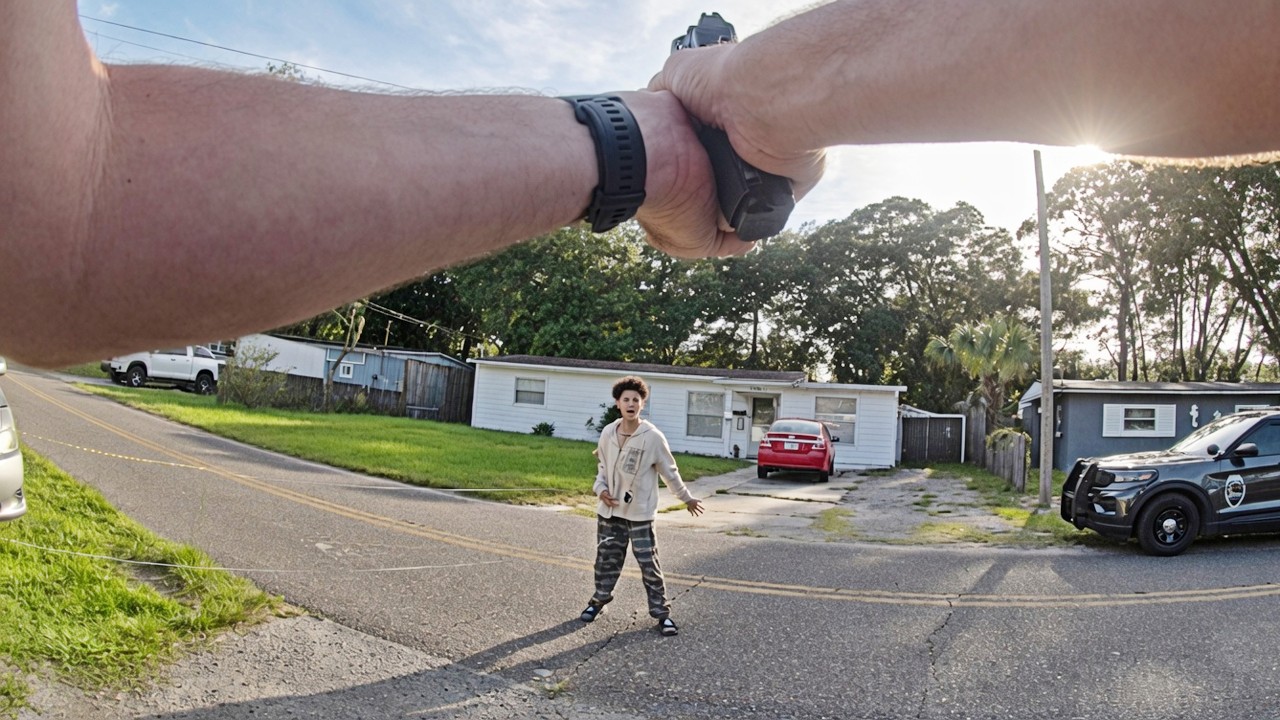
What PoliceActivity And JSO Report
According to the public source material, the incident began with officers responding to a family report rather than a random patrol encounter. JSO says callers reported that a family member had a gun and had made threats. That framing matters because it explains why officers were already approaching a potentially armed situation before the shooting sequence shown in the source video.
The official JSO account says the suspect came out of a shed and ran when officers made contact. Police then described a foot chase. During that chase, JSO says the suspect reached toward the waistband area. The agency says a Taser was deployed and did not stop the suspect. JSO then reports that one shot was fired toward officers before two officers returned fire.
For readers, the key is not to turn that sequence into a broader conclusion than the sources support. The source video and JSO statement can support a recap of the reported sequence. They cannot, on their own, prove every mental state, answer every tactical question, or establish final courtroom responsibility. That is why the language in this article stays with “police said,” “JSO reports,” and “the source video shows” where appropriate.
The PoliceActivity title uses a concise video headline: “Armed Suspect Shot After Firing at Jacksonville Officers.” That title is useful for identifying the clip and search topic. A reader-facing explanation still needs more context: who reported the incident, where it happened, what agency record is available, and what remains subject to review.
What The Video Can Show And What It Cannot Prove
Source video is powerful because it gives viewers a direct look at time, motion, distance, and urgency. In a short police shooting clip, those visible elements often shape public reaction. Viewers can see movement, hear commands if audio is included, and understand why seconds matter in an officer-involved shooting review.
But video also has limits. It may not show the full call history, all radio traffic, every witness statement, every camera angle, or the later investigative file. A single uploaded clip may also be edited for length or privacy. The safe way to read the Jacksonville video is to pair it with the official JSO account and to avoid filling gaps with assumptions.
One common mistake is to treat an online video title as a verdict. A title can identify the main event, but it does not provide the whole legal record. The Jacksonville source material says a shot was fired toward officers and officers returned fire. That is a serious reported fact, but readers should still separate the public source recap from any later prosecutorial, civil, or policy review.
The second mistake is to argue from silence. If the public video does not show a detail, that does not automatically mean the detail did or did not happen. It means the detail is not visible in the public segment. That distinction is important for fair coverage, especially when a person has been seriously injured and officers’ use of force is under review.
Why The Jacksonville Source Context Matters
JSO’s public statement adds several details that a viewer would miss by watching only the headline. It places the call on Kline Road East. It says the original report involved a family member with a firearm. It says officers encountered the suspect, that the suspect ran, and that the sequence escalated during a foot pursuit. Each of those points gives the source video a more specific frame.
The open-data result also helps readers understand the public record category. It identifies the matter as an officer-involved shooting record, names the incident date, and lists the weapon field as a handgun. Those fields are not a full investigation, but they help distinguish a sourced public-safety recap from a recycled social post with no traceable basis.
Context also keeps the story from becoming a simple outrage clip. A useful article should ask what the source says, what it does not say, and how a reader can verify the basics. That is why this Navyago recap includes the PoliceActivity video, the JSO public source, the location, the date, and a short FAQ focused on reader questions rather than speculation.
For comparison with another source-based public-safety explainer, readers can see Navyago’s related recap here: Officer Shoots Armed Suspect Video: What the Source Reports. The point is not to merge the two cases. The point is to show the same reading method: source first, claims second, speculation last.
What Remains Unconfirmed After The Public Video
Several things remain outside the public clip and the brief source records available here. The article does not claim to know the suspect’s motive. It does not claim a final criminal finding. It does not claim that every officer decision has been reviewed or cleared. It also does not claim to know what every witness saw before officers arrived.
Those gaps are not minor. In a police shooting, later review can involve body-worn camera footage, radio logs, dispatch notes, forensic work, witness interviews, officer statements, medical records, and prosecutor review. Public video can be the start of understanding, but it is rarely the entire file.
Readers should also be careful with names. JSO public records identify the subject and age, but a source-based recap does not need to repeat personal detail beyond what helps identify the public record. The important public-interest question is the sequence reported by the agency and the evidence viewers can check, not private information about family members.
That is the main editorial boundary. The source gives enough to explain why the Jacksonville video is being watched. It does not give enough to turn the article into a final legal judgment. The most accurate summary is that JSO says the suspect fired toward officers and officers returned fire during a June 7, 2026 response on Kline Road East.
Reader Checks Before Sharing The Clip
Before sharing the armed suspect shot after firing at Jacksonville officers clip, readers should check three things. First, is the source video linked? In this article, the PoliceActivity YouTube embed is included below. Second, is the local agency record named? Here, the Jacksonville Sheriff’s Office public page and open-data record provide the local source layer. Third, does the article separate reported facts from conclusions? This recap keeps those layers apart.
Readers should also look for overstrong language. Words like “proved,” “executed,” “ambush,” or “cover-up” can outrun the public evidence when used without a full record. The safer approach is to describe what the source says and what the video appears to show, then leave room for later review.
The same habit applies to comments and reposts. A viral post may strip the video from its location, date, and agency source. Once that happens, viewers are reacting to a fragment instead of a record. Source-based reading slows that down. It gives a reader a way to verify the title, the agency, the date, and the reason the video matters.
Source Video
Sources
Sources: PoliceActivity YouTube source video, https://www.youtube.com/watch?v=jFk8OPWaZJs, video ID jFk8OPWaZJs; Jacksonville Sheriff’s Office public news record, https://www.jaxsheriff.org/News/20260607-OIS.aspx, for the June 7, 2026 officer-involved shooting on Kline Road East; and JSO public record snippets for incident date, location, and weapon field. Accessed August 1, 2026.
FAQ
What is the armed suspect shot after firing at Jacksonville officers video about?
It is a PoliceActivity source-video recap of a Jacksonville Sheriff’s Office incident. JSO says officers responded to an armed family-member call on June 7, 2026, and two officers returned fire after one shot was fired toward police.
Does the video prove the full legal outcome?
No. The video and public JSO records describe the reported sequence, but they are not a complete court file, prosecutor review, or final civil-policy finding.
Why does this recap use cautious wording?
Officer-involved shooting coverage can affect real people and public trust. Cautious wording keeps facts tied to sources and avoids claiming guilt, motive, or final responsibility beyond the public record.
Where can readers verify the source?
The source video is embedded above and linked in the Sources paragraph. Readers can also compare the account with Jacksonville Sheriff’s Office public records about the June 7, 2026 Kline Road East incident.