
Florida man refuses to surrender video is a source-based recap of a June 4, 2026 Bay County, Florida arrest shown in PoliceActivity footage. According to the source description, deputies responded to a domestic disturbance, tried to arrest a shirtless suspect, and the encounter became a physical struggle before authorities listed multiple charges.
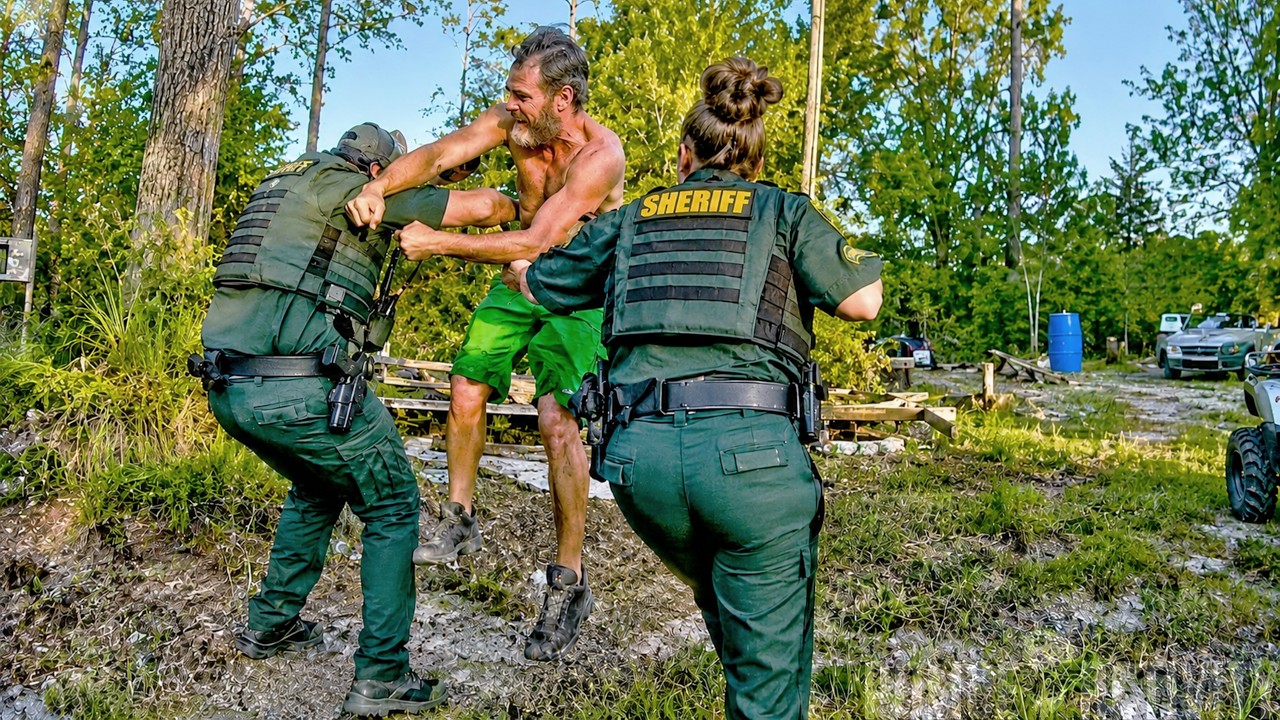
Table of Contents
Florida man refuses to surrender video: what the source reports
The Florida man refuses to surrender video was published by PoliceActivity and is presented by the channel as public-source police incident documentation. The source description places the incident in Bay County, Florida, and says Bay County Sheriff’s Office deputies responded to a residential property on June 4, 2026 to investigate a domestic disturbance.
According to the source description, deputies completed an initial on-scene investigation and then attempted to place a shirtless suspect under arrest. The description says the situation turned volatile as the man physically resisted responding officers. The footage and captions then show a rapid shift from a brief verbal exchange to a close physical struggle, with multiple deputies working to take control and place the suspect in handcuffs.
This article treats the video as a source-based explainer, not as a verdict. The public video can show commands, movement, resistance, and officer responses, but it does not by itself establish every legal element of a charge or the final result of the case. That difference matters because bodycam clips often move faster than the legal process that follows them.
In that limited sense, the Florida man refuses to surrender video is useful when readers want the source timeline before reading claims elsewhere.
For another Navyago source-video explainer in the same public-interest lane, readers can compare the format with Navyago’s police pursuit PIT maneuvers video recap. The same rule applies there: start with what the source shows, then separate source facts from interpretation.
What the footage shows before the struggle
The opening captions show deputies approaching and asking what is going on. Within seconds, the exchange becomes tense. The suspect repeatedly tells officers not to touch him, while deputies move closer and give commands. The video does not provide a full pre-incident history, so the safest reading is narrow: the viewer sees the point where officers are already at the property and the arrest attempt is beginning.
That narrow reading is important. A viewer who sees only the video may be tempted to fill in the missing minutes with assumptions about what happened before deputies arrived. The source description provides one piece of context: deputies were investigating a domestic disturbance. It does not provide a full witness packet, full call audio, court filings, or a final judicial outcome.
As the struggle starts, the captions show deputies giving repeated commands to get on the ground, release an arm, provide hands, and stop resisting. The captions also show the suspect saying he cannot breathe and deputies responding while continuing to secure his hands and legs. Because the available material is a short source video, the article does not add medical conclusions or force conclusions that are not established by the source.
The key source fact is the sequence: a domestic disturbance response, an attempted arrest, a verbal refusal, a physical struggle, and handcuffing. That sequence is enough for a public-interest recap, but not enough to substitute for court records or the full investigative file.
For readers who searched the Florida man refuses to surrender video, this narrow sequence is the safest starting point.
Why the arrest struggle matters for readers
Arrest struggle videos attract attention because they compress high-risk decisions into a few seconds. Viewers see movement, shouting, urgency, and force, but they may not see every fact that shaped the officers’ decision to arrest, every statement from witnesses, or every later review. That is why the Florida man refuses to surrender video should be read as a source document with limits.
For searchers landing on the Florida man refuses to surrender video, the central value is a careful source map. The video is useful when it helps readers identify the reported timeline, the visible commands, the handcuffing struggle, and the charges listed by the source. It becomes less useful when it is treated as a complete courtroom record.
For readers, the useful question is not only whether the footage looks intense. The useful questions are: what source facts are stated, what can be seen in the footage, what is only alleged, what charges were reported, and what remains unknown. This structure helps avoid two common errors: treating a short clip as the entire case, or dismissing the source facts because the clip is uncomfortable to watch.
The PoliceActivity description says multiple deputies were involved in taking the suspect to the ground and placing him in handcuffs. The captions support that broad sequence by showing several voices and commands during the struggle. The video also illustrates why arrest scenes are difficult to summarize fairly: several things happen at once, and the viewer may focus on whichever detail appears most dramatic.
A careful recap keeps the wording modest. The source says the suspect was booked on listed charges. The footage shows a struggle. It does not show the full legal process after booking. It does not tell readers whether any charge was later reduced, dismissed, amended, or proven. Those details would require separate official court or law-enforcement records.
That is why the Florida man refuses to surrender video should be described as reported footage, not a complete court file.
Reported charges and what they do not establish
According to the PoliceActivity source description, the Bay County Sheriff’s Office formally booked the suspect on several charges after the encounter. The listed charges include Domestic Battery and Attempted Aggravated Battery connected to the initial domestic disturbance. The description also lists three counts of Resisting with Violence, one count of Resisting Without Violence, and Obstruction – Depriving Means of Protection.
Those are source-reported charges, not a conviction statement. A charge is an accusation or formal booking category at a stage of the process. A court outcome is different. This article does not claim that the suspect was convicted, does not claim motive, and does not claim a final legal result. If a later public record updates the case, that record should be reviewed separately.
The distinction protects readers and the people involved. It also makes the article more useful. Someone searching for the video may want to know why the encounter mattered and what charges were reported, but they should not leave with an unsupported belief that every legal question has already been answered by a three-minute clip.
The charges are still relevant because they explain why the source presents the video as more than a routine call. The reported domestic disturbance context and the later resisting-related charges frame the footage as a public-interest arrest incident. They do not remove the need for attribution and caution.
For SEO and reader clarity, the Florida man refuses to surrender video headline stays tied to the video source rather than expanding into unverified case claims.
The Florida man refuses to surrender video therefore works best as a reported-charge explainer. It can show why the arrest drew attention, while the wording still leaves room for the legal process and later records.
How to read bodycam footage without overclaiming
Bodycam footage can be valuable because it preserves words, timing, and movement that a written summary may flatten. It can also mislead when a short clip is treated as the entire case. The Florida man refuses to surrender video gives readers a view of the arrest moment, but it does not show every interview, dispatch detail, witness statement, or later filing.
A legal-safe reading starts by separating three layers. First are visible or audible events: deputies arrive, commands are given, the suspect refuses contact, a struggle occurs, and deputies work to secure handcuffs. Second are source statements: the PoliceActivity description says the call was a domestic disturbance and lists booking charges. Third are unresolved legal questions: final court outcome, complete evidence, and any later official review.
This layered approach is especially important for incidents involving domestic disturbance allegations. The subject matter can involve private victims, family members, medical details, or household facts that are not necessary for a public recap. Navyago’s article therefore avoids adding names, addresses, private family details, or speculative descriptions that are not needed to understand the Florida man refuses to surrender video.
Readers can still learn something practical from the footage. The clip shows how quickly an arrest attempt can shift from conversation to physical control. It also shows why repeated commands and body position matter in police reports and later legal review. But the video should be read alongside official records when a reader wants a complete case history.
That makes the Florida man refuses to surrender video a starting point for source review, not the final answer on every legal question.
What remains unclear from the public source
The public source does not provide a complete case file. It does not include a full dispatch log, full officer reports, all witness accounts, defense filings, prosecutor filings, or a court docket result. It also does not establish whether the reported charges changed after booking. Those gaps are normal for a video-source recap, but they should be visible to readers.
It is also unclear from the source alone what happened before the first visible exchange in the clip. The description says deputies responded to a domestic disturbance and attempted an arrest after their initial investigation. It does not show the entire initial investigation. Because of that, the article does not claim that the video establishes the entire domestic disturbance allegation.
The source also does not provide a complete force review. The captions show the suspect saying he cannot breathe and deputies continuing to secure control. That is a significant detail for readers to notice, but the public clip does not include medical review, agency review findings, or a complete timeline from first contact to transport. Any stronger conclusion would require separate records.
When the Florida man refuses to surrender video is shared outside its source context, those missing records are easy to overlook.
The clearest fair summary is this: PoliceActivity published a Bay County, Florida source video showing an arrest struggle after a domestic disturbance response. The source description lists several charges after booking. The article can explain that source record, but it should not turn the Florida man refuses to surrender video into a final judgment.
Reader checks before sharing the clip
Before sharing the Florida man refuses to surrender video, readers should keep three checks in mind. First, the source is a public YouTube upload and not the full investigative record. Second, the captions and description identify a reported domestic disturbance response and listed booking charges, but they do not answer every court question. Third, the fairest use of the clip is to track visible commands, movements, and source-reported facts without turning a fast scene into a final legal conclusion.
The Florida man refuses to surrender video also shows why short bodycam excerpts need careful wording. A few seconds can show an officer’s command, a suspect’s response, a takedown, or a handcuffing attempt, but the same excerpt may leave out earlier statements, dispatch audio, later medical review, or court filings. A reader can describe what the footage shows while still saying that later records would be needed for a full case history.
For that reason, Navyago’s recap uses source-based language. It says the source description lists charges, it says the footage shows a struggle, and it avoids unsupported claims about motive, guilt, or the final outcome. This makes the Florida man refuses to surrender video easier to understand for searchers who want the source facts without extra speculation.
A careful viewer can ask five simple questions while watching the Florida man refuses to surrender video: who published the clip, what location and date are stated, what commands are audible, what charges are reported by the source, and what records are still missing. Those questions keep the article anchored to the source instead of drifting into claims that the video alone cannot prove.
This same discipline matters when the Florida man refuses to surrender video is discussed on social media. Comments may focus on one dramatic frame, one quote, or one moment in the struggle. The safer reader habit is to return to the full source embed, read the source note, and treat the article as a map of what is known, what is reported, and what remains unverified.
The Florida man refuses to surrender video is therefore useful as a starting document, not a complete case file. Readers who need a final legal answer should look for later court records, agency statements, or docket updates. Readers who only need the public-source sequence can use this recap to separate the visible footage from assumptions.
FAQ
What is the Florida man refuses to surrender video about?
The Florida man refuses to surrender video is a PoliceActivity source video about a June 4, 2026 Bay County, Florida arrest after deputies responded to a domestic disturbance. The footage shows an attempted arrest becoming a physical struggle, so this Florida man refuses to surrender video recap focuses on source facts and limits.
What charges does the source description list?
The source description lists Domestic Battery, Attempted Aggravated Battery, three counts of Resisting with Violence, one count of Resisting Without Violence, and Obstruction – Depriving Means of Protection. Navyago treats those as reported charges, not convictions.
Does the video establish the final legal outcome?
No. The video and description show source facts and reported charges, but they do not provide a final court outcome. A final result would require separate official records.
Why does Navyago avoid naming private details here?
The source is a public-interest police video, but domestic disturbance cases can involve private people and sensitive household facts. This recap uses only details needed to explain the source video.
Source Video
Sources
Sources: PoliceActivity, “Florida Man Refuses To Surrender and Fights Deputies,” uploaded June 26, 2026, accessed July 28, 2026: https://www.youtube.com/watch?v=DKCwFjJoYZw. Source video ID: DKCwFjJoYZw. Source thumbnail: YouTube maxresdefault thumbnail.